



The Pan-African Paradigm of Industrial Sovereignty and Popular Capital
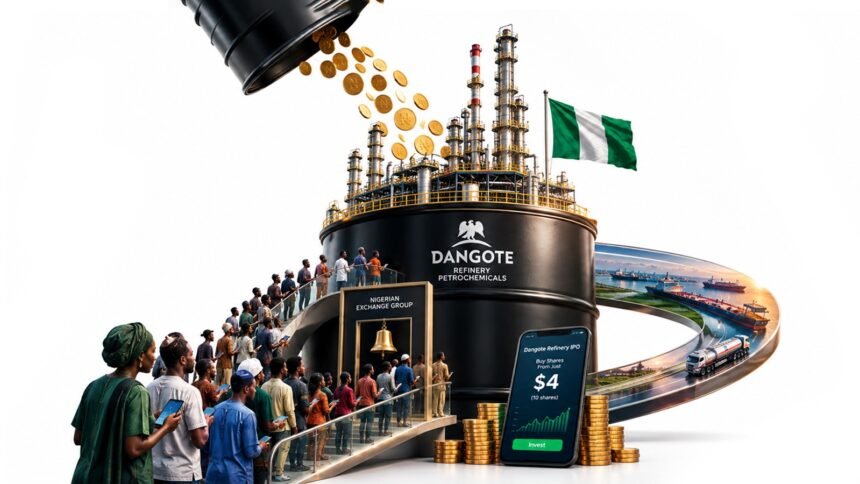
Ten shares. Four dollars. A gavel struck inside the Nigerian Exchange Group’s Lagos trading floor on Monday morning, and with it Africa’s largest share sale in history opened to anyone who could spare the price of a modest lunch. Aliko Dangote, the continent’s richest man, has spent two decades assembling an industrial conglomerate out of cement, sugar and salt. Still, the $2.1 billion initial public offering of his oil refinery marks a structural departure from earlier chapters of African capitalism. Rather than leaving ownership of a systemically important national asset concentrated among foreign institutional capital or a narrow domestic elite, the “people’s IPO” framing attempts to fold ordinary Nigerians directly into the architecture of industrial wealth. Built at a cost of roughly $20 billion on the outskirts of Lagos, the refinery has already converted Nigeria from a net importer to a net exporter of refined fuel, a trajectory few African economies have managed to reverse in the postcolonial era. Whether popular ownership survives contact with a pricing structure that still favors institutional investors will determine whether this becomes a genuine template for continental self-determination, or merely the latest instance of sovereignty rhetoric layered atop a conventional capital raise. The continent is reclaiming the terms of that question in real time.
A Refinery Reshapes a Nation’s Balance Sheet
The scale of the underlying asset explains the appetite for the offering. Dangote’s refinery processes 700,000 barrels of crude daily, with a declared ambition to reach 1.4 million barrels by 2029, a target that would place it among the largest single refining complexes anywhere in the world. Since starting operations in 2024, the plant has restructured Nigeria’s fuel market from the ground up, ending a long-standing paradox in which Africa’s largest crude producer imported the majority of its refined petroleum products from abroad. Analysts at Renaissance Capital Africa described the facility as having “transformed Nigeria’s economy from a net importer to a net exporter of refined petroleum products, making it a systemically important institution for the nation.” That systemic weight is precisely what makes the ownership question consequential: a facility this embedded in national fuel security functions less like an ordinary listed company and more like sovereign infrastructure, which is why Dangote’s framing of the sale as a democratisation exercise carries political as well as financial stakes for a government eager to demonstrate that industrial gains reach beyond a single family’s balance sheet.
Pricing the Promise of Popular Ownership
The democratisation narrative sits uneasily beside the mechanics of the sale. Retail investors buying into Monday’s offering will pay a higher price than the institutional investors who entered through a July private placement that raised $2.5 billion for a 6% stake. This transaction valued the company at $40 billion against the IPO’s implied valuation closer to $49 billion. Refinery chief executive David Bird attributed the earlier discount to conditions institutional investors accepted, including a lock-up period restricting when they can sell. For retail participants, the barrier to entry remains deliberately low: shares can be bought in blocks as small as ten, translating to a minimum investment of roughly $4 via fintech and digital investment platforms, undercutting even MTN Nigeria’s already-modest 2021 retail threshold of about $8. The structural tension is unresolved: a low entry price signals genuine inclusion, but a valuation gap between private and public tranches signals that the earliest and largest capital still captured the better terms, a recalibration retail Nigerians are being asked to accept on trust.
Global Capital Circles the Refinery
Geopolitical currents beyond Nigeria’s borders have sharpened outside interest in the asset. Supply disruptions tied to the war involving Iran have lifted demand for the refinery’s output, allowing it to sell jet fuel into western European markets that might once have sourced it elsewhere, a windfall Dangote has openly credited with boosting recent earnings. The United Arab Emirates’ state oil company, ADNOC, has expressed interest in investing in the plant alongside other parties, though Dangote declined to elaborate, citing non-disclosure obligations. The Africa Finance Corporation, one of the institutional investors already inside the July placement, confirmed that sovereign wealth funds and other development finance institutions were among its co-investors, underscoring how deeply this ostensibly domestic industrial story is now interwoven with global capital flows. Dangote has further signaled ambitions for a secondary listing of the refinery business in the United States within three to four years, a move that would internationalize the asset’s shareholder base even as its retail framing remains rooted firmly in Nigerian self-reliance.
The Retail Rush and Its Limits
Early signs suggest the retail appetite is real, even if its durability is untested. Nigerian investment app Bamboo reported traffic far above normal levels as the offering opened, at times preventing some users from logging in altogether. Lagos business owner Chris Chijioke told Reuters he intended to buy 2,000 shares despite reservations about the sale price, citing Dangote’s track record as sufficient justification. Charles Robertson, head of macro strategy at FIM Partners, characterized the sale as “a huge event for Nigeria, symbolizing African self-reliance,” pointing to a broader boom in Nigerian equities driven by domestic retail interest since 2024. Should the offering be oversubscribed, Dangote’s team retains a greenshoe option to issue additional shares, potentially pushing the total raise from 2.15 trillion naira toward the full $2.1 billion target. Dangote has also signaled intent to eventually list every company within his conglomerate, suggesting Monday’s IPO functions as a template rather than a singular event.
Reclaiming the Architecture of African Capital
What Monday’s listing ultimately tests is whether African industrial wealth can be structured to widen participation without diluting the discipline that built it in the first place. A “people’s IPO” that still privileges early institutional entrants is not a contradiction so much as an unfinished negotiation between two legitimate imperatives: attracting the patient capital that construction-scale infrastructure requires, and ensuring that the citizens whose fuel security the refinery underwrites are not permanently locked out of its upside. Nigeria’s equity markets have shown they can absorb genuine retail enthusiasm when the underlying asset is credible, and a $20 billion refinery that has already reversed a decades-old import dependency is about as credible as African industrial assets get. The coming weeks, as subscription figures firm up and shares begin trading, will show whether that enthusiasm translates into durable, broad-based ownership, or whether the architecture of African capital continues to reward those already closest to it. Either outcome will shape how the next generation of continental industrialists chooses to raise money, and to whom.