


The Pan-African Paradigm of Security Sovereignty and Foreign Entanglement
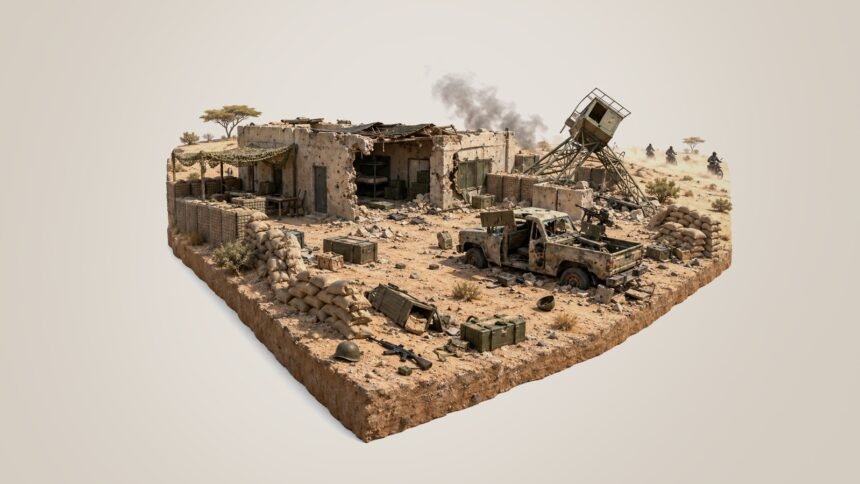
A military camp in the central Malian region of Mopti fell to jihadist fighters last Thursday, was briefly contested, and by Friday the attackers had returned and claimed what they called “total control” of the barracks at Dioura. By the time security and local sources reached AFP on Monday, the death toll had climbed past fifty soldiers, among them five paramilitaries from Russia’s Africa Corps, with some accounts placing the true figure closer to eighty and dozens more Malian troops taken prisoner. The attack is one of the deadliest the Malian army has suffered in a conflict now well into its second decade, and it lands at a moment when Mali’s junta has staked its legitimacy on a counterterrorism partnership with Moscow that was meant to succeed where French military support failed. That the Africa Corps could not prevent Dioura’s fall, and that reinforcements reportedly never arrived, raises an uncomfortable question for a government that turned away from a former colonial power in the name of sovereignty: whether substituting one foreign security guarantor for another has actually delivered the self-determination it promised, or relocated the same structural dependency. Mali’s soldiers, and the families now burying them, are the ones bearing the cost of finding out.
The Anatomy of an Overrun Garrison
Accounts from the scene describe a garrison that jihadists struck once, withdrew from, and then reoccupied the following day without the Malian army mounting a reinforcement effort. “The jihadists attacked the Dioura camp and returned the next day,” one local source told AFP, adding pointedly that “the army did not send reinforcements to the site.” An officer present at the scene put the toll starkly: “The death toll is high. Leaving aside the wounded, I can say that we are mourning the deaths of more than 50 of our personnel, including five members of the Africa Corps.” Other security sources in Mopti offered higher estimates, between sixty and eighty soldiers killed, alongside dozens taken prisoner. The Al-Qaeda-linked Group for the Support of Islam and Muslims, JNIM, moved quickly to claim the attack on its own communication channels, framing the seizure of a functioning Malian army barracks as proof of the junta’s weakening grip over its own territory.
Mali’s Retaliation and the Limits of Air Power
In a statement issued Sunday, Mali’s army confirmed it had launched “air-ground operations” against the attackers at Dioura, reporting the “neutralization” of several fighters attempting to flee on motorcycles into bushland southwest of the town. The response illustrates both the junta’s continued capacity for retaliatory strikes and the narrower reality that air power arriving after a barracks has already fallen cannot undo the loss of personnel, equipment and prisoners already absorbed by the enemy. For a military government that has centered its domestic legitimacy on restoring order where a civilian administration allegedly failed, a battlefield loss of this magnitude, compounded by the capture of Malian soldiers, is difficult to frame as anything but a serious operational setback, regardless of the retaliatory operations mounted in its aftermath.
A Decade of Deepening Crisis
Dioura does not sit in isolation. Since late April, JNIM and its Tuareg separatist allies have waged a sustained campaign explicitly aimed at weakening Mali’s junta rulers. This campaign has already produced the capture of the strategic northern city of Kidal and the killing of the country’s defense minister. In mid-July, at least fifty other soldiers died when a coalition of Tuareg separatists and jihadists ambushed a convoy leaving Anefis for Gao, a near-identical toll to Dioura occurring barely two months earlier. Mali has been in a state of continuous security crisis since 2012, driven by Al-Qaeda- and Islamic State-aligned jihadists, criminal networks and armed separatist movements operating across a territory the state has struggled to fully govern for more than a decade, regardless of which external partner has supplied its weapons and training.
The Russia Pivot and Its Costs
Mali’s junta, installed through successive coups in 2020 and 2021, has systematically distanced itself from France, its former colonial power, in favor of deepening military and political ties with Russia. The presence of Africa Corps paramilitaries among Thursday’s dead at Dioura is a direct consequence of that realignment, and it complicates the narrative that the pivot away from Paris has delivered a more effective or more sovereign security architecture. Human Rights Watch has separately documented Russian paramilitary involvement in civilian deaths in Mali in recent weeks, adding a further layer of scrutiny to a partnership the junta has largely shielded from public accounting. What remains consistent, regardless of which foreign force stands alongside Malian troops, is the persistence of the underlying threat and the mounting toll it exacts on the army rank and file.
Reclaiming Security Without Borrowed Guarantors
Dioura’s fall is a reminder that sovereignty asserted through the choice of foreign patron is not the same as sovereignty exercised through durable domestic capacity. Mali’s junta has now fought this war with two different external backers and arrived, a decade on, at a casualty count that continues to climb regardless of the flag on the shoulder patches of the soldiers fighting alongside its own. A genuinely self-determined security architecture for the Sahel will have to be built on intelligence, logistics and reinforcement capacity that Malian institutions themselves can sustain, rather than on the periodic substitution of one foreign military relationship for another. Until that capacity exists, garrisons like Dioura will remain vulnerable regardless of who trains the soldiers defending them, and the burden of that vulnerability will continue to fall on the same rural communities and rank-and-file troops who have borne it since 2012.