





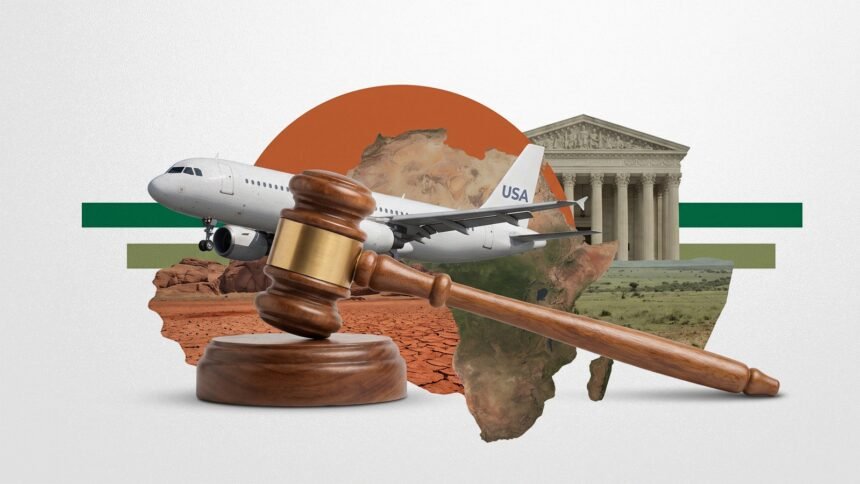
A US appeals court has upheld requirements that migrants facing deportation to countries they have no connection with must be given notice and a meaningful opportunity to raise concerns that they could face persecution or torture.
The ruling by the Boston-based First US Circuit Court of Appeals is significant for several African countries that have entered agreements with Washington to receive deportees who are not their citizens.
The court largely upheld a lower-court ruling that found the US Department of Homeland Security’s procedure for carrying out such deportations unlawful. The case concerns migrants with final removal orders who were subsequently targeted for deportation to countries that were not listed in those orders or identified during earlier proceedings.
The appeals court did not rule that the US government is prohibited from deporting migrants to third countries. Instead, it upheld requirements for greater procedural protection before such removals take place.
Under the ruling, migrants must receive effective notice of the proposed third country and a meaningful opportunity to challenge the removal if they have a reasonable fear of persecution or torture there.
The decision could affect the way Washington implements agreements with African governments that have agreed to receive third-country deportees.
Uganda, Equatorial Guinea, Liberia, the Central African Republic and South Sudan have featured in the US administration’s third-country deportation arrangements.
Uganda received its first group of 12 deportees under its agreement with the US in April 2026, while Liberia agreed to receive up to 1,200 people over a year.
Equatorial Guinea has also received deportees under the program. At the same time, the US sent eight men to South Sudan after the Supreme Court lifted temporary restrictions in an earlier stage of the legal dispute.
The arrangements involve people who are not necessarily citizens of the African countries receiving them and, in some cases, have no previous connection to those countries.
That has made the agreements an increasingly important part of the Trump administration’s immigration policy and a growing issue for African governments involved in receiving deportees.
The legal dispute centers partly on how much notice migrants receive before being sent to a third country.
Under the policy challenged in court, some migrants could receive as little as six hours’ notice before removal.
The appeals court said migrants must have enough information and an opportunity to raise legitimate concerns about their safety in the proposed destination.
The court, however, partly reversed one aspect of the lower court’s order dealing with the sequence in which the US government must select a country for removal.
The central requirement for notice and an opportunity to challenge removal to a third country was preserved.
According to Reuters, more than 25,000 migrants have been affected by third-country deportations, with people sent to countries including Mexico, Uganda and others under agreements reached during the Trump administration.
The exact number of people sent to African countries is less clear, with figures from monitoring and advocacy groups differing from official US government data.
The US government has not published a single consolidated figure covering all third-country deportations.
The legal ruling therefore does not cancel the agreements between Washington and African governments. Instead, it sets additional procedural requirements that US authorities must meet before carrying out removals covered by the ruling.
The Trump administration has indicated that the policy remains in operation while it considers its next legal steps. The case could ultimately reach the US Supreme Court.
African governments receiving deportees, the ruling could mean greater scrutiny of how such agreements are implemented and what protections are available to people transferred to their territory.
It also puts renewed attention on the terms of the agreements themselves, including questions over the treatment of deportees, their legal status in receiving countries and what happens if they face danger or are subsequently removed elsewhere.
For now, the ruling does not prevent African countries from receiving people deported from the US. It instead requires the US government to give affected migrants a meaningful opportunity to challenge their removal to a proposed third country before the deportation takes place.