



The Pan-African Paradigm of Diplomatic Coercion and Assertive Statehood
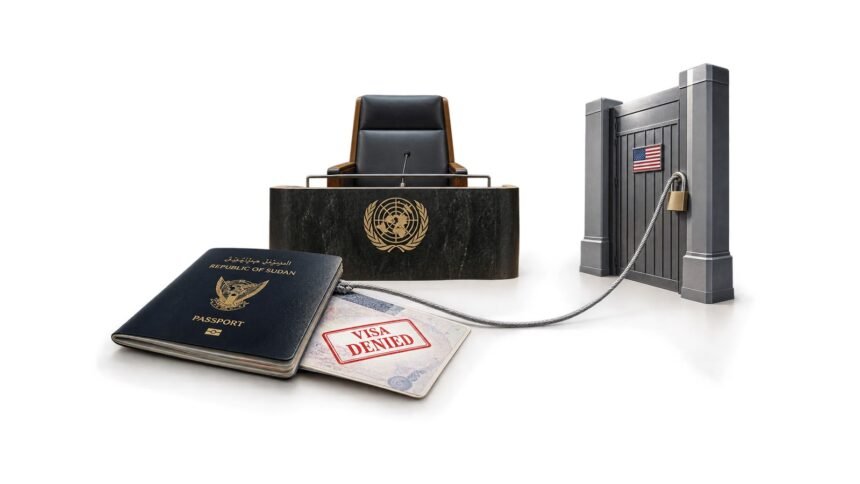
A visa withheld, a general grounded, and an empty seat where Sudan’s head of state should sit at the United Nations General Assembly: this is what sovereignty looks like when it collides with the leverage of a superpower. On September 22, the United States declined to issue Sudanese army chief Abdel Fattah al-Burhan the documentation he needed to address the body he has addressed on his country’s behalf since 2021, tying the decision explicitly to a ceasefire proposal Khartoum has resisted for months. For a continent whose postcolonial diplomacy has long been shaped by conditions attached from outside, the episode is a familiar one dressed in new urgency: humanitarian leverage repackaged as bureaucratic delay, and a government’s presence on the world stage made contingent on capitulation to terms it did not set. Sudan’s foreign ministry called the withholding a violation of the UN’s host-country obligations; the objection is itself a broader claim about the architecture of who gets to speak for Africa, and on whose schedule. As the continent’s institutions increasingly insist that African crises be resolved on African terms, Sudan’s blocked appearance becomes a test case for reclaiming the basic dignity of representation.
A Visa as Instrument
The mechanics of the dispute are narrow but consequential. US officials have made Burhan’s attendance at this week’s General Assembly contingent on his acceptance of a 90-day ceasefire drafted by Washington’s senior advisor for Arab and African affairs, Massad Boulos, a proposal Sudan’s army publicly voiced reservations about as early as July. A senior Sudanese source told Reuters that Burhan postponed his trip to New York without ever receiving formal notice of denial, leaving Khartoum in a diplomatic limbo where neither acceptance nor refusal produces resolution. Sudan’s UN ambassador, Al-Harith Idriss Al-Harith, wrote directly to Secretary-General António Guterres on September 21, arguing that barring a head of state’s participation “would effectively prevent” a member state from exercising its most basic institutional right. Guterres’s office responded that the secretary-general was “deeply concerned,” a formulation that signals sympathy without commitment to intervene. Sudan’s foreign minister, Mohieldin Salem, is expected to deliver the address in Burhan’s place. This substitution preserves Sudan’s formal presence while conceding the substantive point that Washington controls the terms of engagement.
The Architecture of Take-It-or-Leave-It
What distinguishes this dispute from routine diplomatic friction is its explicit conditionality. A Sudanese diplomatic source described the American posture bluntly: “Burhan rejects this take-it-or-leave-it approach; any proposal is subject to suggestions and changes.” That framing captures the asymmetry at the heart of mediated peace processes in which the mediator also controls access to the platform where legitimacy is publicly conferred. The Boulos ceasefire sits inside a broader “Quad” mediation structure that includes the United Arab Emirates, Egypt and Saudi Arabia, external powers whose own interests in Sudan’s war are different. Layered onto this is a separate and newer point of friction: a US proposal to widen an existing arms embargo on Darfur, the Rapid Support Forces’ stronghold, to cover the entirety of Sudanese territory, a move Burhan’s allies say would disproportionately constrain the army rather than the paramilitary force more often named as the aggressor.
Whose Humanitarian Crisis, Whose Leverage
Sudan’s war, which the United Nations calls the world’s largest humanitarian crisis, has displaced millions and fractured the country into rival governance projects: Burhan’s transitional council in Port Sudan and Mohamed Hamdan Dagalo’s parallel administration, which has struggled for international recognition since its founding. Dagalo, addressing troops departing for battle, reportedly said “it’s time for the rifles to speak,” a line that underscores how far this remains a military calculation rather than a political one on either side. Against that backdrop, a withheld visa reads less as procedural friction and more as a signal about whose voice international institutions are prepared to amplify and whose they are prepared to sideline pending compliance. Sudan’s former civilian prime minister, Abdalla Hamdok, is in New York this week alongside his anti-war coalition, a reminder that the General Assembly’s stage was never Burhan’s alone to claim, and that the contest over representation runs through Sudanese civil society as much as through Washington’s calendar.
Reclaiming the Terms of the Table
The deeper question the Burhan visa dispute raises is not whether a single ceasefire proposal succeeds or fails, but whether African states can insist on institutional presence as a right rather than a privilege extended on external terms. Sudan’s appeal to the UN Charter, its argument that host-country obligations exist precisely to prevent this kind of coercive gatekeeping, is itself a claim to procedural sovereignty distinct from the substance of the war. Whatever the outcome this week, the episode adds to a growing continental record of African governments testing whether multilateral institutions can be made to honor their own rules evenly, or whether access will continue to be rationed according to great-power priorities. For Sudan’s civilians, caught between an army that will not be told what to accept and a paramilitary force that has chosen rifles over rooms, the diplomatic theater in New York is a long way from Khartoum’s markets and el-Fasher’s siege lines. But the principle at stake, that African leaders should not have to earn their seat at the table through capitulation, is one the continent’s institutions are increasingly unwilling to concede without a fight.