





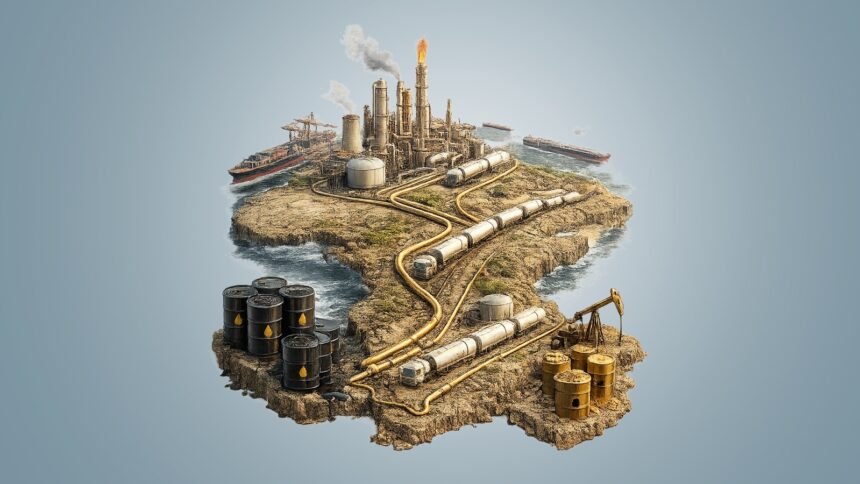
The Pan-African Imperative: Structural Overhaul of Resource Dependencies
Across the African landscape, the contemporary execution of macroeconomic policy is increasingly defined by an aggressive shift from primary extraction toward domestic industrial processing. For decades, sub-Saharan Africa’s resource-dependent economies remained trapped in an asymmetric trade paradigm, exporting crude oil and importing expensive refined petroleum products from international markets. This structural imbalance systematically drained foreign exchange reserves, leaving local markets deeply vulnerable to external supply shocks. Reclaiming the continent’s economic destiny requires establishing high-capacity, sovereign refining architectures. By internalizing the value-added phases of the carbon value chain, African industrial anchors are laying the groundwork for true economic self-reliance, ensuring that continental resources directly fuel local transport, electrical grids, and advanced manufacturing networks.
Nigeria’s Downstream Transformation: Reversing the Upstream Paradox
The contemporary oil production and refining outlook in Nigeria is undergoing a historic realignment, fundamentally altering the country’s standing within global energy markets. Historically known as an upstream powerhouse hampered by a complete deficit in domestic refining capacity, the state has long grappled with the fiscal strain of subsidizing imported fuel. However, in mid-2026, this downstream dependency is being reversed as major infrastructure projects transition from gestation phases to high-velocity performance tests. The rapid expansion of local processing capacity is positioning the country to achieve self-sufficiency in transport fuels, stabilize the national balance of payments, and turn the West African maritime corridor into a net exporter of refined petroleum products.
The Architecture of Industrial Might: Operational Thresholds of the Lekki Mega-Project
At the center of this downstream revolution is the Dangote Petroleum Refinery, a monumental private-sector initiative that has rewritten the rules of African industrialization. During a series of rigorous performance tests conducted by international process licensors in early June 2026, the facility achieved a remarkable operational milestone by ramping up its crude processing volume to 700,000 barrels per day. This performance significantly exceeded the refinery’s official nameplate capacity of 650,000 barrels per day, demonstrating exceptional engineering resilience and structural efficiency. Under the guidance of executive leadership, including Vice President Devakumar Edwin, the conglomerate has already articulated its next strategic milestone: an aggressive capacity expansion target of 1.4 million barrels per day within the next 30 months. This operational scale would cement the complex as one of the largest single-train refining facilities in the world.
The Transcontinental Footprint: Disruption and Domination in Global Energy Trade
The rapid scale-up of the refinery has triggered an immediate and profound expansion of its commercial footprint across regional and international maritime trade lanes. Since commencing initial fuel production, the facility has continuously increased its output of premium motor spirit, automotive gas oil, and aviation turbine fuel. Data from global cargo-tracking architectures indicate an aggressive surge in seaborne exports, which rose from 168,000 barrels per day in February to 353,000 barrels per day in April. Approximately half of these outward flows are systematically captured by neighboring African states seeking protection from international maritime disruptions. Simultaneously, the refinery has successfully penetrated core Western and Middle Eastern energy markets, dispatching high-quality fuel shipments directly to consumer networks in France, the United Kingdom, the Netherlands, the United States, and Saudi Arabia.
The Transatlantic Jet Fuel Corridor: Securing European Aviation Supply Lines
The emergence of a substantial structural surplus in specialized aviation turbine fuel has paved the way for highly strategic, long-term supply agreements between West African producers and European aviation hubs. Led by Chief Executive David Bird, the refinery’s downstream division has actively capitalized on its massive jet fuel surplus, attracting intense interest from international commodity trading firms and major European logistics networks. By establishing direct, high-volume supply links with the European Union, the facility is successfully diversifying Western Europe’s fuel import dependencies. This transatlantic integration provides an essential alternative supply line during periods of severe geopolitical instability in traditional Middle Eastern corridors, proving that African industrial complexes can meet the strict quality standards of global aviation markets.
The Mechanics of Structural Shifts: Fueling the West African Economic Engine
The macroeconomic impacts of domestic refining extend far beyond simple export statistics, serving as a powerful catalyst for wider West African industrialization. By providing a reliable, localized supply of diesel, gasoline, and industrial inputs, the refinery helps insulate regional manufacturing and agricultural sectors from the extreme price volatility of international commodity markets. Market analysts observe that the rising availability of regional barrels is steadily displacing traditional European imports across the Atlantic seaboard. While global energy experts suggest it is still early to determine whether recent export fluctuations represent a permanent realignment of international trade routes, the continuous growth of local market share demonstrates an undeniable pivot toward sub-Saharan industrial self-determination.
The Path to Continental Sovereignty: Integrating Regional Energy Frameworks
The way forward for Nigeria and the wider sub-Saharan region depends on the successful expansion and integration of these industrial gains into a resilient, continent-wide distribution network. Reclaiming the path to sustainable economic growth involves optimizing cross-border logistics, reducing maritime transport barriers, and harmonizing regulatory standards within the African Continental Free Trade Area (AfCFTA) framework. To sustain this industrial momentum, future policy must focus on strengthening upstream-downstream linkages, ensuring that regional crude producers have guaranteed access to high-capacity domestic refining centers. By combining disciplined private capital deployment with supportive sovereign trade frameworks, Africa can transition from a historical position of resource vulnerability into a dominant, self-sustaining hub of global industrial production.