




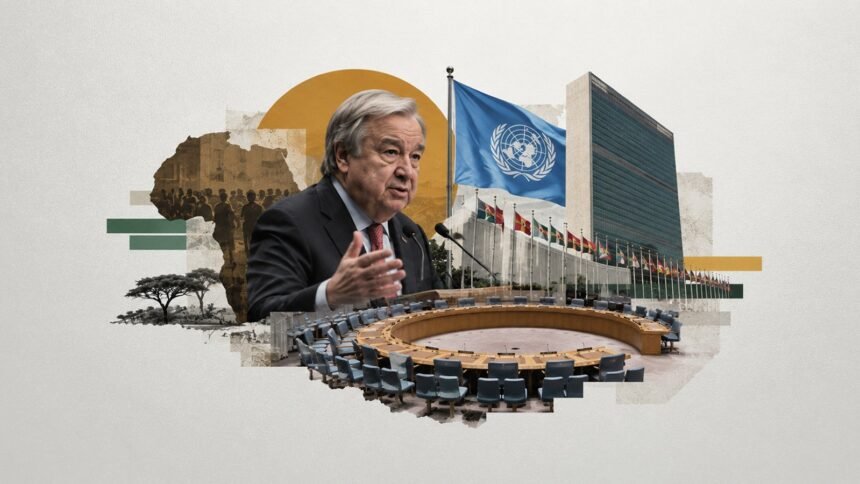
United Nations Secretary-General António Guterres has renewed calls for reform of the Security Council, saying Africa’s continued exclusion from permanent membership is no longer defensible.
Speaking on September 22 at the opening of the 81st session of the UN General Assembly, Guterres said the Council still reflects a global order created after the Second World War, despite major changes in the distribution of political and economic power.
“A 21st-century Security Council without permanent African seats is unjust and indefensible. This must change,” Guterres said.
The Security Council currently has 15 members, including five permanent members from China, France, Russia, the United Kingdom and the United States, which hold veto power. The General Assembly elects the remaining 10 seats for two-year terms.
Africa has three elected seats at any one time. Still, it has no permanent seat, despite the continent accounting for 54 UN member states and being a major focus of UN peacekeeping operations.
The African Union has for years pushed for a greater role in the Council’s decision-making. Under the Common African Position contained in the Ezulwini Consensus and Sirte Declaration, adopted in 2005, the AU is seeking at least two permanent seats with the same rights and privileges as existing permanent members, including veto power if the veto is retained, alongside five non-permanent seats.
The AU says the current arrangement is a historical injustice rooted in the structure of global institutions created when much of Africa was still under colonial rule.
In May 2026, AU Commission Chairperson Mahmoud Ali Youssouf again called for permanent African representation, saying the continent should not remain excluded from permanent decision-making despite its demographic and political weight.
The issue has gained renewed attention as African countries continue to argue that decisions taken by the Security Council directly affect the continent, particularly on conflicts, peacekeeping and international security.
Guterres said reform should make the Council more representative and better reflect the geopolitical realities of the present day.
“Africa needs to be at the table, not on the menu,” he said, arguing that the continent should not have to wait indefinitely for permanent representation.
His comments came as he delivered what is expected to be his final opening address to the General Assembly as secretary-general. His second term ends on December 31, 2026.
Beyond Security Council reform, Guterres used his address to warn that the international system is facing four major tests: war and peace, inequality, climate change and artificial intelligence.
He said conflicts have intensified, inequality has widened, climate change has become a daily reality and the rapid development of artificial intelligence is creating new challenges for governments and international institutions.
He also called for stronger international rules governing AI, particularly where technology could be used in decisions involving life and death.
The question of who will succeed Guterres is also unfolding alongside the reform debate, with candidates from Africa, Latin America and the Caribbean, and Europe seeking the top UN post.
For African governments, however, the Security Council reform debate goes beyond the current leadership transition. The AU has maintained its Common African Position for more than two decades and continues to push for permanent representation as part of a broader effort to reshape global decision-making.