



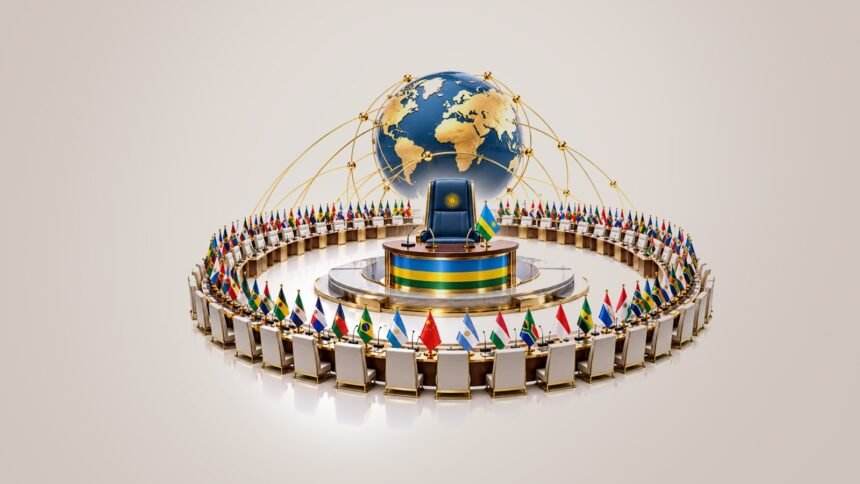
Rwanda will chair the Group of 77 (G77) and China in 2027, taking over from Uruguay to lead a 134-member grouping of developing countries that coordinates their positions on economic and development issues at the United Nations.
Rwanda was elected by acclamation on September 25 during the group’s 50th Annual Meeting of Ministers for Foreign Affairs in New York, held on the sidelines of the 81st session of the United Nations General Assembly.
The chairmanship will give Rwanda a year-long role in coordinating the group’s activities, representing its common positions and leading its engagement in UN discussions on issues affecting developing countries.
What Is The G77?
The Group of 77 was established on June 15, 1964, by 77 developing countries at the end of the first session of the United Nations Conference on Trade and Development (UNCTAD) in Geneva. The founding members signed a joint declaration outlining their shared economic interests.
The group held its first ministerial meeting in Algiers, Algeria, in October 1967, where members adopted the Charter of Algiers, setting out principles for cooperation among developing countries.
Its membership has since expanded to 133 countries, with China participating alongside them, bringing the grouping to 134. Despite the expansion, it retained the name G77 because of its historical significance.
The group describes itself as the largest intergovernmental organization of developing countries within the UN system, representing countries from Africa, Asia-Pacific, Latin America and the Caribbean.
What Does The G77 Do?
The G77 provides developing countries with a platform to coordinate their positions and pursue common interests within the United Nations.
Its main objectives include promoting the collective economic interests of developing countries, strengthening their negotiating capacity on international economic issues, and advancing South-South cooperation.
Through the group, member states coordinate positions on issues such as financing for development, trade, climate change, and the implementation of the Sustainable Development Goals.
The grouping also seeks to give developing countries a stronger collective voice in international negotiations, where individual countries may have limited influence.
How Is The Chair Chosen?
The G77 chairmanship rotates among three regional groups: Africa, Asia-Pacific, and Latin America and the Caribbean. Each region takes its turn, with the chair serving a one-year term.
Uruguay held the chairmanship in 2026, while the African Group was allocated the position for 2027.
Rwanda’s election followed the regional rotation system, under which the African Group put forward its candidate for the next term.
How Was Rwanda Chosen?
At the September 25 ministerial meeting in New York, Mario Lubetkin, Uruguay’s Minister of Foreign Affairs and the group’s 2026 chair, announced that it was Africa’s turn to lead in 2027 and that Rwanda’s candidature had been endorsed.
The candidature had been circulated to member states ahead of the meeting. Lubetkin subsequently asked ministers whether they wished to elect Rwanda by acclamation, and the proposal was adopted without a vote.
The group’s 2026 Ministerial Declaration later formally welcomed Rwanda’s election by acclamation to the 2027 chairmanship.
What Does The Chair Actually Do?
The chairmanship is the G77’s highest political authority within its organizational structure. The chair acts as the group’s spokesperson and coordinates its activities and common positions across UN processes.
In practice, this involves representing the grouping in meetings with UN officials and other international partners, coordinating negotiations among member states and helping them reach common positions on issues of shared concern.
The chair also oversees the group’s work during its term, including ministerial meetings and the preparation of collective statements and declarations.
However, the chair does not make decisions on behalf of member states independently. Its role is to facilitate coordination and represent positions agreed upon by the group.
The 2027 term will involve coordinating the priorities of 134 countries while representing their shared interests in international discussions on development and economic cooperation.