


The Pan-African Paradigm of Energy Rights and Political Accountability
Three hundred and sixty-one. That is the number of cuts to the distribution of drinking water that the Tunisian Water Observatory recorded in August 2026 alone, according to Human Rights Watch. Set beside it are two further numbers: 1,101 protest actions in July and 1,093 in August, recorded in all 24 governorates by the Social Observatory of the Tunisian Forum for Economic and Social Rights, the highest July and August figures in years. Between those statistics lies the story of a state that let its power grid fail during one of the hottest summers on record and then treated the people who complained as a security threat.
Human Rights Watch argues that Tunisian authorities failed to ensure an adequate supply of electricity and water during two months of extreme heat, undermining the right to health and endangering lives. The finding matters well beyond Tunisia, because it reframes electricity, often treated as a technical utility, as the infrastructure on which every other social right now rests.
A Foreseeable Collapse
July 2026 was the second-hottest July since 1950, and the national utility, the Tunisian Electricity and Gas Company (STEG), reportedly imposed rotating outages because it lacked capacity. The cuts were concentrated between 1 and 5 p.m., when air conditioning pushed demand to its peak. Crowd-sourced data cited by Human Rights Watch suggest that in extreme cases outages lasted up to 12 hours, and a second wave in late August brought cuts of up to two hours at a time in every region.
None of this arrived without warning. The General Secretary of the General Federation of Electricity and Gas said STEG had alerted its supervising ministry to the risk of shortfalls and the need for new capacity as early as 2024. A 2026 report by the Tunisian Economy Observatory found that STEG’s investment in electricity generation fell by 87 percent over five years. The trajectory is the familiar one of a public utility starved of capital until the system breaks under the first serious stress.
Hospitals Without Power
The human cost is where the official record and independent accounts sharply diverge. On 22 July the Tunisian Young Doctors Association estimated that between 150 and 200 people had died over the preceding days from heatstroke or from the failure of medical equipment on which they depended. Local media reported five deaths after home respirators stopped working. The Health Ministry, by contrast, reported 633 heat-related medical cases in public hospitals on 29 August, made no mention of deaths, and denied that health services had been disrupted. Neither figure has been independently verified, and the gap between them is itself evidence of the problem Human Rights Watch describes: the absence of transparent public information.
A doctor at one of the largest hospitals in Tunis told the organisation that the backup generator covered only intensive care units and operating theatres, leaving the emergency department with no power and no contingency plan. Because admissions depended on electronic records, staff could not register patients arriving during an outage, even those in life-threatening condition. During one outage, neonatal doctors ventilated newborns by hand.
Water, Prisons and the Weight of Heat
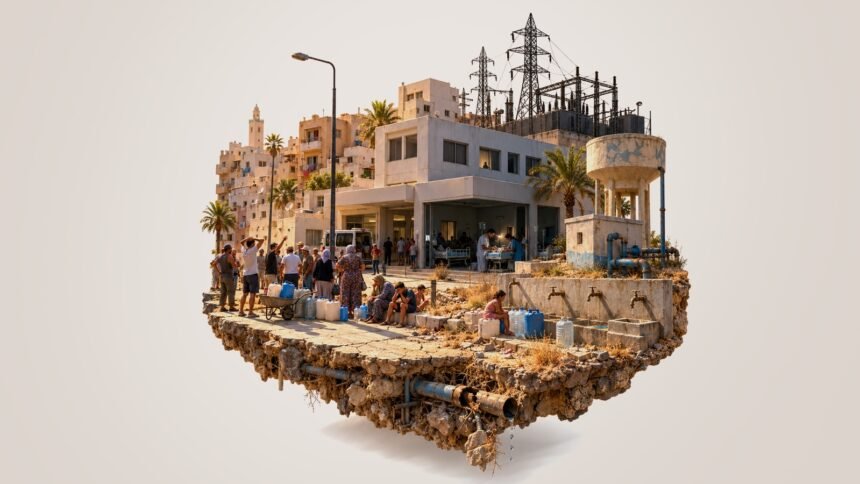
Because pumping stations run on electricity, the blackouts became a water crisis. Tap water turned intermittent in many areas, and the cuts fed a bottled water shortage in a country where much of the population relies on bottled water as its main source of drinking water. Public confidence in tap water is low, with reports of cloudy or yellowed water, even though the National Authority for Food Safety says it is safe.
The heaviest burden fell on people with no means of escape. Five detainees at Mornaguia prison reportedly died on a single day, 28 August, and the Tunisian League for Human Rights documented 20 deaths in prisons and detention facilities amid conditions made worse by heat and by water and power cuts. The state holds a direct duty of care over people it detains, and that duty does not lapse when the grid does.
Sabotage as a Political Explanation
President Kais Saied offered a different account. On 26 August he said the outages in several regions were not ordinary failures but deliberately planned acts of sabotage meant to stoke tensions. Human Rights Watch notes that the authorities provided no evidence of sabotage. In late July, prosecutors’ offices across the country opened investigations into STEG managers and employees, which shifts the blame for a capital investment failure onto individual workers.
Protesters met a harder response still. After an August 13 demonstration over water shortages in Borj Erras, authorities arrested 12 people, including nine children, and investigated them on suspicion of conspiring against state security before releasing them the next day. After the grassroots movement Nafas marched in Tunis on 20 August under the slogan “No water, no electricity, no freedom,” authorities arrested activist Seifeddine Arfaoui at his home. On 31 August a Tunis court sentenced him to 18 months in prison under article 86 of the Telecommunications Code over a Facebook post about slogans chanted at the protest.
The Legal Architecture of Basic Services
The obligations are not ambiguous. Article 48 of the Tunisian Constitution requires the state to provide drinking water to everyone on an equal basis. The African Commission on Human and Peoples’ Rights has held that a government’s failure to provide basic services, including safe drinking water and electricity, violates the right to health under the African Charter. Human Rights Watch goes further and argues that access to electricity should be recognized as a distinct human right, because health, housing, water and education all depend on it.
Toward Structural Sovereignty Over Power
Tunisia’s summer is a warning for every African state facing hotter seasons with ageing grids. Structural sovereignty over energy is not secured by blaming saboteurs or jailing people who post slogans online. It is built through sustained public investment, honest reporting of deaths and failures, and institutions that treat citizens’ complaints as data rather than dissent. Bassam Khawaja of Human Rights Watch put the demand plainly: the government should publish a death toll and set out a clear plan to restore electricity and water. A state that cannot keep a neonatal ward lit, and will not say how many people died in the dark, has an asymmetric relationship with its own citizens. Correcting that imbalance, through capacity, transparency and accountability, is the real test of sovereignty in a warming century.