



War Has Turned Petrol from an Ordinary Import into a Daily Ration in Sudan, and the Cost is Now Landing on the Fares, Wages and Shop Prices of People Far from the Front Line
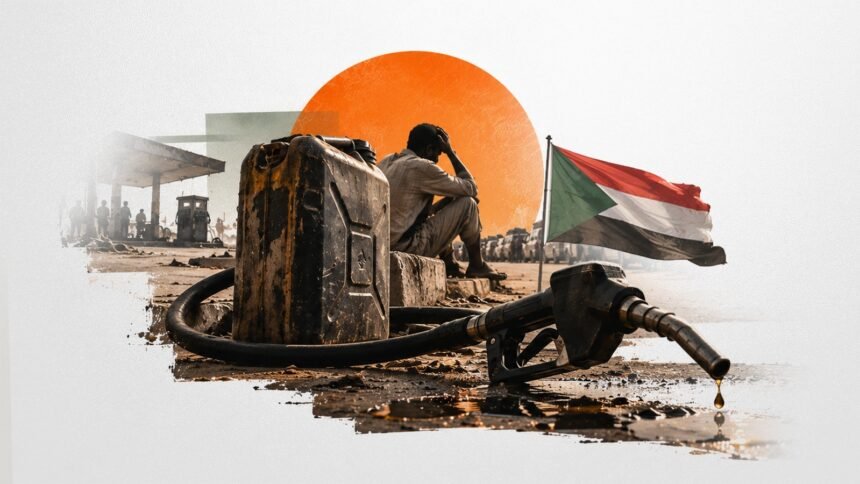
Seven times a day, Azhari Mohamed drives his minibus and eight passengers from the Shagar neighborhood of Port Sudan to the city center and back. He starts at 6 a.m. and stops at 9 p.m. He is 60 years old, and for every two days he spends on the road, he now loses a third to the queue at a petrol station, where a wait of more than five hours can end with the pumps running dry before his turn. When that happens, he joins the back of another queue at another station and starts again.
His minibus burns about three gallons (11 liters) of petrol a day, costing about 105,000 Sudanese pounds, roughly $11.30 at the parallel-market exchange rate. After running costs, he keeps about 50,000 pounds ($5.40) a day for a household that includes his wife and a daughter at university whose tuition and daily expenses he helps to cover. “We can no longer work because of the fuel shortages. The transport fares are no longer enough to cover the cost of running the vehicle and our household expenses,” he said. To make up for the daylight hours lost in queues, he drives extra hours at night.
What a Gallon Costs Now
The shortages have pushed prices up. A gallon (3.8 liters) of petrol now costs 40,000 Sudanese pounds ($4.30) in Gazira State, south of Khartoum, and 35,000 pounds ($3.80) in Port Sudan. This month the Transport Chambers Union, which regulates public and private transport services, raised intercity bus fares by 40 percent and minibus fares by 30 percent. Those increases protect operators only partly, and they pass the bill directly to passengers who were already struggling.
Aziza Ibrahim, a 38-year-old cleaner from Port Sudan’s Umm al-Qura neighborhood who supports four children, shows where that bill lands. Before the war, the trip from her home to the main transport station in the city center cost 700 pounds ($0.08). Some routes now charge 2,500 pounds ($0.27), others 2,000 pounds ($0.22). She needs 11,000 pounds ($1.18) a day for the round trip to work, so she has cut her working week to three days. Even so, transport takes nearly half of her monthly salary of 400,000 pounds ($43), on top of the cost of treatment for her diabetes. “Sometimes I have to borrow money just to be able to go to work,” she said. She repays the loan when her salary arrives at the start of the month.
A War Fought Through the Oil Sector
The roots of the crisis run back to the war that began on 15 April 2023 between the Sudanese Armed Forces and the paramilitary Rapid Support Forces. Sudan’s Ministry of Energy and Petroleum last year estimated the sector’s war-related losses at $20 billion. The World Bank has reported that attacks on the Balila oil field disrupted supplies to the Khartoum refinery, which once met about 60 percent of the country’s demand for petrol and liquefied petroleum gas. With oil production sharply down, Sudan now relies on imports at a time when the war between the United States and Iran is disrupting global energy markets and raising the price of gas, petrol and diesel.
The United Nations Development Program says the war has pushed average incomes in Sudan back to levels last seen in the 1990s. Fuel is one of the channels through which that loss travels. A country that once refined much of its own petrol now buys more of it from abroad, at prices set by a crisis it has no part in, while its own fighting keeps its oil infrastructure exposed.
Rules That Thinned the Market
Not every cause lies on the battlefield. Economic analyst Sidi Ohaj points to government conditions for petroleum importers, which require them to deposit 200kg of gold with the Central Bank and to own fuel storage facilities before they can operate in Sudan. Some importers could not meet those conditions and left the market, reducing supply. “One of the causes of the current crisis is the government’s decision to regulate the operations of petroleum import companies,” he said. “Some companies did not meet the requirements, which led to their exit from the market. This reduced supply relative to demand.”
Ohaj argues that the government must urgently ease import procedures to raise domestic supplies, because the shortages are spreading through the wider economy. He also warns that the continuing war, and particularly drone attacks that threaten infrastructure across Sudan, remains one of the main challenges facing the oil sector. His argument points to a real policy dilemma: rules written to keep a strategic trade under control can, in wartime, also narrow the pool of suppliers just when the country most needs fuel to flow.
From the Pump to the Shelf
Ahmed al-Haj, a trader in Omdurman market, sells skincare products such as petroleum jelly, which he packages himself. The raw materials are imported. “Higher diesel and petrol prices have increased the cost of transporting a tonne of goods by 30 to 50 percent,” he said. “That increase is then reflected in the price of the products.” When power cuts force him onto a fuel-powered generator for heating or packaging, his daily bills rise again.
Deliveries within Omdurman that once cost 5,000 pounds ($0.70) now cost between 10,000 and 12,000 pounds ($1.07 to $1.29), and reaching customers in other states has become impossible because of transport costs. Transport and distribution workers are making fewer trips, he says, so goods are piling up at traders’ premises. In this way, a fuel shortage becomes a cost-of-living crisis for millions: the minibus fare, the cleaner’s commute, the price of a jar of petroleum jelly and the delivery that no longer happens are the same problem seen from different places.
Energy as a Measure of Self-Rule
For Sudan, control over its own energy supply has become a test of whether the state can still provide the basics of daily life. Much of the petrol that the Khartoum refinery once produced now has to be bought abroad, and the oil fields that fed it remain in reach of the war. Azhari’s request is modest: “We just need fuel to be available so we can work.”
Meeting it would require an end to the fighting that keeps damaging the oil sector, import rules that widen supply instead of narrowing it, and a plan to rebuild domestic refining so that the price of a gallon in Port Sudan depends less on events far beyond Sudan’s borders. Until then, the self-determination that matters most to Sudanese workers is counted in liters of petrol and in the hours they spend waiting for it.