





Three Months After 80,000 Crossed in Two Days
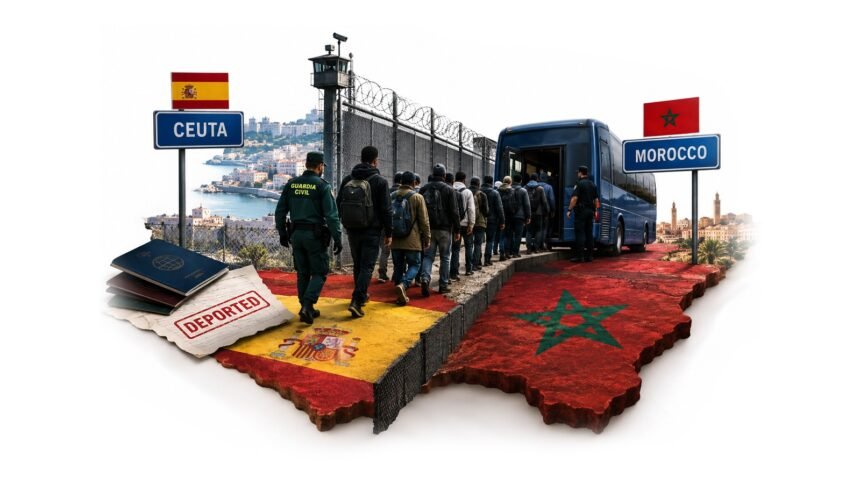
A city of about 80,000 people that took in roughly 80,000 more in two days: that was Ceuta in late July, when a mass border crossing from Morocco overwhelmed the Spanish enclave on the North African coast. At least 100 people died during the crossing into the autonomous city, which covers just 18.5 square kilometers. On Tuesday, Spain carried out its first deportations from Ceuta since that crisis, sending back more than a dozen migrants whose asylum applications had been rejected.
The numbers are small, but the move is a signal. It shows Madrid moving from emergency management to removals, with Morocco agreeing to act as the receiving country, and it lands in the middle of a Spanish election campaign in which the July crossing has become a central issue. For Africans on both sides of the fence, the episode is a reminder that Europe’s southern frontier is drawn on African soil and policed, in large part, by an African state.
Who Was Sent Back
Spain’s Interior Ministry said on Tuesday that it had deported the migrants from Ceuta after their asylum applications were rejected, and that Morocco had agreed to receive them. Non-governmental organizations said 16 people had been deported, coming from African, Middle Eastern and Asian countries. The ministry did not publish a full breakdown of nationalities, and it is not yet clear what happens to the deportees once they are in Moroccan hands.
That last question is the one rights groups are pressing. Handing over people who are not Moroccan nationals to Morocco raises the question of whether they will be held, moved on, or returned to their countries of origin, and under what safeguards. Without public tracking of what happens after the handover, neither Spanish voters nor Moroccan citizens can judge whether the returns are as safe as officials say.
A City That Doubled Overnight
The scale of July’s crossing still shapes Ceuta. Most of the people who entered in late July left within days, but about 8,000 migrants remain in the city. Some are sleeping on the streets, while the Spanish state, charities and civil society groups are housing others. For a territory of Ceuta’s size, that is a large population living in limbo, waiting for asylum decisions that, for some, will now end in removal.
Tuesday’s deportations suggest that the authorities intend to work through those cases and return those who are refused, rather than let the waiting population settle. They also test how far Morocco is willing to cooperate as the numbers grow.
The Safe-Country Argument
Amnesty International has warned that the human rights of those deported from Ceuta could be at risk. “Spain, despite its [progressive] speeches in Europe, is not ensuring that human rights guarantees are met for people who cross its borders in Ceuta and Melilla,” said Virginia Alvarez, an Amnesty International researcher. “Morocco does not respect many human rights.”
Madrid disputes the accusation. The Interior Ministry said that the European Union considers Morocco to be a safe country and that the deportations are carried out “with all the necessary safeguards”. The disagreement is not only legal but political: the safe-country label allows European governments to return people to a neighbor quickly, while rights groups argue that such labels gloss over what happens to migrants, particularly non-Moroccans, after the handover.
Madrid’s Election Clock
The timing is hard to separate from Spanish politics. The Ceuta crisis has become a major challenge for Prime Minister Pedro Sanchez, who is seeking re-election in snap polls scheduled for 29 November. Tens of thousands of protesters have gathered across Spain in recent months to denounce the government’s handling of the situation, and right-wing parties have used the crisis to attack him. Santiago Abascal, leader of the far-right Vox party, has branded the prime minister a “traitor”.
Against that backdrop, deportations carried out a month before the vote serve as a message to voters as much as a migration measure. The risk for the people concerned is that their cases are decided at a moment when speed and visibility matter more to politicians than careful protection.
Morocco’s Leverage and Its Burden
For Rabat, accepting returns from Ceuta is both a favor and a form of leverage. Cooperation on migration gives Morocco weight in its dealings with Spain and the European Union. Still, it also places on Morocco the responsibility, and the reputational risk, of receiving people Europe has rejected. Each return reinforces a model in which a North African state absorbs the costs of Europe’s border decisions.
Whose Border Is It?
Ceuta’s fence runs across the African continent, and the people who climb it or swim around it include many Africans looking for work, safety or both. A fairer arrangement would give African governments a stronger voice in how that frontier is managed: genuine asylum screening, transparent tracking of deportees after handover, and investment in the conditions that push people towards the fence in the first place. Without that, Africa’s northern edge will keep serving as Europe’s outer wall, with African states taking the strain and African migrants paying the price.