





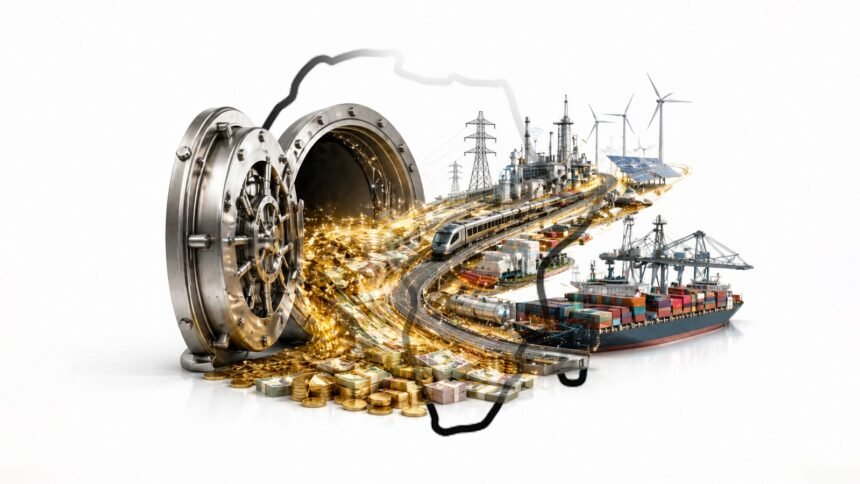
Africa’s pool of domestic capital has grown to more than $2 trillion, overtaking external financing flows accumulated over the past decade and signaling a shift in how the continent can fund its development, according to the Africa Finance Corporation (AFC).
Findings from the 2026 State of Africa’s Infrastructure Report, released during the Africa We Build Summit in Nairobi, show that while Africa received about $1.7 trillion in external financing between 2014 and 2024, internal non-bank capital reserves surpassed $2 trillion by the end of 2025.
The report argues that Africa now has sufficient internal financial resources to drive infrastructure and industrial growth, but the challenge lies in effectively directing those funds into productive sectors.
“The constraint is no longer capital, it is intermediation, we have the savings, but not yet the systems to channel them into infrastructure and industry at scale,” said Samaila Zubairu, President and CEO of AFC.
He stressed that the continent’s development agenda must now move beyond raising funds to ensuring they are efficiently deployed. This includes building integrated infrastructure systems rather than isolated projects.
Growth in domestic capital has largely been driven by institutional investors. Pension funds and insurance assets have exceeded $1 trillion for the first time, while public development banks hold $276 billion and sovereign wealth funds account for $164 billion. Central bank reserves also rose from $480 billion in 2024 to $530 billion in 2025.
Part of this growth has been supported by favorable commodity markets and increased gold accumulation. Gold now accounts for around 17 per cent of Africa’s total reserves, up from below 10 per cent just a few years ago.
Despite this progress, much of the capital remains tied up in short-term and low-risk instruments such as government securities. The report attributes this to limited investment pipelines, regulatory frameworks that prioritize liquidity, and a lack of risk-sharing mechanisms, factors that continue to limit long-term investment in infrastructure and industry.
External financing declines
At the same time, external funding sources are becoming less dependable. Official development assistance dropped from $83.8 billion in 2020 to $73.5 billion in 2023 and is expected to decline further.
According to the Organization for Economic Co-operation and Development (OECD), global aid fell by 23.1 per cent in 2025, marking the steepest annual decline on record.
Sovereign borrowing has also slowed significantly, with issuances falling from over $29 billion in 2018 to between $4 billion and $6 billion annually in recent years. Foreign direct investment has remained relatively flat at around $45–55 billion per year, far below the continent’s financing needs.
As a result, the report suggests that external capital is increasingly playing a supporting role, rather than being the main driver of development.
The AFC report highlights integrated infrastructure as the most effective way to unlock growth. In transport and logistics, corridors are most impactful when designed as full economic systems, linking ports, railways, roads, storage, and trade infrastructure to industrial activity.
East Africa offers a clear example. The Port of Mombasa handles more than 45 million tonnes of cargo annually, while ongoing rail developments are extending connectivity inland, including along the Naivasha, Kisumu corridor.
In aviation, the report identifies air transport as one of the fastest ways to boost regional integration. Across Kenya, Rwanda, and Ethiopia, the sector contributes about $5.5 billion to GDP and supports roughly one million jobs.
“Aviation is a low-hanging fruit for Africa and key to achieving the African Continental Free Trade Area,” said Rita Babihuga-Nsanze, AFC’s Chief Economist.
The report also points to the need for integrated energy systems that combine generation, transmission, storage, and industrial use. Projects such as the Ethiopia–Kenya power interconnector demonstrate how regional cooperation can improve efficiency and expand access.
Recent global disruptions, including the Russia–Ukraine conflict and the 2026 Middle East crisis, have exposed weaknesses in Africa’s supply chains and reinforced the need for stronger domestic production and storage systems.
Currently, Africa imports more than 70 per cent of its refined fuel and spends an estimated $230 billion annually on essential imports such as food, fertilizer, and industrial materials.
In the digital sector, while connectivity has expanded, the report notes a gap in supporting infrastructure such as fiber networks, data centers, and internet exchange points, key elements needed to translate connectivity into economic productivity and job creation.
Overall, the report concludes that Africa’s next phase of development will depend less on raising capital and more on building systems that link finance, infrastructure, and industry into coordinated ecosystems capable of supporting long-term growth.