






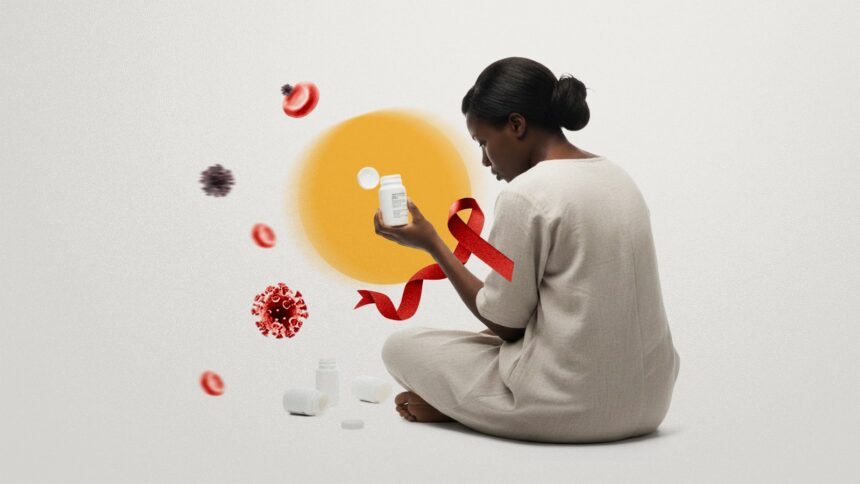
From Kinshasa to the Cape: The Virus That Rewrote a Continent
HIV emerged in equatorial Africa not as an act of nature alone, but through the violent intersections of colonialism, labor migration, and medical malpractice. The earliest documented case—retroactively identified in a 1959 Kinshasa blood sample—spread silently along railway lines and river routes that Belgium had built to extract rubber and ivory. By the late 1970s, unsterilized syringes in colonial vaccination campaigns and the rapid urbanization of post-independence cities turned a zoonotic spillover into a pan-African pandemic. Within a decade, adult prevalence in Kampala, Kigali, and Lusaka exceeded 25%. In the absence of diagnostics or treatment, AIDS became known across languages as “the slim disease,” “the radio disease,” or simply “the end of the road.”
The human toll was apocalyptic. Between 1981 and 2005, sub-Saharan Africa recorded more than 20 million AIDS deaths—more than all 20th-century wars on the continent combined. Fifteen million children were orphaned. Life expectancy in Botswana collapsed from 64 in 1990 to 39 in 2002. Economies shrank by 2–4% annually in the hardest-hit countries. Yet this catastrophe also forced the largest, most rapid public health mobilization in history.
The Burden in 2025: Numbers That Still Shock
As of December 2025, 26.1 million Africans live with HIV—69% of the global total. Prevalence remains highest in the southern cone: Eswatini (27.1%), Lesotho (23.3%), Botswana (21.9%), South Africa (19.6%), and Zimbabwe (13.4%). In absolute terms, South Africa (7.8 million), Nigeria (2.5 million), Mozambique (2.4 million), Tanzania (1.7 million), and Uganda (1.5 million) dominate.
The epidemic has shifted from generalized to hyper-concentrated. While national prevalence has fallen, key populations bear grotesque burdens: 25–50% of female sex workers in most capital cities, 18–30% of men who have sex with men in urban West Africa, and 15–40% of people who inject drugs along the Indian Ocean coast. Adolescent girls and young women (15–24) continue to acquire HIV at triple the rate of their male peers—4,000 new infections every week across Eastern and Southern Africa.
Progress, however, is undeniable. New infections have fallen 59% since the 2000 peak. AIDS deaths have dropped 70% since 2004. Mother-to-child transmission is now below 5% in Botswana, Rwanda, and Namibia. Twelve countries have achieved or surpassed the 95-95-95 targets. Yet the last mile is proving the most treacherous.
The PEPFAR Miracle and Its Sudden Fracture
From 2003 to 2024, the U.S. President’s Emergency Plan for AIDS Relief (PEPFAR) invested $110 billion, supported 20.8 million people on treatment, and prevented 7.9 million vertical transmissions. In 2024 alone, PEPFAR funded 68% of all antiretroviral therapy in sub-Saharan Africa, 88% of PrEP initiations, and 71% of viral load testing. It trained or salaried 320,000 health workers and sustained 18,000 laboratories.
Then came January 2025. The second Trump administration froze all non-military foreign assistance. In March, Secretary of State Marco Rubio issued a narrow waiver for “lifesaving” activities—defined as HIV treatment, testing, and prevention of mother-to-child transmission. Everything else—community adherence support, outreach to key populations, orphan and vulnerable children programs, economic strengthening, human rights interventions, and most prevention for adolescent girls—was terminated with 30–90 days’ notice.
The rupture was immediate and brutal:
- Malawi lost 62% of its community-based services overnight; two CEDEP clinics serving gay men and transgender women closed permanently.
- Uganda saw 41 civil-society organizations shutter, affecting 180,000 people on treatment.
- Kenya’s 150 USAID-supported clinics laid off 38,000 staff.
- Mozambique lost 42% of its viral load testing capacity.
- South Africa’s differentiated service delivery models for stable patients collapsed in five provinces.
An independent modeling study published in The Lancet in October 2025 projected that abrupt PEPFAR withdrawal from just seven high-burden countries would cause 680,000 additional infections and 192,000 excess deaths by 2030—effectively erasing a decade of progress.
The Hollow Promise of “America First Global Health”
The September 2025 strategy document reaffirms the U.S. commitment to the 95-95-95 targets and the 2030 goal of ending AIDS as a public health threat. Yet it simultaneously declares that outreach to key populations, community-led monitoring, and social support services are no longer “core” or “lifesaving.” The new bilateral compacts demand that countries increase domestic funding by 15–25% annually or face phased reductions—knowing full well that debt service already consumes 40–90% of health budgets in many nations.
This is not a transition; it is abandonment dressed as sustainability.
Pan-African Alternatives: From Dependency to Ownership
Africa is not helpless. The continent has already begun to forge its own path.
- Domestic Resource Mobilization South Africa now funds 78% of its response. Kenya has introduced an AIDS levy on alcohol and tobacco. Nigeria has committed $120 million annually to local ARV manufacturing. The African Union’s 2024–2030 AIDS Strategy aims to raise $12 billion in new domestic financing by 2028.
- Regional Manufacturing Revolution: Eight African companies now produce WHO-prequalified antiretrovirals. Rwanda’s BioNTech mRNA facility and Senegal’s Institut Pasteur are developing long-acting injectables. By 2030, Africa aims to deliver 60% of its HIV commodities locally, slashing costs by 30–50%.
- Community-Led Resilience Uganda’s village health teams, Eswatini’s rural health motivators, and Lesotho’s community ART groups have sustained 90%+ retention rates even during funding shocks. These models cost $40–80 per patient per year—less than one-tenth of facility-based care.
- The Global Fund and New Donors. The Global Fund has pledged to fill 40% of the PEPFAR gap in 2026–2028. China, the EU, and the Islamic Development Bank have increased contributions. Brazil has offered technical support without ideological conditions.
- Innovation at Scale Long-acting cabotegravir (every two months) and lenacapavir (twice yearly) are being rolled out in South Africa and Kenya. Self-testing has reached 28 million people since 2020. Drones now deliver drugs to remote health posts in Rwanda and Ghana.
Toward an African-Led Endgame
The abrupt dismantling of PEPFAR’s prevention architecture is a moral and epidemiological catastrophe. But it is not the end of the story.
Africa has the knowledge, the community systems, the political will, and—slowly—the financial muscle to finish what was started. The 2030 goal is slipping, but it is not lost. What is required is not charity, but space: debt cancellation, technology transfer, and respect for African-led solutions.
The continent that gave the world the virus can also deliver its defeat—not through dependence on distant capitals, but through the fierce, collective determination of its people.


