




The Pan-African Paradigm of Infrastructure and Legitimacy
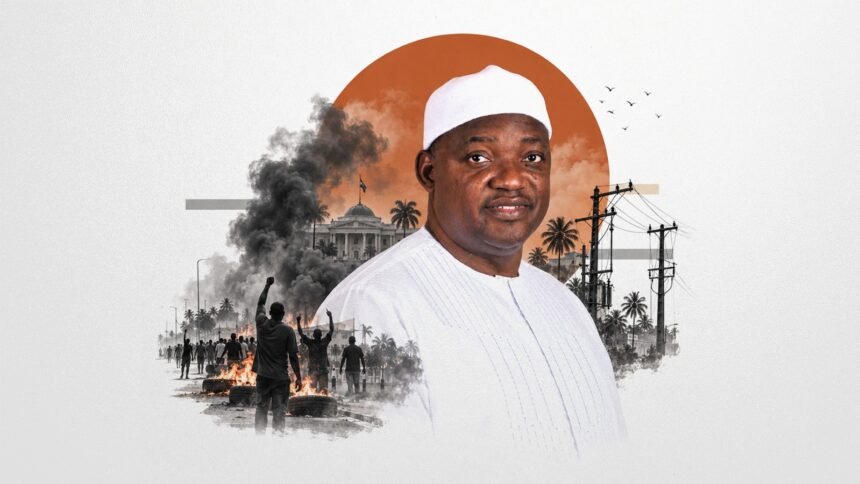
Plumes of smoke over Banjul and the chant “Barrow must go” compress into a single overnight scene, a dynamic playing out across much of the continent: the collapse of basic infrastructure translating almost instantly into a crisis of political legitimacy. Electricity, more than perhaps any other public utility, functions as a daily referendum on governance, its failure felt not in abstract statistics but in spoiled food, unlit clinics, and children studying by phone-light, grievances that accumulate quietly until they detonate in the street. Gambia’s blackout protests, arriving three months before a presidential election in which Adama Barrow is seeking a third term, sit squarely within a continental pattern in which utility failures have repeatedly become the proximate trigger for demands about deeper structural questions: who governs, on whose behalf, and with what accountability for basic service delivery. The paradigm here is not simply about generators and grid capacity, but about whether West African publics can compel their governments toward a model of infrastructure sovereignty that treats reliable power as a right rather than a periodic promise renewed each election cycle.
A Night of Barricades in Banjul
Protesters gathered overnight across multiple locations in Gambia’s capital, including near President Barrow’s official residence, burning tires and erecting barricades as police deployed tear gas to disperse the crowds, according to witnesses and a Reuters correspondent on the scene. Residents described blackouts lasting as long as 48 hours, a duration that transforms routine load-shedding into something closer to sustained infrastructural abandonment. The unrest was not confined to the capital. In Farafoto, protesters gathered outside the residence of Vice President Mohammed B.S. Jallow. They destroyed banners at a local office of the ruling National People’s Party, symbolically targeting the governing party’s physical presence and signaling frustration that extended beyond the utility itself to the political structure overseeing it. By Tuesday morning, traffic in Banjul had returned to normal, but the underlying grievance, and the political calendar bearing down on it, had not.
Voices From the Blackout
Ousainu Jammeh, a resident of Banjul’s Westfield area, described the cumulative toll of the crisis in stark terms: “There is no light everywhere. There is no light. People have been crying about electricity.” Jammeh said he joined the protests after tear gas landed in his own house, and later helped douse fires and clear barricades once the demonstrations subsided in the early hours. These individual accounts matter structurally as much as anecdotally: they establish that the blackout crisis is not a distant policy failure but a lived, physical intrusion into homes, prompting a mode of political participation- street protest, barricade-building- that stands in sharp contrast to Gambia’s institutional channels for grievance. The gap between the two reflects a broader continental pattern in which formal accountability mechanisms are widely seen as too slow or too compromised to address urgent material failures, pushing citizens toward direct, visible confrontation instead.
The Utility’s Own Account
Gambia’s National Water and Electricity Company Ltd (NAWEC) has attributed the crisis to “an unforeseen surge in electricity demand during the peak period,” driven by high temperatures, alongside what it described only as “a technical incident affecting one of the major power-generating units on the import side,” without further elaboration. The utility acknowledged the situation would require continued load-shedding “affecting several parts of the country.” However, it offered no timeline for resolution and did not respond to requests for comment following the unrest. The vagueness of NAWEC’s technical explanation, a demand surge attributed to weather, paired with an unspecified generating-unit failure, has done little to reassure a public already primed to read infrastructure failure as evidence of deeper mismanagement, particularly given that heat-driven demand spikes are a predictable, recurring seasonal pattern rather than a genuine surprise for a utility tasked with national energy planning.
A Government’s Apology, and a Deadline
Gambia’s information minister, Ismaila Ceesay, described the events of the previous night as “deeply disconcerting” and issued a formal apology to those affected, acknowledging in a statement that “as a government, we recognize the frustration, anger and hardship that many Gambians are experiencing.” President Barrow himself visited NAWEC facilities on Tuesday morning, promising the imminent arrival of new generators and telling reporters, “We are committed to ending this crisis. Gambians deserve reliable electricity, and we will deliver by the end of October.” That pledge now functions as a firm, publicly stated political deadline, one that arrives roughly a month and a half before the December presidential vote, compressing an already fraught infrastructure timeline into the heart of an election campaign in which Barrow’s third-term bid is likely to be judged as much on kilowatts delivered as on any other single metric of governance.
Sovereignty Measured in Reliable Current
Gambia’s blackout crisis distills a continental argument about what political legitimacy requires in the current decade: not merely competitive elections, but the demonstrated capacity to deliver the basic infrastructure that competitive elections are ultimately meant to be accountable for. As Barrow’s government races against its own self-imposed October deadline, the coming weeks will test whether West Africa’s smallest mainland state can convert an acute crisis into durable structural investment, or whether the promised generators arrive just in time to defuse street anger without addressing the underlying grid fragility that produced it. For a nation still consolidating its democratic institutions after decades of authoritarian rule under Yahya Jammeh, the capacity to keep the lights on has become inseparable from the broader project of self-governance, a reminder that sovereignty, reclaimed at the ballot box, must ultimately be sustained at the substation.