



Slavery built the Cape wine industry, and the few estates now acknowledging it are discovering that memory raises immediate questions about wages, housing and the right of farm workers’ families to stay on the land.
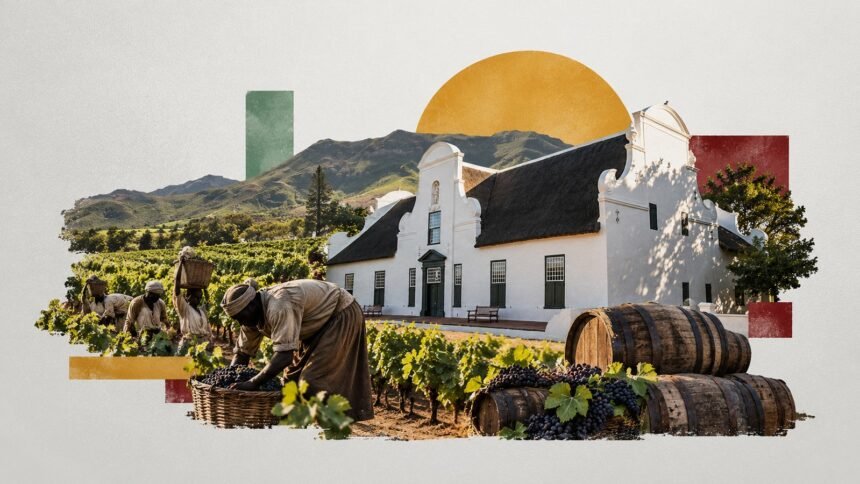
In 1652, Jan van Riebeeck established a colony for the Dutch East India Company where Cape Town now stands, and within a few years the first enslaved people were brought there to work in houses and on farms. Three decades later, in 1685, Groot Constantia was founded. From then until the British colonial government abolished slavery in 1834, about 30 enslaved people lived on the estate at any given time.
Today Groot Constantia is South Africa’s oldest wine farm, and about 450,000 visitors pass through its gates each year to see vineyards sloping towards a bay ringed by mountains, or to taste Grand Constance, a sweet wine reputed to have been Napoleon’s favorite. Unusually among the region’s old estates, it also has a museum that covers the history of slavery, run by the state body Iziko Museums.
Panels describe the work enslaved people did and what they ate. Two plaques list the names of people taken by force from Mozambique, Madagascar, India, Sri Lanka and Indonesia, paying tribute to “the enormous contribution of these men, women and children” and acknowledging “their oppression and suffering under slavery and their resilience and courage”.
An Industry Built on Coerced Labor
“The wine industry was very dependent on enslaved labor,” said Kate Ekama, a historian at Stellenbosch University. By the 1820s, her research shows, about 80 percent of coerced workers were enslaved, with the remainder dispossessed Indigenous people. By the 19th century, the 21 most prominent wine families owned 3,557 enslaved people between them, according to Wayne Dooling, a lecturer at the School of Oriental and African Studies.
There is no complete count, but historians agree that only a handful of estates explicitly acknowledge their history of enslavement, in an industry that sold 36.3 billion rand (about 1.65 billion pounds) of wine last year. “People don’t want to sully their legacy,” said Linda Mbeki, the Iziko Museums curator at Groot Constantia. “To acknowledge slavery history; to acknowledge culpability, if not directly, comes with privilege and generational wealth.”
A Foundation Admitted
Groot Constantia’s chief executive, Jean Naudé, presents the museum as an act of acceptance. “We have accepted that it’s part of our history and we are actually grateful for what they have done,” he said. “It’s sad that it was built on that unsound foundation, but the foundation is there and the least we can do today is to build something proper on that foundation.”
The estate’s ownership history is also unusual. The South African government owned it from 1885 to 1993, after which it was transferred to a not-for-profit trust. Rico Basson, chief executive of the industry body South Africa Wine, acknowledged that slavery had “left deep social and economic inequalities” and said that acknowledging history and improving conditions for today’s workers are both important.
Evictions Beside the Exhibits
Remembrance has not ended criticism. Unions and workers’ rights groups draw a line from slavery through colonialism and apartheid to the present conditions of wine farm workers, many of whom descend from enslaved people. At least 10 families, mostly of former workers, have been evicted from Groot Constantia since July, according to the Trust for Community Outreach and Education (TCOE), a non-governmental organization, and the Commercial, Stevedoring, Agricultural and Allied Workers Union (CSAAWU).
“You may want to claim the history of being the oldest wine farm, but at the same time those that have given their labor and that have built the sector can be easily dispensed with,” said Mercia Andrews, a TCOE director. Mr Naudé said evictions do not take place without a court order, and pointed to his 2024 statement that the estate “upholds fairness and complies with all relevant laws at all times for all employees”. The eviction figure is the group’s count; the estate’s position is that it acts lawfully.
Solms-Delta: Redress, Then Debt
One farm tried to go further. Solms-Delta in Franschhoek, about 40 miles east of Cape Town, was founded in 1690 and bought in 2001 by the neuropsychology professor Mark Solms. “You live in a big house on a farm with a whole lot of poor people, who are there as a direct result of that history,” he said. In 2005, he helped workers set up a trust and take a loan to buy a neighboring farm. From 2004 to 2016, the estate employed the historian Tracey Randle, who arranged archaeological digs, set up a history museum, and helped workers revive their musical traditions.
Nico Jansen, a third-generation resident who identifies as Indigenous Khoikhoi and became estate manager in 2001, admits he first doubted the promises of better homes and wages. Today the farm is closed. Mr Solms says the government took over the workers’ shares in 2016 without the promised funding, pushing the estate into business rescue; a 2018 department statement blamed “accumulated debt and poor management”. Tommy Hall, an American technology executive, has pledged to buy back the shares for the workers, and those involved hope to sell wine again in about a year.
Land, Memory and Who Owns the Future
Owning the story of one’s own past is part of a people’s self-determination, but in the Cape winelands the story cannot be separated from the soil. Plaques and museums are a start; housing, wages and secure tenure for the descendants of the enslaved are the harder measure.
Mr Jansen put the stakes plainly as other farms evict families who have lived on them for generations: “We built this land with our blood and tears and sweat. And now it’s being taken away.” An industry that wants credit for confronting its history will be judged on whether those who built it can stay.