




Africa has 179 seaports, yet moving a container through them remains costly, because delays at quays, customs posts and inland corridors turn routine deliveries into expensive ordeals for businesses and landlocked states.
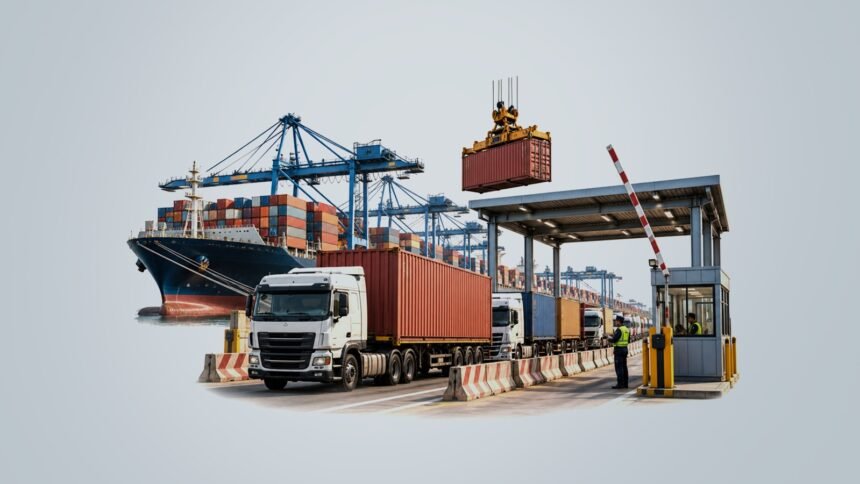
“Somebody has to pay for the truck, the driver, and the waiting time.” The line comes from Toby Maier, chief executive for the Middle East and Africa at DHL Global Forwarding, and it sums up a problem that maps of the continent’s coastline conceal. At several African terminals, he says, a haulage truck sent to collect an import container can spend up to seven days idling outside the gate. In Abu Dhabi, by comparison, gate-in to gate-out collection takes roughly 15 minutes.
While the truck waits, the driver’s wages accrue, the fleet sits idle, and port storage fees pile onto the bill. Multiply that across thousands of containers, and the cost of African trade becomes less a question of distance than of time.
Africa’s coastline has 179 ports or maritime harbors, according to a continental transport database published in Scientific Data in December 2025, alongside 132 inland river ports and dry docks. But that inventory counts facilities, not how fast cargo moves through them.
Friction Between the Ship and the Customer
For Mr Maier, the continent’s high logistics costs rarely come from a shortage of berths. They come from friction in the links between ships, quaysides, customs authorities and domestic distributors. A delay at any one point converts a routine delivery into a costly one.
“For me, it’s always very ironic that, in a continent where available GDP per capita is the lowest in the world, people have the highest logistics cost per unit because of the inefficiencies in the overall system,” he said. He supplied no comparative dataset to support that ranking, and it should be read as one executive’s assessment rather than a measured fact. He did list the sources of expense: inadequate infrastructure, inconsistent clearance procedures, documentation problems and limited transport capacity.
Technology helps, up to a point. Morocco’s APM Terminals MedPort Tangier, which began operations in June 2019, uses remote-controlled ship-to-shore cranes, 70 automated rail-mounted gantry cranes and automated gate lanes. But an automated terminal does not fix what happens after the gate: goods still need regulatory approval and reliable onward transport.
Customs: Where Costs Compound
Customs clearance is the most volatile point in the chain. “Customs clearance continues to complicate shippers’ operations and inflate outlays,” Mr Maier said. “The moment a container is delayed, statutory demurrage and private quay storage charges compound rapidly, creating severe financial distress.” Manual inspections, opaque valuations and incompatible electronic document standards drive much of the cost. He also acknowledged that shippers often cause their own delays with flawed paperwork or mismatched codes.
His firm bars sensitive cargo, such as chemicals, regulated pharmaceuticals and hazardous goods, from leaving its port of origin until destination documents and permits are checked. It says it has trained more than 28,000 small and medium-sized enterprises worldwide, 11,000 of them in sub-Saharan Africa, in export documentation, trade finance and customs classification. Customs’ exact share of freight bills, Mr Maier said, “varies country by country, transport mode by transport mode, and client by client”; he gave no corridor breakdown.
The Burden on Landlocked States
The costs multiply for Africa’s 16 landlocked developing countries. In an August 2025 assessment, UN Trade and Development (UNCTAD) found that landlocked developing countries globally face freight costs 50 percent above world averages and transit times twice as long as coastal neighbors. Upgrading a terminal in Mombasa, Tema or Durban solves only one link for a business inland.
Reform works when governments coordinate. On East Africa’s Northern Corridor, customs digitization and integrated border management at Malaba, the crossing between Kenya and Uganda, cut transit delays from three days to three hours. UNCTAD says its Automated System for Customs Data, used in two-thirds of the world’s landlocked developing economies, has reduced clearance times by up to 90 percent in modernized ports.
Fuel, Capacity and a Growing Market
Global shocks reach African shippers too. Mr Maier estimates that fuel makes up roughly a third of transport costs, depending on the mode, and says jet fuel prices more than doubled during the Middle East disruption, though he gave no reference period. African businesses compete with other markets for vessel and aircraft space, and some companies that once supplied spare parts through Dubai now serve Africa directly from China or Europe.
The forwarding market is large. Ken Research, a market research firm, estimates Africa’s freight-forwarding market at 18.2 billion dollars in 2025, rising to 27.73 billion dollars by 2032. DHL announced in October 2025 a planned investment of more than 300 million euros in sub-Saharan Africa across its divisions. More capacity, however, does not automatically mean lower bills.
Trade on African Terms
Economic self-reliance depends on being able to move goods at a predictable cost, from the farm to the port and from one African country to another. As long as containers wait for days at the gate and cargo crosses borders on paper that does not match, African producers will pay a hidden tax that their competitors elsewhere do not.
The Malaba example shows that the fix is often administrative rather than physical: shared customs systems, aligned procedures, and governments willing to coordinate. Ports put Africa on the map of world trade; whether that trade becomes affordable depends on what happens between the ship and the customer.