


The deadliest Ebola outbreak in Congo’s history is now in eight provinces, and the killing of a nurse in Tshopo shows that the hardest part of the response is often winning the trust of the communities it is meant to protect.
What happens to an epidemic response when the people sent to stop the virus are accused of spreading it? In Bafwasende, a rural town in Congo’s Tshopo province, the answer came on Saturday, 24 October 2026. A nurse responding to an Ebola alert was killed by protesters, and a second health worker was seriously injured and remains in hospital.
The two were targeted by local youths who accused them of contaminating water sources and spreading the Ebola virus, according to local reports. The details of what happened in the minutes before the attack have not been published, and the Ebola response team had not given its own account of the circumstances by the time this brief was prepared.
The killing is not an isolated event. It is the latest in a series of violent incidents that have dogged the response since the outbreak was declared in May, and it comes as neighboring countries tighten their borders against the disease.
Condemnation From the UN and WHO
Julien Harneis, the UN’s Senior Ebola Response Coordinator, extended condolences to the nurse’s family and colleagues. “I strongly condemn this attack and call for a thorough investigation,” he said. “I urge communities to protect health workers and allow them to carry out their work safely.”
The World Health Organization’s Director-General, Tedros Adhanom Ghebreyesus, also sent condolences and wished the injured worker a swift and full recovery. “Everyone working to protect communities from this deadly disease must be able to work in dignity and safety,” he wrote. “Healthcare must always be protected.”
An Outbreak Without a Vaccine
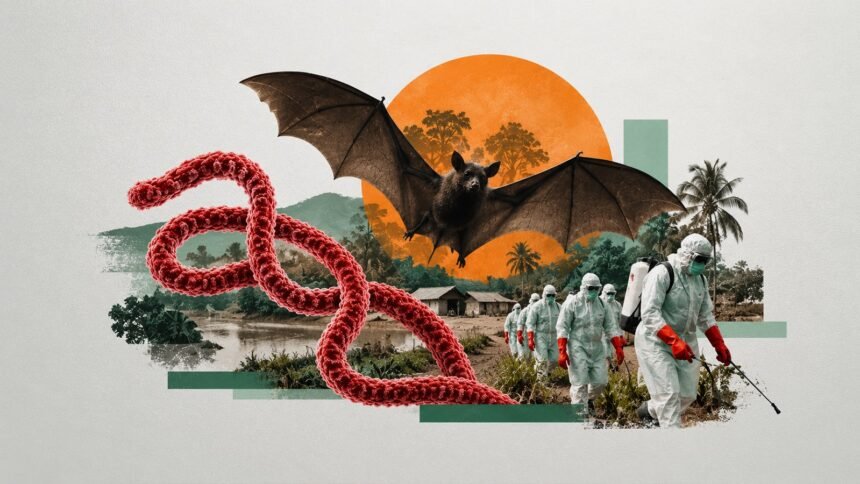
The outbreak is caused by the Bundibugyo species of Ebola, which is relatively rare and for which there is still no approved vaccine or specific treatment, though trials are under way. The disease spreads from person to person through contact with infected bodily fluids such as blood or vomit.
Recent WHO figures put the toll in Congo at more than 9,760 cases and some 4,727 deaths since the outbreak was declared on 15 May; another current count gives more than 4,800 deaths and nearly 10,000 infections. By either count, the UN describes it as the deadliest Ebola outbreak in the country’s history. First reported in the volatile east, it has now reached eight provinces: Bas-Uélé, Haut-Uélé, Ituri, North Kivu, South Kivu, Sud-Ubangi, Tshopo and Nord-Ubangi.
Without a vaccine, the response depends almost entirely on the work the nurse in Bafwasende was doing: answering alerts, isolating the sick, tracing contacts and persuading families to change how they care for the ill and bury the dead. That work cannot be done from a distance, and it cannot be done where health workers fear for their lives.
A Record of Attacks
Last month, a politician was beaten to death after promoting measures to stop the spread of Ebola. In August, the Red Cross said its volunteers had been injured and an ambulance set on fire in 11 violent incidents during the first 100 days after the outbreak was declared.
Each incident shares a familiar root: a belief that the response itself is the danger. Rumors that teams poison water or bring the disease with them thrive in places where public services have long been absent, where outsiders arrive with protective suits and unfamiliar rules, and where earlier promises from the state were not kept. Mistrust of this kind is rarely cured by statements from Geneva or Kinshasa; it is eased, slowly, by local voices people already know.
Borders Close, Cases Travel
The wider region is reacting. Uganda has banned all non-essential travel to and from Congo. Only essential travelers, including aid workers, truck drivers and security personnel, may cross under strict health screening, and Ugandans returning from Congo will “undergo 21 days of quarantine at their own cost”, the health ministry said. All travelers entering Uganda must now complete locator forms. “All these are measures to ensure that we keep Uganda free of Ebola,” said Health Minister Chris Baryomunsi.
Uganda recorded 20 cases and two deaths early in the outbreak and was declared free of the disease in August. The new restrictions follow two cases elsewhere: a Kenyan businessman who arrived from Congo and died two days after reaching Nairobi, and a woman confirmed in Nigeria. Both had passed through Uganda’s Entebbe airport on the same day. The patient in Nigeria, the Ugandan-born wife of a Swiss diplomat, was flown with her husband to Switzerland on Monday; the WHO’s regional director for Africa, Dr Mohamed Janabi, said the evacuation meant Nigeria currently had no Ebola cases and that it would keep monitoring 52 contacts. In Kenya, a first group of 20 contacts went home after 21 days in quarantine, while 98 others remain under supervision and seven people who tested positive are stable.
Health Security Built on Trust
Africa’s ability to manage its own health emergencies rests on more than laboratories and stockpiles. It rests on the frontline workers, most of them local, who walk into villages when an alert comes in. Protecting them is a national responsibility, and so is the slower work of earning the trust that makes their protection less necessary.
A thorough investigation into the Bafwasende killing, as the UN has requested, would be a start. So would greater investment in community health workers and local leaders who can explain the response in their own languages, and in services that remain after the outbreak ends. A continent that wants to stop depending on outsiders to contain its epidemics will need its own people to believe that the response is theirs.