





The Pan-African Paradigm of Fractured Peace and Manufactured Silence
A soldier’s footsteps on a Mekelle street, a family hoarding cash before the banks close, a phone that rings and rings into a dead network these are the small, human instruments through which a war returns. On September 24, the Tigray People’s Liberation Front and allied fighters in Amhara and Afar seized three local airports. They struck federal positions, shattering a truce that had held, however imperfectly, for four years. For a continent still tallying the cost of the 2020-2022 conflict, an African Union estimate places the toll at roughly 600,000 dead from combat, famine, and healthcare collapse; the return of drone strikes over Tigray and the disappearance of Ethio telecom’s signal are not abstractions but warnings. The paradigm here is not simply of war resuming; it is of sovereignty contested from within, where neither Addis Ababa nor Mekelle can claim to speak for a durable peace, and where outside actors from Asmara to the Gulf watch for openings. What Ethiopia does next will test whether the continent’s institutions can compel accountability before the machinery of famine and forced conscription reassembles itself, or whether reclaiming the peace dividend of 2022 has already slipped out of reach.
The Silence Engineered in Mekelle
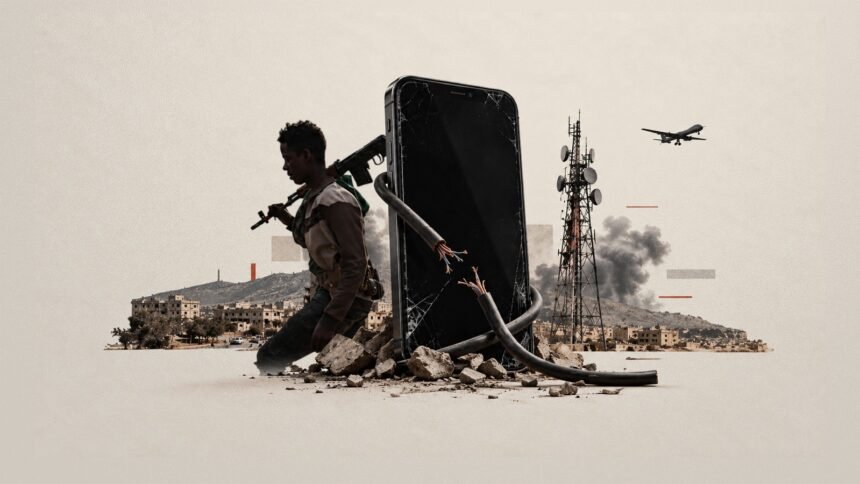
On Friday, calls and messages routed through Ethio telecom’s network into Tigray failed to connect, while Safaricom’s Ethiopian subsidiary reported only patchy service. NetBlocks, the independent internet-monitoring group, confirmed the disruption across the region. Four sources with direct knowledge, including a diplomat, said the TPLF itself had ordered the shutdown — a tactic one source linked to neutralizing the federal military’s drone advantage, since battlefield drones depend on the very mobile infrastructure being severed. The TPLF has denied responsibility and pointed instead at the government; neither Prime Minister Abiy Ahmed’s office nor the telecom operators responded to requests for comment. The asymmetry is instructive: Ethiopia’s military claims a significant materiel advantage, and its imported and domestically manufactured drone fleet has struck Tigray targets steadily since August, according to the conflict monitor ACLED. Silencing the network becomes, in this reading, less a wartime accident than a structural countermeasure, a reminder that in modern African conflicts, the architecture of communication is itself a battlefield asset to be seized, denied, or weaponized by whichever side can control it.
Casualty Arithmetic and the Fog of Claims
Ethiopia’s National Defense Force said its North East Command had routed Tigrayan forces for a second time since Wednesday, claiming 436 enemy fighters killed, 220 wounded, and 44 captured, an escalation from Thursday’s tally of 272 killed and 260 wounded. A senior Tigrayan official conceded the federal figures were not exaggerated. However, neither side disclosed its own losses, and none of the battlefield reports from either camp could be independently verified. A source close to the TPLF countered that federal troops had been pushed onto the defensive by Tigrayan forces and their Amhara and Afar allies, with fighting reported within kilometers of Lalibela’s airport, near the UNESCO-listed rock-hewn churches that draw pilgrims and tourists alike. This contested arithmetic, each side asserting momentum the other denies, is itself a symptom of an information vacuum that the network blackout has deepened, leaving neither Ethiopian civilians nor the international community with a reliable account of who controls what, and at what human cost.
Recruitment, Fear, and the Return of Wartime Coercion
Local and international rights groups, along with residents interviewed independently, describe intensified forced recruitment by the TPLF since Wednesday’s offensive began, with fighters going house-to-house in towns like Maichew in search of young men. One resident described hiding indoors rather than risk conscription or venture to work. The TPLF denies the practice, but the pattern echoes tactics documented during the earlier war, when both sides pressed civilians into service under threat. For a movement that dominated Ethiopian politics for nearly three decades before Abiy’s 2018 ascent, and that now casts its renewed offensive as defensive rather than expansionist, the credibility of that claim rests uneasily against testimony of coerced recruitment gathered independently of either government or rebel messaging, evidence that the structural violence of this war is being absorbed first and worst by the ordinary residents it claims to liberate.
A Region Already Overextended
Ethiopia’s federal government has accused Eritrea of bankrolling the TPLF and its allies, a charge Asmara denies. At the same time, analysts warn the renewed fighting could further destabilize a Horn of Africa already strained by Sudan’s civil war, contested Red Sea shipping lanes, and spillover from conflicts further afield in the Middle East. This is the crux of the structural risk: Ethiopia does not fight in isolation. Its northern conflict sits astride some of the continent’s most consequential fault lines, food security corridors, refugee flows, and maritime chokepoints that regional and global powers all have a stake in. A resumed Tigray war threatens to reopen displacement routes that already strain Sudanese and Somali response capacity, compounding a humanitarian architecture across the Horn that was fragile even before this week’s fighting began.
Reclaiming the Peace Dividend
The 2022 Pretoria agreement was supposed to prove that African-led mediation could end even the continent’s bloodiest recent war without external imposition. Its unraveling this week tests whether that model of sovereign conflict resolution can be salvaged, or whether it was always a ceasefire of exhaustion rather than a genuine settlement of the underlying grievances over federal power-sharing, territorial control, and Tigrayan political representation, the issues that triggered the war in the first place. The African Union, the Intergovernmental Authority on Development, and Ethiopia’s own federal structures now face a narrowing window to intervene before famine conditions and mass displacement re-establish themselves, as they did between 2020 and 2022. Reclaiming that peace will require more than a restored phone signal; it will require federal and Tigrayan leaders alike to answer for a truce that, it turns out, neither side was prepared to keep.