





The Pan-African Paradigm of Value-Chain Sovereignty and Critical-Minerals Independence
A hundred and fifty thousand metric tons a year of sodium metabisulphite, sodium hydrosulphide and sodium isobutyl xanthate, names unlikely to feature in any political speech, yet central to whether Southern Africa’s copper and cobalt wealth translates into regional industrial capacity or continues flowing outward as raw ore awaiting processing elsewhere. This week, mining chemicals importer Kemcore secured environmental clearance for a manufacturing plant in Botswana designed to supply precisely those chemical reagents to copper and cobalt mines across the Democratic Republic of Congo and Zambia. The approval, unglamorous as it sounds, represents a meaningful structural shift: rather than importing mining chemicals from distant manufacturing hubs, the region’s mineral-processing supply chain could soon draw on domestic Southern African production. As global demand for battery minerals intensifies under the pressures of the energy transition, the question of who controls the supporting industrial inputs, not just the extraction of copper and cobalt themselves, but the chemical reagents required to process them, has become a genuine test of whether African states can capture value beyond the raw-material stage of their own mineral economies.
The Deal in Concrete Terms
Kemcore founder and Chief Commercial Officer Calisto Radithipa described the environmental clearance as an important development milestone, one that clears the way for the company to pursue financing for a facility with a total projected cost of roughly $140 million. The company is targeting financial close by December 2026, construction throughout 2027, and initial production beginning in the first half of 2028, a timeline that, if met, would position the plant as the first integrated battery-minerals chemical complex in Southern Africa. Radithipa told Reuters that talks with funders are advanced, citing strong interest from regional and local financial institutions drawn to the opportunity of gaining exposure to critical minerals demand without the capital intensity and operational risk of investing directly in a mine. That framing is significant: it positions chemical-input manufacturing as a lower-risk, higher-margin entry point into the battery-minerals value chain, potentially attractive to African institutional investors who have historically been priced out of direct mining investment by capital requirements and geological risk.
Why Location and Inputs Matter
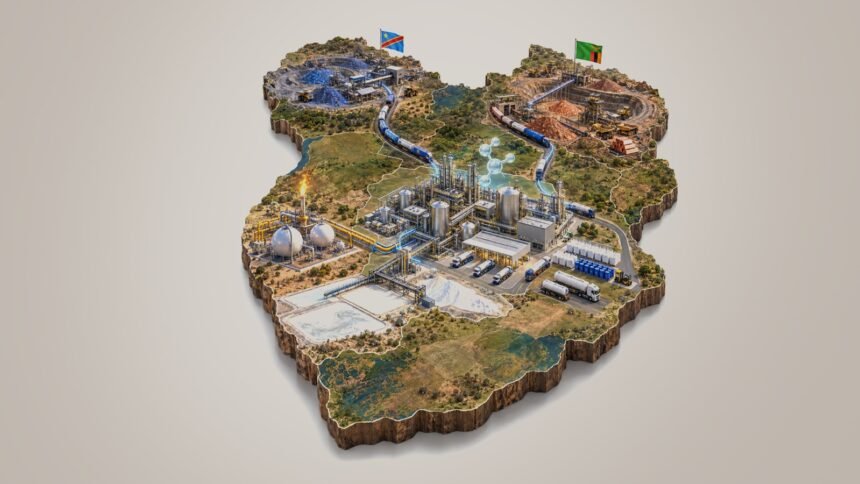
The plant will be built within Botala Energy’s Leupane Energy Hub and Industrial Park in central Botswana, a siting decision driven by proximity to the raw materials the facility itself requires: gas, soda ash and salt. Discussions to secure gas supply from Botala Energy’s ongoing coal bed methane project are described as advanced. At the same time, soda ash and salt will be sourced from the Botash mine, located roughly 300 kilometers northeast of the Kemcore site. This clustering of interdependent industrial projects, an energy hub supplying gas to a chemicals plant that in turn supplies reagents to copper and cobalt mines hundreds of kilometers away in neighboring countries, illustrates the kind of integrated industrial architecture that mineral-rich but historically under-industrialized Southern African economies have struggled to build. Botala Energy’s parallel plans to develop 700 megawatts of hybrid power generation at the same hub suggest an ambition extending beyond this single chemicals facility, toward a broader industrial cluster anchored around the region’s mineral wealth rather than dependent entirely on external chemical and energy imports.
Regional Stakes: Zambia and the DRC
The plant’s intended customers, copper and cobalt mining operations across Zambia and the Democratic Republic of Congo, sit at the heart of global battery-mineral supply chains, given the DRC’s dominance in cobalt production and Zambia’s status as one of Africa’s largest copper producers. Both countries’ mining sectors have historically depended heavily on imported processing chemicals, adding cost, logistical complexity, and supply-chain vulnerability to operations already exposed to volatile global commodity cycles. A regionally manufactured alternative, sited within a reasonable transport distance in Botswana, could meaningfully reduce that exposure while keeping a larger share of the value generated by mineral processing within Southern Africa rather than paying premiums to chemical exporters based outside the continent. This dynamic matters particularly as global competition for battery-mineral supply chains intensifies, with both Western and Chinese industrial interests seeking to secure preferential access to Central and Southern African copper and cobalt. A domestically anchored chemicals supply chain gives regional mining operations, and, by extension, regional governments negotiating mineral development terms, additional leverage and reduced dependency on any single external supplier.
Building the Architecture Beneath the Minerals
Botswana’s Kemcore approval illustrates a less visible but structurally important dimension of the continent’s ongoing effort to capture more value from its mineral wealth: the industrial inputs and supporting infrastructure that determine whether extraction translates into broader regional development. Headline mineral deals, mine openings, export agreements, sovereign wealth arrangements, tend to dominate coverage of Africa’s critical-minerals moment. Still, facilities like Kemcore’s proposed plant represent the connective industrial tissue that makes those headline deals function more efficiently and with greater regional benefit. If Kemcore meets its projected timeline, the facility would mark a genuine, if modest, step toward the kind of integrated regional mineral-processing architecture that policymakers across Southern Africa have long identified as necessary for the continent to move beyond raw-material export dependency. The test now lies in execution: securing the advanced financing talks Radithipa described, meeting construction timelines, and proving that regionally manufactured mining chemicals can compete on cost and reliability with established import channels. Success would offer a template, unglamorous, chemical-formula-heavy, but structurally significant, for how African states can build sovereignty over their mineral futures one supporting industry at a time.