




The Pan-African Paradigm of Sovereign Defense and Asymmetric Warfare
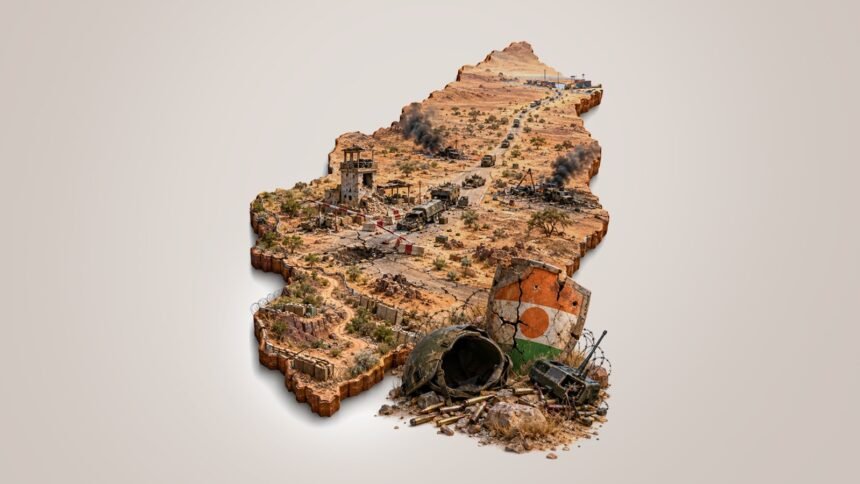
Two ambushes within eight days, more than fifty gendarmes and soldiers dead, and a jihadist affiliate confident enough to claim the killings by name within hours: this is the arithmetic confronting Niger’s military government as it enters its fourth year in power. The attacks near Abala-Filingué and Birni-N’Konni are not isolated tragedies but data points in a longer continental pattern: postcolonial armies, built along colonial-era lines to police populations rather than repel insurgencies, now straining against enemies that move through the same terrain their forebears once patrolled as subjects. The paradigm at stake is not simply military competence but the deeper question of what sovereignty is actually for. A junta that seized power promising security has instead presided over an expanding insurgent footprint, a fact that unsettles the coup-as-corrective narrative used to justify military rule across the Sahel since 2020. For Niger and its neighbors, reclaiming sovereignty over this territory will mean building institutions that can out-govern insurgency, not merely out-arm it, a recalibration that has barely begun.
Abala-Filingué and Birni-N’Konni: The Anatomy of a Two-Front Collapse
The scale of the losses is what distinguishes this episode from the steady drip of Sahelian violence. A convoy of gendarmes was ambushed near Abala-Filingué in western Niger, security sources said, before a second and deadlier assault at Birni-N’Konni killed more than thirty soldiers days later. Islamic State Sahel Province, the regional affiliate of the group, issued statements claiming both attacks, a claim corroborated by SITE Intelligence Group’s monitoring. The geography matters: western Niger has become the connective tissue between Mali’s insurgent-held north and the tri-border zone shared with Burkina Faso. In this area, state authority has thinned to checkpoints and garrison towns. That the group struck twice in the same week, against organized security convoys rather than soft civilian targets, signals both operational confidence and a deliberate strategy of attrition against the institution the junta depends on most for legitimacy, its own army.
The Kremlin’s Shadow: Coup-Proofing Versus Counter-Insurgency
Niger’s security architecture has been reshaped by the same forces reshaping its politics. Last month, mutinous soldiers attacked the presidency and the international airport in Niamey, triggering a standoff resolved only with the backing of Africa Corps. This Kremlin-controlled paramilitary structure has absorbed much of the old Wagner network’s African portfolio. That episode, coming just weeks before this month’s attacks, exposes a structural tension inside military-led states across the region: resources and political attention are disproportionately allocated to coup-proofing, protecting the junta from its own ranks, rather than to the counter-insurgency campaigns that justified the coup in the first place. Analysts and security sources describe a frontline increasingly aware of this asymmetry, where soldiers absorb the casualties of a war whose command structure appears preoccupied with internal loyalty rather than external defeat of the insurgency it was mandated to end.
Frontline Fatigue and the Erosion of Institutional Trust
Repeated losses in western Niger have produced what security analysts now describe as a mounting crisis of morale within frontline units, a condition with its own destabilizing logic. An army that cannot protect its own convoys struggles to project the deterrent capacity a state needs to hold territory, and each unanswered ambush erodes the tacit bargain between soldiers and the government that commands them. The January assault on Niamey’s civilian airport and military airbase by the same Islamic State affiliate demonstrated that insurgent reach now extends to the capital itself, collapsing the buffer zone that previously separated the “war” from the seat of government. This is the structural bind facing Sahelian juntas broadly: having centralized authority through force, they inherit sole responsibility for a security failure that is regional, cross-border, and resourced by transnational militant financing networks far beyond what any single garrison can interdict.
Trans-Saharan Contagion: A Regional Matrix, Not an Isolated Front
Niger’s crisis cannot be read in isolation from the wider Sahelian trajectory. Mali and Burkina Faso, its partners in the junta-led Alliance of Sahel States, face parallel insurgent pressure from rival jihadist factions. At the same time, Western military withdrawals, first France’s, then the United States’ reduced footprint, have left a vacuum increasingly filled by Russian-aligned paramilitary structures with their own extractive and political agendas rather than genuine counter-insurgency mandates. Regional cooperation frameworks that once coordinated cross-border operations against militant movements have weakened as the AES bloc formally severed ties with the Economic Community of West African States, removing a layer of institutional coordination precisely when the insurgency has grown more mobile across the Mali-Niger-Burkina Faso tri-border zone. The result is a security landscape in which each state absorbs attacks that originate, move, and are financed across borders its own army cannot unilaterally secure.
Reclaiming the Sahel: Sovereignty Beyond the Barracks
What Niger’s losses this month make plain is that sovereignty measured only in flags raised over capitals is an incomplete sovereignty. The junta’s founding claim, that removing an elected, foreign-aligned government would restore security faster than diplomacy could, is now being tested against a body count that keeps climbing. A durable answer will not come from further militarization alone, nor from deeper dependence on external paramilitary patrons whose loyalty is transactional. It will require the harder, slower work of rebuilding trust between the state and the communities it claims to protect, reforming a security sector. Hence, it defends territory rather than regimes, and reasserts genuine self-determination over a battlespace increasingly shaped by outside actors on every side. Until that recalibration happens, the arithmetic of ambushes will keep being written in the names of soldiers who did not choose the war they are dying in.