





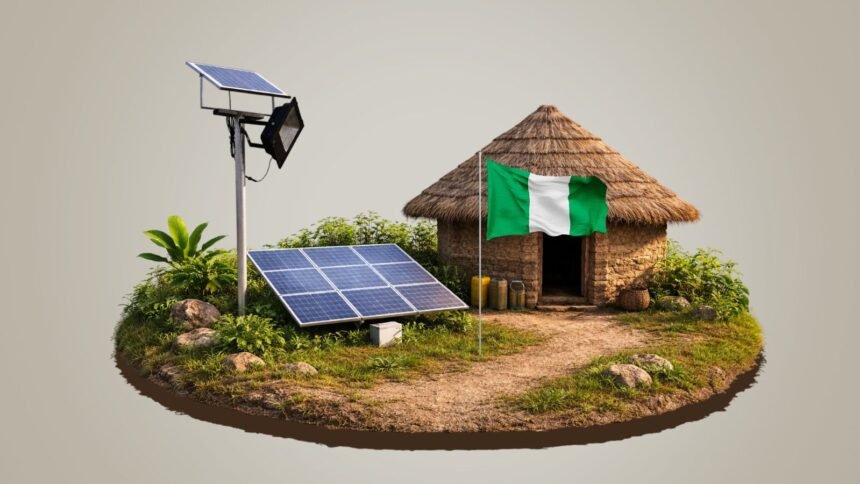
On a dusty roadside in Namu, a farming town in Nigeria’s Plateau State, the sound that now cuts through the late‑afternoon heat is not a diesel generator but the steady hum of an electric rice mill.
Inside a low concrete building, women feed grain into machines powered by a new 50‑kilowatt solar mini‑grid commissioned by Nigeria’s Rural Electrification Agency, with support from the United Nations Development Programme and the Global Environment Facility under the Africa Minigrids Programme.
Until recently, much of this work depended on unreliable fuel and daylight.
According to the agencies involved, the mini‑grid now provides clean, reliable power to more than 1,500 direct beneficiaries, including 180 women rice processors, around 100 households, several schools, health centres, and small businesses, linking energy access directly to agricultural value chains and local incomes.
Examples like Namu underpin a growing argument among African and international commentators that the mid‑2020s, and 2026 in particular, are emerging as a turning point in the continent’s clean‑energy and climate‑resilience push.
Across multiple analyses and opinion pieces, solar mini‑grids and climate‑smart agriculture are increasingly described not as side projects, but as tools of economic strategy, often enabled by public‑private partnerships that share risk and crowd in capital.
Background and Stakes
For more than a decade, Africa has featured in global climate debates primarily as a victim of droughts, floods, and heatwaves driven largely by emissions elsewhere.
That framing has not disappeared, but recent commentary from outlets such as Citizen Digital, The Standard (Kenya), and African Leadership Magazine argues that a parallel story is emerging: one in which cheaper renewables, new finance mechanisms, and regulatory reforms turn climate investments into platforms for growth.
Several opinion and analysis pieces published between late 2025 and early 2026 explicitly describe 2026 as a “turning point” or a potential “breakthrough year” for Africa’s clean‑energy transition, citing expanding project pipelines in solar, storage, and distributed systems.
These arguments build on a wider backdrop of global commitments, reaffirmed at the 2023 Nairobi Africa Climate Summit and at COP30 in Brazil, to scale up renewable energy and increase climate finance for developing regions, including Africa.
At COP30, negotiators and observers reported pledges totalling over 50 billion dollars in new commitments for African renewables, including targeted funds for off‑grid solar and mini‑grids in underserved regions.
However, disbursement and implementation details are still evolving.
In this context, 2026 is being framed by some analysts as the year when a decade of energy and climate road maps must start to show visible results on the ground.
Human Stories and Real‑World Examples
In Namu, the mini‑grid project illustrates how sustainability initiatives are increasingly designed around “productive uses” of energy.
The Rural Electrification Agency and UNDP describe the installation as a system that powers rice milling, cassava processing, and cold storage, in addition to lighting and basic services.
“This is not just about electrifying a community; it is about energizing lives, livelihoods, and local economies,” said Elsie Attafuah, UNDP Nigeria Resident Representative, at the commissioning in March 2026. “The Namu mini‑grid is a beacon of hope for rural development and a model for inclusive, sustainable electrification.”
Speaking at the same event, REA’s managing director, Abba Aliyu, called it “the first commissioned project under the Africa Minigrids Programme in Nigeria” and said that for Namu’s residents, it means “more than access to power, it’s access to opportunity.”
Across the Continent, Similar Linkages Are Emerging
The Africa Minigrids Program, implemented by UNDP with Global Environment Facility funding, is a country‑led technical assistance program that supports African states to rapidly and cost‑effectively provide electricity via low‑carbon mini‑grids.
Program documents say it aims to enhance the financial viability of mini‑grids and “promote scaled‑up commercial investment,” particularly where they can power households, key social services, and productive uses such as irrigation and small industry.
Industry groups such as the Africa Minigrid Developers Association argue in policy briefs and opinion essays that renewable mini‑grids are among the most practical ways to close Africa’s energy access gap while cutting emissions and powering rural economies.
At the same time, climate‑smart agriculture is gaining ground, as development agencies and African governments back solar‑powered irrigation, improved seeds, and better storage to help farmers adapt to changing rainfall patterns while moving up the value chain through local processing.
Policy, Debate, and Expert Views
Behind these experiments is a policy shift toward using public‑private partnerships and blended finance to unlock investment at scale.
The Africa Minigrids Program, for example, explicitly seeks to reduce hardware, soft, and financing costs while helping governments strengthen regulations so that private developers can operate within clearer rules and more predictable markets.
Commentators who see 2026 as a pivotal year point to three trends.
First, they highlight steady declines in the cost of solar and storage technologies, which make hybrid systems more competitive with diesel in many rural and peri‑urban settings, even if exact price points differ by market.
Second, they note that some of the climate‑finance commitments announced in recent summits are beginning to take shape as blended‑finance facilities and guarantees for mini‑grids and climate‑smart value chains. However, access to this capital remains uneven.
Third, regulatory reforms, such as Nigeria’s Electricity Act 2023, which expands roles for state‑level actors and private participation in the power sector, are cited as creating clearer pathways for off‑grid and distributed solutions.
Critics and Cautious Observers Raise Important Caveats
Mini‑grids still often depend on concessional funding or subsidies, and some developers warn that tariffs acceptable to regulators may not always cover long‑term operation and maintenance costs.
Civil society voices also worry that a strong focus on “bankable” projects could sideline the poorest or most remote communities unless equity and affordability are built into national strategies and contracts from the outset.
There is a broader debate about how far these initiatives can go in reconciling development and climate goals.
Some advocates argue that African countries must be supported to leapfrog directly to low‑carbon systems. In contrast, others emphasize that energy security and immediate job creation will continue to drive hard choices, including on the role of fossil fuels in power mixes.
What Comes Next
For communities like Namu, the sustainability “pivot” is measured in more tangible terms: extra milling hours, fewer days lost to fuel shortages, and a bit more resilience when weather or prices change.
For African policymakers and their partners, 2026 is shaping up as a test of whether those local gains can be replicated and sustained at scale, rather than remaining a patchwork of promising pilots.
If the current momentum leads to durable reforms, stable financing, and genuine community participation, future assessments of Africa’s climate story may focus as much on the opportunities created as on the risks endured.
If not, the year some analysts hailed as a potential turning point may instead be remembered as another moment when ambition outran implementation.