


The Pan-African Paradigm of Memory and Extraction
The history of slavery and colonial plunder has been told largely without the women who lived it. That omission is not an accident of the archive but a continuation of the same power that made the plunder possible. This is the thesis at the heart of Mababu, a series of 23 staged photographs by the Congolese artist Pamela Tulizo, profiled by The Guardian on 6 October. Mababu means “ancestors” in Swahili, and the series sets out to restore African women to the center of a story from which they have been pushed to the margins.
Tulizo told The Guardian that the project began with a question about the women of her own community in Goma: why are they so strong, and where does that strength come from? Her research led her back to the era of slavery, which she found is often remembered through the men forced across oceans, while women remained largely invisible and their stories untold.
Staging the Ancestors
Tulizo approached Mababu as if she were making a film, using actors, costumes, make-up, and outdoor sets shot in Goma and Belgium. The series portrays figures such as Kimpa Vita, the Congolese medium who became a figurehead of resistance to slavery, and Queen Nzinga, the monarch of the Ndongo and Matamba states in present-day Angola who led fierce resistance to Portuguese colonialism. It also reaches across the Atlantic to Solitude, a Maroon leader in the French colony of Guadeloupe who was executed after the Matouba revolt was suppressed and whose last words, The Guardian notes, were “live free or die”.
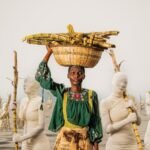
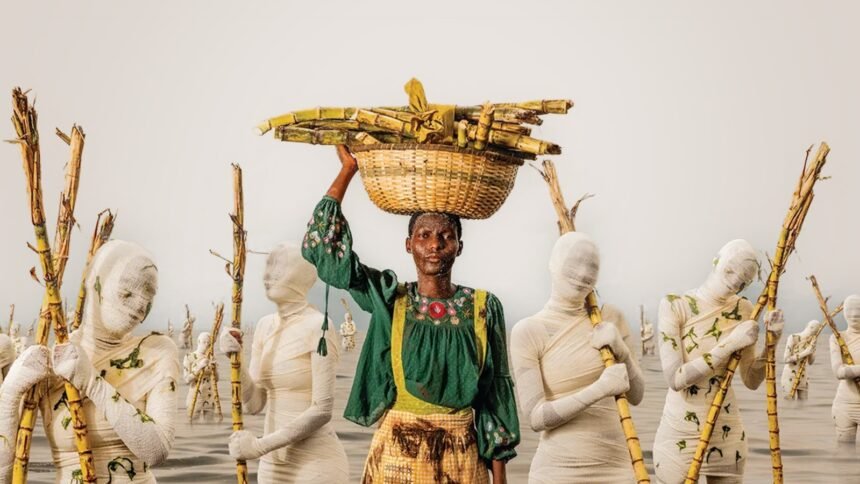
In one scene, a woman stands in Lake Kivu holding a basket of cotton, tobacco, or sugar cane, surrounded by women bound in bandages, a reference, according to The Guardian’s captions, to funeral rituals and to the idea of a hidden self. The images do not soften past suffering, but they refuse to define their subjects by it.
Fashion as a Language of Dignity
Fashion is central to the series. Tulizo uses color, accessories, and styling to express hope, courage, and strength, so that even a woman shown bound or suffering is elevated by a hat, a dress, or a pair of gloves. To her, such a woman remains a heroine, and fashion is the means of honoring her. This is a deliberate counter-architecture to the visual record of empire, in which African women so often appeared, if at all, as anonymous figures. By dressing her ancestors with care, Tulizo asserts their full personhood.
The approach continues work for which she is already recognized. In 2020, her series Double Identity, which contrasted media portrayals of Congolese women as victims with their real identities, won the Dior photography and visual arts award for young talents. That prize helped her finance Tulizo Elle Space, a cultural center for women and girls in Goma, which she founded in 2021.
From Tobacco to Lithium
The titles of the opening works, Tumbako, Miwa and Pamba, refer to tobacco, sugar cane and cotton, three commodities that fuelled the transatlantic slave trade. Slavery did not happen in a vacuum, Tulizo told The Guardian; the pursuit of natural resources drove it. She draws a direct line to eastern DRC today, where decades of competition over mineral wealth have driven devastating conflict and sexual violence. Then it was tobacco, sugar and coffee, she says; today it is war and sexual violence over lithium, gold and minerals.
The comparison is pointed. The global race for electric vehicles and technological dominance, which she argues depends on Congolese raw materials, reproduces an old asymmetric trajectory in which value flows outward and violence stays local. Mababu thus works as both memorial and indictment, linking the extractive economy of the past to the supply chains of the present.
An Artist in Exile
Tulizo’s own path embodies the pressures she depicts. She began as a reporter, turning to photography when writing could not hold everything she wanted to say. There was nowhere to train as a photographer in Goma, she recalls, so she learned by taking pictures whenever she could, becoming one of only a handful of female photographers in the city, with no role model and initial resistance from family and peers in a male-dominated field. When renewed violence broke out in the region in early 2025, she fled and now lives in France. The cultural center she built in Goma and the war that drove her out of it sit side by side in her story.
Cultural Sovereignty and the Right to Remember
Mababu: Spirit of the Ancestors is on show at GC De Markten in Brussels from 8 to 31 October, as part of a cultural diplomacy initiative of the Vrije Universiteit Brussel. There is a sharp symbolism in exhibiting a Congolese reckoning with slavery and extraction in the capital of the former colonial power. Cultural sovereignty means more than access to foreign galleries, however. It means African artists defining the terms on which African history is seen, African institutions able to keep and show that work at home, and audiences in Goma as well as Brussels able to recognize their ancestors in it. Tulizo’s photographs make the case that memory is itself a resource worth defending, and that restoring women to the record is part of the structural sovereignty Africa still has to win.