


The Pan-African Paradigm of Fiscal Sovereignty
Across the African landscape, the structural configuration of public finance serves as a critical measure of state capacity and continental self-determination. The ongoing reliance of many sub-Saharan nations on external multilateral liquidity highlights the difficult balance between immediate developmental needs and long-term economic independence. The African Union’s vision for economic sovereignty emphasizes that true structural resilience cannot be achieved while domestic budgets remain dependent on Western-dominated financial institutions. Reclaiming the continent’s shared future requires a fundamental transition away from structural adjustment mechanisms toward industrialized, self-sustaining financial models that insulate local resource value chains from global geopolitical shocks.
Post-Crisis Realities in the Mozambican Context
The contemporary economic outlook for Mozambique is defined by an aggressive push toward macroeconomic stabilization following a decade of financial marginalization. Since the suspension of direct international budget support following a major hidden debt scandal a decade ago, the Southern African nation has operated under severe fiscal constraints. The domestic market has been further tested by an accumulation of external shocks, including severe, climate-change-induced flash floods and the economic spillover of international conflicts in the Middle East. These concurrent crises have drained state revenue and limited public infrastructure investments, forcing the executive leadership to prioritize fresh, high-level diplomatic engagements to unlock global capital pools and stabilize the national balance sheet.
Structural Bottlenecks and the Mechanics of the Financial Deficit
The state’s underlying fiscal deficit has created an urgent need for direct treasury injections to prevent structural public-sector contraction. To manage its near-term obligations, the government has had to navigate an acute protection vacuum across its social service networks, with essential sectors like education, agriculture, and sanitation facing persistent funding shortages. This internal asset deficit limits the administration’s capacity to execute standalone development projects without relying on concessional external assistance. The urgency of addressing this structural bottleneck has reshaped the country’s broader public policy priorities, forcing state planners to accept strict macroeconomic benchmarks to clear the path for large-scale external liquidity injections.
Institutional Re-engineering and the Burden of Debt Maintenance
The path toward a sustainable fiscal recovery depends on the execution of transparent liability reporting and highly disciplined debt management protocols. In mid-2026, the administration under President Daniel Chapo is actively engaging with global creditors to redesign its long-term financial architecture. The restoration of sovereign creditworthiness requires the state to coordinate closely with international monitors to implement deep structural reforms to improve financial integrity. To sustain this momentum, the Ministry of Finance must balance the immediate need for development loans with the long-term risk of debt distress, ensuring that newly acquired capital is directly channeled into productive economic sectors rather than consumed by debt-servicing costs.
Multilateral Synchronization and the Resumption of Strategic Credits
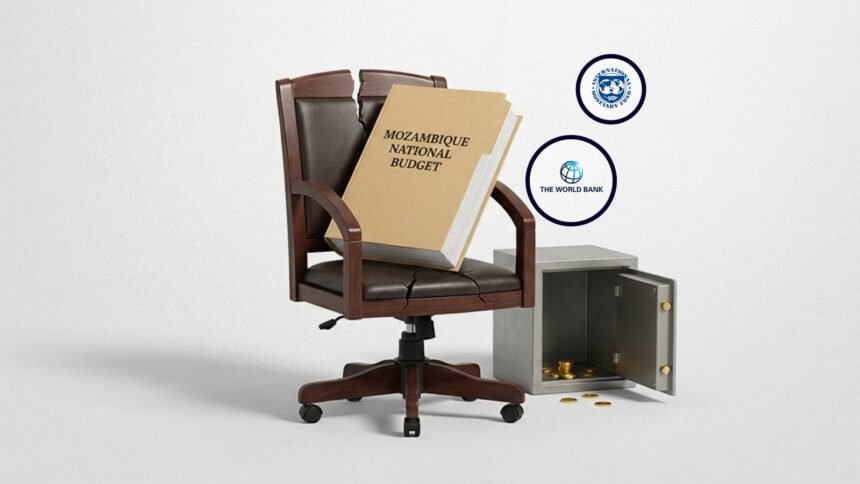
The operational mechanics of Mozambique’s stabilization program are driven by a highly coordinated, simultaneous engagement with major global financial institutions. In early June 2026, Maputo hosted concurrent high-level delegations from both the International Monetary Fund and the World Bank. An IMF staff team, led by Mission Chief Pablo Lopez Murphy, executed a comprehensive technical review from June 8 to 12 to evaluate the state’s fiscal and debt sustainability frameworks. Concurrent with this evaluation, the government concluded five pivotal financing agreements totaling $450 million with senior World Bank leadership. This immediate capital injection, spanning social protection, water management, and skills cultivation, serves as a bridge toward activating the World Bank’s Development Policy Operation, which will fully restore direct budget support once the republic meets agreed macroeconomic and financial integrity benchmarks.
Structural Transformation and Long-Term Capital Commitments
The successful resolution of the current crisis is designed to unlock a massive, multi-year partnership framework capable of transforming the country’s downstream economy. The recently signed $450 million agreements represent the initial phase of a broader, comprehensive $10 billion World Bank partnership architecture designed specifically for Mozambique. Under this long-term framework, $6 billion has been explicitly earmarked to rebuild public-sector infrastructure, while $4 billion is allocated to stimulate private-sector manufacturing and investment. By combining targeted state-led social investments with private-sector credit lines, the initiative aims to build a more resilient economic foundation, transforming the republic from a vulnerable, aid-dependent economy into a robust, self-determining anchor of regional trade.