




Pan African: Re-engineering Extractive Frontiers into Industrial Zones
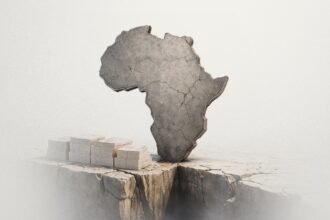
Across the African landscape, the contemporary implementation of macroeconomic policy is shifting from the passive export of primary raw materials to the strategic establishment of domestic manufacturing hubs. The Pan-African vision for the mid-2020s recognizes that long-term fiscal stability requires local economies to climb the global value chain. Rather than allowing vast mineral reserves, such as North Africa’s phosphate deposits, to be exported raw, African states are partnering with global capital to build high-capacity processing networks on continental soil. This shift serves as a key pillar for regional stability, demonstrating that advanced technological interventions and localized sovereign oversight can transform legacy logistics routes into high-yielding industrial corridors that protect the continent’s long-term commercial interests.
Morocco’s Economic Outlook: The Convergence of Tariffs, Transit, and Green Energy
The economic outlook for Morocco is defined by an aggressive campaign to leverage its unique geographic proximity to the European Union and its extensive network of international trade agreements. Positioned at the crossroads of Europe, Africa, and the Middle East, the Kingdom has actively diversified its economy by transforming its northern coast into a premier automotive manufacturing hub. Rabat’s contemporary pitch to global investors includes a competitive framework featuring a five-year corporate tax holiday, a highly skilled young labor force, and access to some 2.5 billion consumers via approximately 50 national free trade agreements, including bilateral pacts with both the United States and the EU. Furthermore, Morocco’s expansion into green energy inputs offers a vital mechanism for foreign manufacturers to significantly reduce their carbon tax liabilities when exporting to the European market.
China’s Industrial Base in Morocco: The Infrastructure of Tanger Tech and Beyond
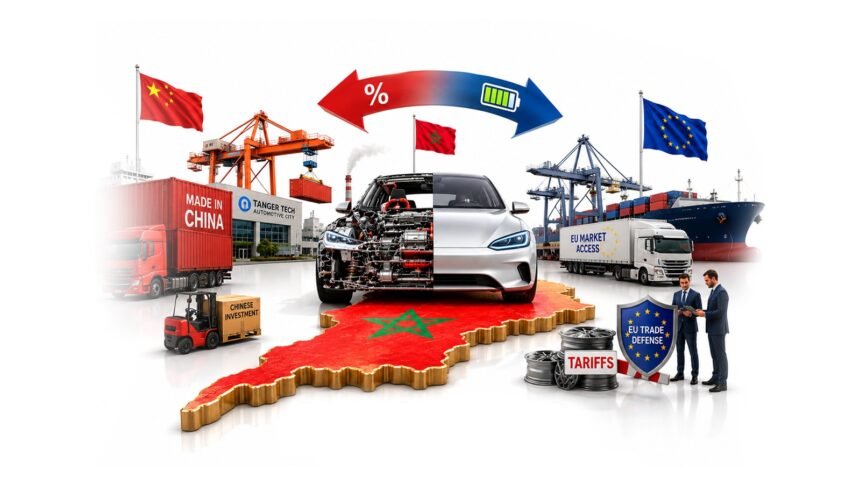
The physical manifestation of Sino-Moroccan industrial cooperation is expanding rapidly across the Kingdom’s specialized economic zones, driven by billions of dollars in post-pandemic greenfield investments. At the forefront of this partnership is the Mohammed VI Tanger Tech City, a massive 500-hectare industrial zone rising outside the port city of Tangier. This high-capacity manufacturing base hosts an emerging cluster of nearly a dozen Chinese automotive component suppliers, including a fully operational Sentury Tire factory and an advanced brake production facility by automotive parts maker APG. This manufacturing network extends down the Atlantic coast to Kenitra, where the Chinese battery giant Gotion High-tech is constructing a massive $1.3 billion gigafactory to power the region’s burgeoning electric vehicle sector.
The Industrial Base Benefit to Africa & EU: Proximity, Jobs, and Supply Chain Integration
The rapid development of Morocco’s Chinese-backed industrial base offers distinct structural advantages for both the host nation and the adjacent European automotive market. In Morocco, strict requirements for the use of local labor ensure that these massive industrial parks generate substantial domestic employment and facilitate genuine technology transfer to local engineers. For the European market, the localization of auto parts manufacturing provides competitive, near-shore supply chains situated right next door to their final assembly lines. By integrating Chinese technological expertise and local raw materials with Morocco’s existing industrial infrastructure, which already hosts major manufacturing plants for European giants like Renault and Stellantis, the Kingdom is successfully assembling a complete value chain capable of supplying components for up to 500,000 electric vehicles annually by the end of 2026.
Morocco-EU Industrial Relations: The Friction of Transshipment and Defenses
Despite the evident logistical benefits of nearshoring, Morocco’s expanding industrial partnership with Beijing has triggered severe regulatory friction in Brussels. European Union trade officials are growing increasingly alarmed that the billions of dollars flowing into Moroccan special economic zones are transforming the North African state into a launchpad for heavily subsidized Chinese goods designed to swamp European manufacturers. EU Trade Commissioner Maroš Šefčovič has explicitly characterized this dynamic as an attempt by Beijing to bypass European trade defenses and manage domestic industrial overcapacity by rerouting or “transshipping” Chinese industrial exports through intermediate trade partners. This regulatory standoff has already led to active enforcement, with the European Commission imposing punitive tariffs on specific Moroccan industrial exports, such as aluminum wheels, because they benefited from unfair subsidies linked to China’s Belt and Road Initiative.
EU’s Frets & African Sovereignty: The Geopolitical Contested Space of De-Risking
The escalating trade tensions between Brussels and Rabat highlight a profound geopolitical conflict in which the EU’s strategy of “de-risking” from China intersects with Morocco’s sovereign right to determine its own national development path. European policymakers are considering restricting access to public procurement and green subsidies through frameworks such as the proposed Industrial Accelerator Act, which would penalize vehicles and components manufactured with non-European state subsidies. However, Moroccan investment officials strongly reject the claim that their economic zones serve as a lawless backdoor for Chinese overcapacity, reminding international investors that all exports must strictly comply with international “rules of origin” that require substantial manufacturing transformation on Moroccan soil. This regulatory clash threatens to transform the southern Mediterranean into a highly contested economic space, where European protectionist policies directly challenge African sovereign efforts to attract global industrial capital.
Industrialization & Development: Vertical Integration and Resource Multipliers
The long-term trajectory of the Sino-Moroccan partnership represents a fundamental shift away from simple assembly toward full vertical integration of the industrial supply chain. Driven in part by rising geopolitical instability in the Middle East, Chinese industrial planners are increasingly focused on securing direct access to North Africa’s massive geological resources, most notably Morocco’s world-class phosphate reserves used in advanced battery manufacturing. By controlling the entire vertical supply chain, from raw mineral processing and high-tech battery anode synthesis to the construction of local transport networks leading directly to high-capacity maritime ports, this industrial cooperation provides a resilient alternative to traditional, vulnerable global logistics lines, allowing the host nation to secure a durable foundation for long-term industrial maturity.
Recent Developments: The Race for Electric Vehicle Dominance
The most significant and high-profile recent development remains the dramatic acceleration of manufacturing timelines across Morocco’s specialized economic zones as the end-of-2026 deadline for full electric vehicle value chain integration approaches. Business delegations from China are arriving in Casablanca at an unprecedented rate of two to three per week, looking to capitalize on Morocco’s unique tariff-free access to Western markets amid the EU’s implementation of up to 45 percent tariffs on direct electric vehicle imports from mainland China. As heavy construction equipment continues to expand Tanger Tech’s footprint rapidly, the project’s developers emphasize that their primary focus remains on delivering affordable, high-quality components for the global transition to clean transport. Success will ultimately be measured by whether Morocco can successfully defend its regulatory compliance in Brussels, ensuring that its strategic industrial hubs function as recognized bridges of global cooperation rather than casualties of a transatlantic trade war.