





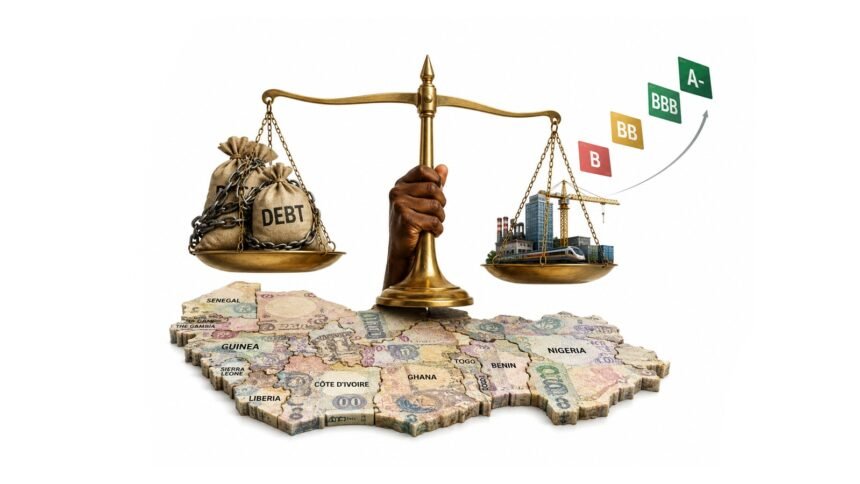
Across the African landscape, the structural evolution of development finance is increasingly defined by a collective push against asymmetric global risk architectures. The Pan-African vision for economic self-determination in 2026 is anchored in a fundamental challenge to the “African premium”—the systemic inflation of borrowing costs driven by subjective global risk perceptions rather than macroeconomic realities. For decades, the continent’s sovereign issuers have argued that international capital markets systematically misprice African risk, effectively trapping emerging economies in a cycle of permanent dependency. Reclaiming the continent’s financial trajectory requires transitioning from a framework defined by external aid and debt vulnerability to one predicated on enterprise innovation, localized capital accumulation, and sovereign credit parity.
West Africa’s Economic Outlook
The aggregate economic outlook for West Africa in mid-2026 reflects a delicate balance between stabilizing domestic growth and escalating external macro-shocks. While traditional export commodities, notably gold, oil, and cocoa, continue to generate vital foreign exchange, regional balance sheets face intense fiscal strain. The macroeconomic fallout of the ongoing international conflict involving Iran has introduced severe transmission shocks, disrupting trans-border logistics, driving up fuel import bills, and inflating global interest rates. Consequently, regional growth momentum is heavily constrained by limited fiscal space and rising debt-servicing requirements. For financial administrators across the Economic Community of West African States (ECOWAS), navigating this volatile environment requires aggressive structural adjustment to protect national output from external contraction.
IMF & Debt Management
The implementation of sovereign debt management frameworks across West Africa is subject to strict oversight by international financial institutions and multilateral adjustment protocols. In the wake of historic default cycles, states have increasingly relied on the G20’s Common Framework to coordinate complex restructuring operations with bilateral and private creditors. However, the operational efficacy of these multilateral mechanisms has been the subject of intense criticism from sovereign borrowers, who argue that the current architecture is inefficient, slow, inflexible, and socially destabilizing. For emerging economies, the rigid conditionalities embedded in debt-relief programs often require severe rollbacks of domestic subsidies and public spending, creating an acute structural tension between global fiscal compliance and domestic social stability.
AfDB-World Bank Debt Relief Efforts
To mitigate the severe political and economic risks associated with traditional structural adjustment loans, multilateral development banks such as the African Development Bank (AfDB) and the World Bank have sought to pioneer adaptive credit-enhancement tools. These interventions are increasingly focused on de-risking African sovereign issuances through partial risk guarantees, contingent capital facilities, and specialized blended finance mechanisms. By providing a structural shield against private investor volatility, these joint multilateral efforts aim to lower the cost of capital for African states, enabling them to bypass prohibitive commercial interest rates. The current institutional consensus emphasizes that development finance must evolve beyond short-term emergency liquidity injections toward long-term, low-cost capital deployment that actively stimulates domestic productivity and infrastructure resilience.
Ghana’s Debt Profile
Ghana’s contemporary debt profile serves as a critical case study in sovereign default recovery and structural financial re-engineering. Following a severe balance-of-payments crisis and a subsequent debt default in 2022, the gold, oil, and cocoa-producing nation was forced to execute a comprehensive restructuring of both its domestic and external obligations. Under the leadership of President John Dramani Mahama and Finance Minister Cassiel Ato Forson, the state has embarked on an aggressive stabilization program to repair its compromised credit standing. While international rating agencies currently hold Ghana’s sovereign credit within sub-investment or “junk” status, the treasury has established a highly ambitious milestone: achieving an investment-grade rating within three years. Meeting this target depends entirely on the state’s capacity to maintain strict fiscal discipline and successfully manage its remaining legacy obligations.
Debt Issues and Underdevelopment
The relationship between escalating public debt and structural underdevelopment remains a primary barrier to long-term economic maturity in the West African corridor. A significant driver of this fiscal expansion is the unsustainable proliferation of state-owned enterprises (SOEs), which frequently function as off-budget liabilities that balloon the overall sovereign debt burden. When the state absorbs the financial inefficiencies of these enterprises, it systematically crowds out the private sector. It drains resources away from vital human capital development, such as healthcare, education, and climate adaptation infrastructure. Financial managers emphasize that relying solely on the sovereign sheet to fund all industrial activity creates systemic structural fragility, turning what should be development-oriented capital into an unproductive debt trap that compromises future generations.
The Way Forward
The way forward for West African states requires a fundamental departure from aid-centric economic models toward a framework anchored in commercial enterprise innovation and structural parity. Reclaiming the region’s financial future involves reforming global debt restructuring mechanisms to make them faster, fairer, and more inclusive of the development requirements of the Global South. Concurrently, domestic administrations must reduce sovereign fiscal exposure by curbing the expansion of inefficient state-owned enterprises and aggressively mobilizing private capital through public-private partnerships. Success will be defined by African states’ capacity to assert their agency on the world stage, transforming the continent’s global narrative from a risk to be managed into an unparalleled opportunity to be seized.