





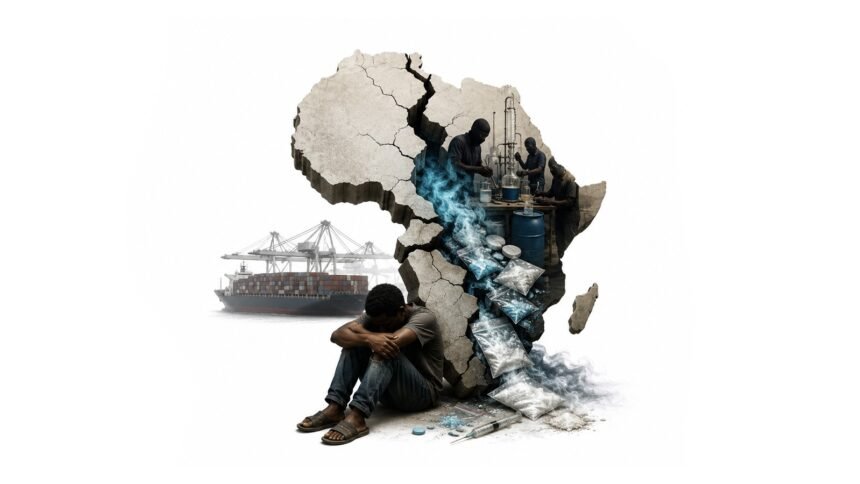
Pan-African: The Transnational Threat to Continental Integration
Across the African landscape, the consolidation of human security and state sovereignty faces a complex, evolving challenge from transnational organized crime. The Pan-African vision for a borderless and prosperous continent, as outlined in the African Union’s Agenda 2063, is increasingly vulnerable to illicit networks that exploit regional trade corridors and porous frontiers. Historically viewed primarily as a transit zone for illicit commodities destined for European and Asian markets, Africa is rapidly transforming into a major consumer and manufacturing base. This shift directly threatens continental stability, as the massive financial flows generated by narco-trafficking undermine state institutions, weaken public health systems, and distort local economies, highlighting the urgent need for a unified, borderless strategy to protect the African social contract.
Drug Cartels in West Africa: The Evolution of a Strategic Hub
West Africa has entered a highly volatile phase in the global drug trade, transitioning from a secondary maritime transit point into a primary operational base for sophisticated international syndicates. The region’s geographic positioning, coupled with gaps in maritime surveillance and border enforcement, has made it a strategic corridor for cartels originating from South America and Asia. Over the past decade, these criminal organizations have successfully embedded their operations within local networks, leveraging local logistical expertise to facilitate the movement of high-value illicit narcotics. This evolution has fundamentally altered the security landscape of the West African coast, transforming it into a high-density zone for international contraband smuggling and tactical criminal financing.
Criminal Organizations & Drugs: The Mechanics of a Manufactured Threat
The structural dynamics of drug syndicates operating within the continent are characterized by a transition from traditional trafficking to domestic chemical manufacturing. This dangerous pivot was made clear by a historic law enforcement operation executed by Nigeria’s National Drug Law Enforcement Agency (NDLEA). In a coordinated strike that dismantled the nation’s largest-ever synthetic drug network, operatives uncovered a massive industrial methamphetamine laboratory operating in the eastern region of the country. This single cartel was responsible for a historic seizure of multi-billion-naira worth of refined methamphetamine and precursor chemicals, alongside the high-profile arrest of the network’s kingpin. The industrial scale of the lab underscores the technical and logistical sophistication of modern African syndicates, which are now capable of managing the entire production cycle, from precursor acquisition to synthesis and international export, within the domestic space.
AU-UN Efforts: The Limits of Multilateral Counter-Narcotics Mandates
Multilateral interventions spearheaded by the African Union and the United Nations Office on Drugs and Crime (UNODC) serve as the primary global framework for cross-border law enforcement. Yet, uneven state capacities frequently constrain their state efficacy. While international treaties emphasize intelligence sharing, harmonized legal frameworks, and joint maritime patrols, the operational reality on the ground is often defined by resource deficits. Inter-agency coordination across West Africa is frequently hindered by administrative friction and a lack of specialized forensic equipment needed to detect precursor chemicals at major ports of entry. The challenge for these global bodies is to move beyond abstract policy declarations toward sustained, technical support that can institutionalize the diagnostic and enforcement capabilities of domestic counter-narcotics agencies.
Substance Abuse & Rehabilitation: The Public Health Fallout of Narco-Production
The rise of domestic synthetic drug manufacturing has triggered a profound public health crisis within African urban and rural centers, turning transit nations into localized consumption markets. Methamphetamine, known locally on the streets by highly addictive variants, has infiltrated vulnerable youth demographics, leading to a sharp increase in substance abuse and drug-induced psychoses. The national healthcare infrastructure is largely unequipped to manage this epidemic, as public rehabilitation centers face chronic underfunding and a severe shortage of specialized medical personnel. This protection vacuum leaves families to bear the immense socio-economic and psychological burdens of addiction, illustrating how the presence of industrial narco-production systematically erodes the health and productive capacity of the population.
War Against Drugs & Poverty: The Socio-Economic Drivers of Criminal Labor
The enforcement campaigns executed under the global “war on drugs” frequently intersect with the realities of systemic poverty and economic marginalization across the continent. For many individuals in under-resourced communities, the illicit drug trade functions as an alternative, high-yield informal economy, providing a source of livelihood that the formal labor market fails to deliver. Cartels actively exploit these socio-economic vulnerabilities, recruiting low-level couriers, lookouts, and lab hands from populations facing chronic unemployment. A purely punitive law enforcement approach that fails to address these underlying economic drivers will inevitably trigger a recursive loop, where the dismantling of one syndicate merely creates a labor vacuum that is rapidly filled by another marginalized demographic.
Human Rights & Regulations: Balancing Seclusion and the Rule of Law
The intensity of contemporary counter-narcotics operations poses critical challenges to the preservation of human rights and adherence to constitutional regulations. In the wake of high-profile cartels being busted, enforcement agencies are frequently tempted to utilize extraordinary measures, including arbitrary detentions, warrantless searches, and the aggressive asset forfeiture of suspected associates. Legal analysts emphasize that the fight against sophisticated criminal syndicates must not be waged at the expense of judicial transparency or individual liberties. Ensuring the rule of law requires that all high-velocity raids, suspect interrogations, and asset seizures are subjected to rigorous judicial oversight, preventing the state’s security apparatus from replicating the lawless behavior of the criminal networks it seeks to dismantle.
The Way Forward: Reclaiming a Secure and Resilient Future
The way forward for Nigeria and the broader West African region requires a comprehensive, human-centric transition from reactive policing to a proactive strategy of structural resilience. Reclaiming the future of the continent depends on the aggressive enforcement of maritime and port security to cut off the supply of precursor chemicals before they reach domestic manufacturing labs. Simultaneously, states must invest in evidence-based public health campaigns, expand accessible rehabilitation infrastructure, and create dignified economic opportunities for youth to neutralize the recruiting power of narco-syndicates. Success will be defined by whether African nations can build a resilient, sovereign governance architecture that treats drug trafficking not merely as a border security threat, but as a multi-dimensional challenge to the health, economic security, and fundamental dignity of its people.