





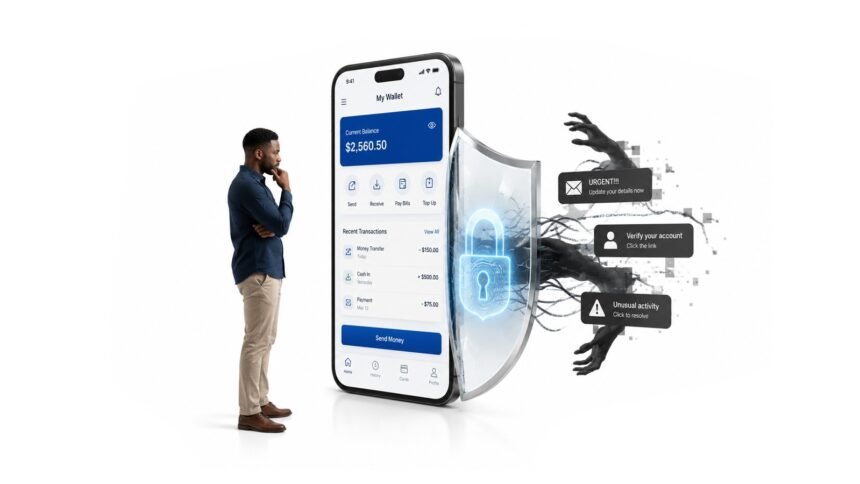
Digital financial experts are warning that the future of fintech may hinge less on technology itself and more on whether users feel safe enough to trust it.
This concern was highlighted in a Visa report, released on May 15, on privacy and security for women-led small and micro businesses in digital financial services. The report examines how issues such as fraud, data privacy, transparency, and digital safety are shaping confidence in fintech systems.
The findings suggest that while Africa has made progress in expanding financial access through mobile money and digital payments, many users, particularly women entrepreneurs, still hesitate to fully embrace digital finance because they do not feel adequately protected.
“Trust is foundational to the digital economy; that’s why we are supporting evidence-based, practical guidance that helps providers build transparent, user-centered experiences,” said Panos Loukos, the Director of Financial Inclusion at Groupe Spéciale Mobile Association (GSMA).
According to the report, only 11 percent of consumers fully understand how their data is used, while 85 percent are concerned about unauthorized access to their personal information.
At the same time, many women entrepreneurs continue to limit their use of digital financial services to basic person-to-person transfers, avoiding products such as digital credit, savings tools, or business analytics because of concerns about privacy and security.
The report argues that privacy and security are no longer merely technical or compliance issues. Instead, they have become central drivers of trust that determine whether users continue engaging with digital finance systems.
Visa Country Manager for East Africa, Victor Makere, said that if the element of trust is broken, the service is actually broken.
“Once trust is breached, it becomes very difficult to bring it back. Fraud itself is also evolving rapidly, shifting from traditional cyberattacks targeting systems to more sophisticated forms of social engineering that exploit human behavior,” he said.
He described scenarios where scammers manipulate users emotionally through fake emergency requests or deceptive messages designed to trick people into sending money.
“So now it is no longer only about securing credentials or platforms. If I allow too much personal information to become available during transactions, that can also expose me to manipulation.”
The report similarly warns that concerns around data privacy and transparency are increasingly affecting how users interact with digital financial platforms.
More than 79 percent of consumers surveyed said transparent communication about data use is a key factor in deciding whether to continue sharing digital information with providers.
Yet many platforms still rely on long and complex terms and conditions that users struggle to understand.
“Research found that many women entrepreneurs perceive fintech systems as opaque, difficult to navigate, or designed around assumptions that do not reflect their realities, especially in rural or informal economies,” said Loukos.
“Instead, products are often built for a default user assumed to have private smartphone access, strong digital literacy, and a clear understanding of financial and legal systems.”
Makere said financial technology providers must now focus on making systems simpler, more intuitive, and easier for ordinary users to navigate, with no need to understand the technical details behind them.
“Simplifying the process is one of the easiest ways of making sure financial education becomes effective,” he said.
The report calls on fintech companies to adopt privacy-by-design principles that place user safety, transparency, and control at the center of product development.
Among its recommendations are simpler consent systems, more discreet transaction features, stronger complaint- and fraud-reporting mechanisms, and greater involvement of women in the design and testing of digital financial products.
Ultimately, the report argues that digital finance systems cannot be truly inclusive if users do not feel safe enough to participate fully.