




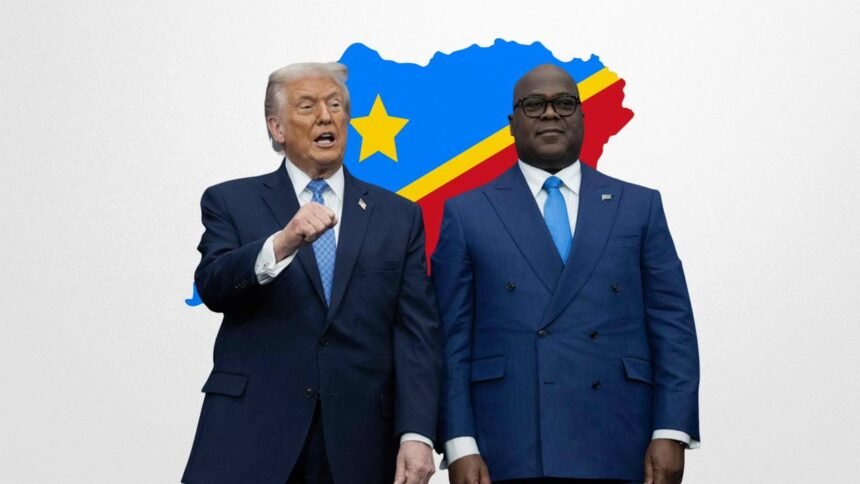
The United States and the Democratic Republic of the Congo have agreed to a five‑year, 1.2 billion‑dollar health partnership that ties new American funding to an unprecedented increase in Congo’s own health spending.
Under a memorandum of understanding covering 2026 to 2031, the U.S. government plans to provide up to 900 million dollars in health assistance, while Kinshasa has pledged to raise domestic health expenditures by 300 million dollars over the same period.
Officials from both countries described the deal as a “strategic health partnership” aimed at strengthening the DRC’s fragile health system and containing infectious disease threats before they spread beyond its borders. The agreement focuses on some of Congo’s most persistent killers: HIV/AIDS, tuberculosis, malaria, maternal and child mortality, as well as polio eradication, disease surveillance, and emergency preparedness.
America First’ Goes Global on Health
The deal is one of a growing number of bilateral agreements being negotiated under Washington’s “America First Global Health Strategy,” a doctrine that explicitly links U.S. funding to partner countries’ budget commitments and to tighter outbreak control measures.
Rather than traditional grants with loosely enforced co‑financing, the new model conditions large U.S. disbursements on “progressively increased” domestic health spending and on detailed reporting of disease and pathogen data.
In a statement, the U.S. Department of State framed the DRC agreement as serving both countries’ interests. Strengthening Congo’s capacity to detect and contain outbreaks, it said, would “safeguard Americans by reducing the risk that new or re‑emerging pathogens spread internationally.”
The DRC’s health ministry, posting on X, called the package a “structural investment” designed to “strengthen the resilience of the healthcare system, improve care for the population and consolidate the country’s healthcare sovereignty.”
The Congo deal follows similar memorandums signed with a growing roster of African countries, part of what analysts describe as a quiet but significant re‑engineering of U.S. global health spending away from multilateral channels and toward bespoke, bilateral compacts.
Media reports and civil society groups say that between 16 African states have either signed or are negotiating comparable agreements. However, some governments have balked at provisions on data sharing and legal jurisdiction.
What the Money is Meant to Do
While officials have not released a detailed year‑by‑year spending schedule, the joint statement and supporting documents outline a broad agenda for how the money will be used. The package is built around strengthening basic health functions and bolstering Congo’s ability to spot and stop dangerous outbreaks.
One pillar is integrated disease surveillance and laboratories capable of detecting and investigating outbreaks within 7 days, including expanding molecular testing and real‑time reporting from provincial health zones.
Another is emergency preparedness and rapid response, with funding earmarked for national and provincial emergency operations centers, stockpiles, and training for rapid response teams.
The partnership also targets maternal, newborn, and child health, focusing on upgrades to primary care facilities, improved referral systems, and expanded immunization coverage. Health workforce development is a fourth strand, covering the professionalization and remuneration of community health workers, as well as additional training for clinicians and lab technicians.
Finally, there is a strong emphasis on digital health and data systems to improve the quality, transparency, and coordination of health information across the country.
The partnership builds on more than two decades of U.S. health engagement in the DRC, including support from initiatives such as the President’s Emergency Plan for AIDS Relief and the President’s Malaria Initiative.
American technical teams and funding have also been central to containing multiple Ebola outbreaks and to responding to the 2024 mpox epidemic in Congo and neighboring countries.
Promise and Unease Across Africa
Congo’s leaders have presented the agreement as a step toward “health sovereignty”, the idea that a country should be able to finance and manage its own health system, while still drawing on external expertise.
For a government grappling with conflict, poverty, and recurrent epidemics, the prospect of 900 million dollars in additional U.S. funding, plus a structured plan to increase domestic spending, is politically attractive.
Elsewhere on the continent, the new U.S. strategy has met a more ambivalent reception. In Zimbabwe, officials recently walked away from talks over a proposed 367 million‑dollar agreement, citing concerns about data sovereignty and what they saw as one‑sided terms.
Zambian authorities have also pushed back against specific data‑sharing clauses in their negotiations, and civil society coalitions across Africa have warned that the pathogen‑access requirements in some deals could undermine collective bargaining for fair access to vaccines and treatments.
Those critics argue that frameworks that oblige countries to share samples and genomic data with U.S. agencies rapidly and allow onward transfer to private pharmaceutical companies risk repeating past patterns, in which the Global South provides raw materials for innovation but sees limited benefit from the resulting products.
Supporters of the agreements counter that fast pathogen sharing is essential for global security and that the funding on offer will help plug gaping holes in national health systems.
High Stakes for Congo’s Health Future
For Congo, one of the world’s poorest nations with a history of some of the deadliest Ebola outbreaks, the stakes are unusually high. If the partnership delivers on its promise, it could accelerate progress against longstanding epidemics, reduce preventable deaths, and leave behind a more resilient health system that is less dependent on external emergency missions.
But the model also carries risks. Meeting the 300-million-dollar domestic spending pledge will require Congolese authorities to sustain higher health budgets over five years, amid volatile revenues and competing priorities. Implementation will hinge on whether money reaches front‑line facilities, whether data systems are robust enough to track results, and whether communities see real improvements in care.
For now, both governments are eager to emphasize the upside. “This structural investment aims to strengthen the resilience of the healthcare system, improve care for the population, and consolidate the country’s healthcare sovereignty,” Congo’s health ministry said.
U.S. officials, for their part, are pitching the agreement as proof that an “America First” approach to global health can align domestic security with shared responsibility abroad.
How that bargain plays out in clinics from Kinshasa to Kasaï, and in future outbreaks yet to emerge from Congo’s forests and cities, will determine whether this new wave of bilateral health deals is remembered as a turning point toward sustainable, country‑led systems or as a missed opportunity in the fight to make global health more equitable.


