





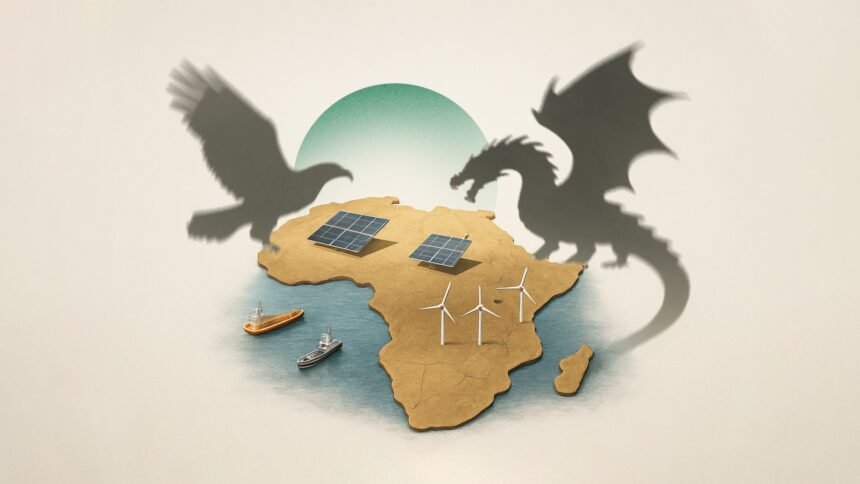
The Hidden Grammar of Global Imbalances
Beneath the spectacle of tariff announcements and retaliatory salvos lies a more profound truth: trade wars are never really about tariffs. As Michael Pettis has persistently argued, persistent trade surpluses in diversified economies are almost always the symptom of systematic internal distortions that transfer income from households to producers. China’s combination of financial repression, hukou restrictions, suppressed interest rates, and constrained labor bargaining power has for decades shifted an extraordinary share of GDP from consumption (barely 38 percent of GDP in 2024) to production and investment (over 43 percent). The inevitable counterpart is a current-account surplus that must be absorbed somewhere in the world.
That “somewhere” has increasingly become Africa.
When the United States responded with escalating tariffs—beginning in 2018 and surging again in 2025 under a second Trump administration—it did not merely raise the price of Chinese widgets. It disrupted the global recycling mechanism through which China’s suppressed domestic demand was transformed into surplus capital and cheap goods for the rest of the world. The result is a profound reorientation of economic gravity, and no continent feels the shifting tectonic plates more intensely than Africa.
Dragon’s Shadow, Eagle’s Retreat: The Great Rebalancing Act of 2025
By November 2025, the tariff landscape had hardened into something close to cold economic warfare. The United States imposed a blanket 10–20 percent tariff on nearly all imports, with selective spikes to 30–60 percent on goods from countries suspected of transshipping Chinese products. China retaliated asymmetrically—through currency management, export rebates, and the accelerated relocation of supply chains to third countries, with Africa as a prime destination.
The numbers tell a stark story. US goods trade with sub-Saharan Africa, which had grown modestly under AGOA, contracted by 18 percent in the first nine months of 2025. American FDI inflows, heavily concentrated in critical minerals, slowed from $8.1 billion in 2023 to an annualized $4.3 billion. Meanwhile, China-Africa trade reached an all-time high of $312 billion in the first ten months of 2025, with Chinese investment commitments under the September 2024 FOCAC exceeding $60 billion for the 2025–2027 cycle. The Belt and Road portfolio in Africa now stands at over $1 trillion in signed contracts, of which roughly 45 percent has been disbursed.
Africa, in short, is experiencing a dramatic substitution effect: as the US retreats behind tariff walls and aid cuts, China fills the vacuum with loans, factories, and markets.
The Energy Crucible: Cobalt, Copper, and the New Great Game
Nowhere is the substitution more dramatic than in the critical minerals and energy sector—the lifeblood of the green transition.
The Democratic Republic of Congo produces 75 percent of the world’s cobalt, and saw Chinese firms secure an additional 15 percent of new mining concessions in 2024–2025. Zambia, holder of 6 percent of global copper reserves, signed $4.8 billion worth of new Chinese processing and power agreements in the single year following the 2025 tariff escalation. By mid-2025, Chinese entities controlled 68 percent of Africa’s cobalt refining capacity and 61 percent of its copper smelting—a near-monopoly that the US Inflation Reduction Act’s “foreign entity of concern” clauses have rendered almost untouchable for Western buyers.
The consequences cascade. Spot cobalt prices, which spiked to $95,000 per tonne in 2022, collapsed to $34,000 by October 2025 as Chinese refiners stockpiled and diverted material away from US-aligned supply chains. Copper followed a similar trajectory. African producers face a brutal squeeze: lower dollar revenues at the exact moment debt service obligations—much of it owed to Chinese policy banks—are rising.
Tariff Ripples and the Collapse of Textile Dreams
Textiles and apparel, once the poster child of African industrialization under AGOA, have been among the hardest hit. Lesotho, Eswatini, Kenya, and Madagascar together exported $2.9 billion worth of clothing to the United States in 2023. By late 2025, effective US tariff rates on many lines had risen from 0 percent to 32 percent once transshipment rules were triggered. Factory closures began in Maseru and Nairobi before the end of the third quarter. Estimates suggest 110,000 direct jobs and 400,000 indirect jobs are at risk across the continent by mid-2026.
Chinese firms, facing their own tariff walls in the US and EU, have responded by accelerating relocation into African industrial zones. Duty-free access within the AfCFTA suddenly looks attractive compared to a 25 percent US tariff. Ethiopia’s Hawassa Industrial Park, 80 percent occupied by Chinese garment firms, is expanding again. The irony is bitter: the same superpower rivalry that is killing AGOA-based apparel exports is simultaneously breathing new life into Chinese-owned factories on African soil.
Currency Wars and the Silent Tax on African Households
China’s response to US tariffs has not been limited to physical relocation. Since early 2025, the People’s Bank of China has guided the renminbi lower in a controlled fashion—roughly 12 percent against the dollar in practical terms. Because most African currencies are directly or indirectly pegged to the dollar or the euro, this amounts to an across-the-board deterioration in the continent’s terms of trade.
Every imported Chinese solar panel, motorcycle, or bag of cement becomes cheaper in local currency terms, further eroding the competitiveness of nascent African manufacturers. At the same time, dollar-denominated debt service becomes more expensive in local currency. The result is a hidden transfer of income from African households and small businesses to Chinese exporters and creditors—a textbook Pettis-style distortion, only this time imposed from the outside.
Pan-African Awakening: From Battleground to Strategic Autonomy
Yet within this storm lies the seed of a historic opportunity.
The African Continental Free Trade Area, now fully operational in 48 countries, offers the first real possibility in decades of reorienting the continent’s economic geography away from radial, north-south dependence toward lateral, south-south integration. Intra-African trade, which accounted for only 18 percent of total trade in 2024, rose to 22 percent in the first half of 2025 as firms rerouted goods to avoid external tariffs.
The African Union has begun to wield this new reality as leverage. At the November 2025 China-Africa Cooperation Forum follow-up meeting in Addis Ababa, African negotiators extracted unprecedented concessions: a five-year moratorium on principal repayments for 22 highly indebted countries, local-content requirements of 40–60 percent in new mining projects, and the establishment of three regional battery precursor plants co-financed by China but with majority African ownership.
Simultaneously, the AU’s Minerals and Energy Strategy, adopted in February 2025, explicitly aims to retain 60 percent of the continent’s critical mineral value addition by 2035. The DRC and Zambia have announced a joint “Battery and Electric Vehicle Special Economic Zone” along their border, pointedly inviting European, American, and Korean investors alongside Chinese ones—on condition that refining and precursor production remain in Africa.
Toward an African Rebalancing
The core insight of the US-China economic war—that persistent imbalances are the result of deliberate internal choices about who gets what share of national income—applies with equal force to Africa itself.
For decades, many African economies have mirrored China’s model in miniature: low wages, repressed financial systems, and an export bias that transfers income from households to elites and foreign investors. The current crisis lays bare the cost of that model. The path forward lies in the opposite direction: higher wage shares, progressive taxation, expanded social protection, and deliberate policies to boost household consumption as a share of GDP.
Countries that begin this rebalancing—Rwanda, Morocco, and Côte d’Ivoire—are already moving in this direction and will discover that a larger domestic market is the most powerful shield against external shocks. When African households consume more of what Africa produces, the continent becomes less dependent on the fickle demand of distant superpowers and less vulnerable to their wars.
The eclipse of US-China economic hegemony over Africa is not a tragedy; it is a revelation. In the shadow cast by warring giants, the continent is being forced to look inward and southward—to build the roads, grids, factories, and institutions that will one day make the eagle and the dragon equally irrelevant.
The age of being a pawn is ending. The age of becoming a power, on Africa’s own terms, is just beginning.