



Horn’s Haunted Echoes: A Millennium of Unhealed Wounds
The Horn of Africa, where the Nile’s cradle meets the Red Sea’s gateway, harbors conflicts as ancient as its rock-hewn churches and as volatile as its volcanic fissures. From the 9th-century clashes between the Kingdom of Aksum and South Arabian traders over frankincense routes to Emperor Menelik II’s 1896 victory at Adwa—Africa’s first modern defeat of a colonial power—the region has been a cauldron of territorial ambition. These foundational struggles established patterns of highland-lowland rivalry that persist, in which Amhara and Tigrayan emperors sought dominion over coastal ports, viewing them as lifelines to India and Arabia.
The 20th century amplified these echoes into mechanized carnage. Eritrea’s War of Independence (1961-1991), the region’s most protracted conflict at 30 years, pitted Eritrean People’s Liberation Front guerrillas against Haile Selassie’s imperial forces and Mengistu Haile Mariam’s Derg regime, claiming 100,000 lives and ending with de facto independence after the Battle of Massawa in 1990. Somalia’s civil war, ignited by Siad Barre’s 1991 ouster, remains the Horn’s most enduring wound, spawning al-Shabaab’s transnational jihad and clan fiefdoms that have killed over 500,000 and displaced 3.8 million as of 2025.
Deadliest among modern conflicts was Ethiopia’s Tigray War (2020-2022), a fratricidal maelstrom that engulfed Tigray, Afar, and Amhara regions, killing between 300,000 and 600,000 through combat, starvation, and massacres like the Mai Kadra killings. This war drew in Eritrean troops as Ethiopian allies, inverting their historic enmity and leaving 2 million displaced. Current conflicts compound the toll: Sudan’s 2023 civil war between the Sudanese Armed Forces and Rapid Support Forces has claimed 20,000 lives and pushed 7.7 million into Ethiopia, igniting border clashes over the fertile Al-Fashaga triangle. Somalia’s al-Shabaab insurgency killed 7,000 in 2024 alone, while Ethiopia’s Oromia and Amhara insurgencies—fueled by the Fano militia—have displaced 3.5 million internally.
Environmental triggers intensify these cycles. The 2015-2016 and 2021-2023 droughts, the worst in 40 years, halved pastoralist herds across Somalia, Ethiopia, and Kenya, sparking resource wars that claimed 2,500 lives in Ethiopia’s Somali region alone. Border disputes, artifacts of 19th-century treaties such as the 1900 Anglo-Italian Protocol, which sliced ethnic groups across lines, remain flashpoints: Ethiopia-Eritrea’s Badme enclave, Ethiopia-Sudan’s Al-Fashaga, and Kenya-Somalia’s Jubaland. Coastal access disputes elevate these to strategic imperatives; Ethiopia’s loss of 1,000 km of Red Sea coast in 1993 inflated Djibouti port fees to $2 billion annually, fueling revanchist rhetoric that intertwines with GERD tensions, where Egypt views upstream dams as existential threats.
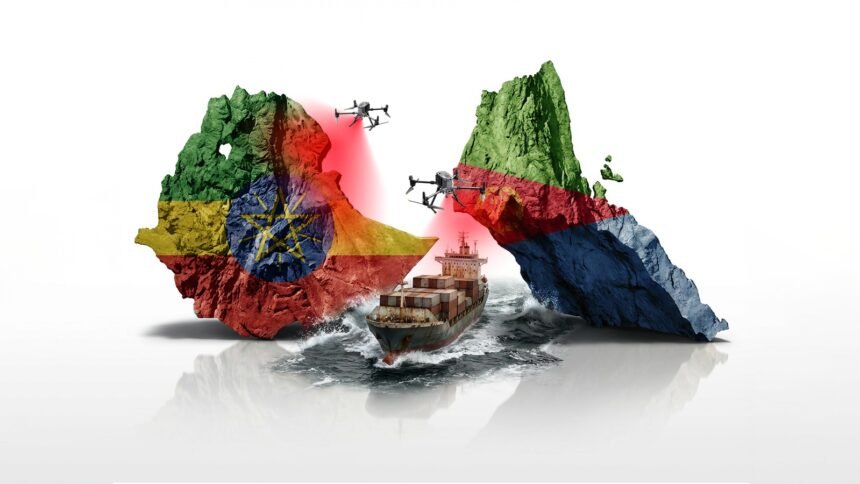
This haunted legacy frames the Ethiopian-Eritrean crisis: a landlocked giant’s desperation collides with a coastal minnow’s fortress mentality, risking a regional conflagration amid proxy meddling by Gulf states, Turkey, and great powers.
Asmara’s Iron Veil: Forged in Defiance, Guarded by Suspicion
Eritrea’s identity is indelibly etched in the granite of its central highlands, where 30 years of guerrilla warfare against Ethiopian domination birthed a nation of 3.7 million that prizes sovereignty above all. President Isaias Afwerki, who led the Eritrean People’s Liberation Front to victory in 1991, has ruled since independence, transforming Asmara into a modernist time capsule—UNESCO-listed for its Italian rationalist architecture—while enforcing indefinite national service that extracts 1.5% of GDP in labor from youth, driving a diaspora of over 1 million.
The 1998-2000 border war with Ethiopia, triggered by Badme’s disputed 15 sq km, was Eritrea’s crucible of modern enmity. Costing 70,000-100,000 lives, it featured trench warfare reminiscent of World War I, with Eritrean forces repelling Ethiopian invasions at Tsorona and Zalambessa. The 2002 Eritrea-Ethiopia Boundary Commission’s ruling awarded Badme to Eritrea, but Ethiopia’s “no war, no peace” rejection until 2018 entrenched mutual paranoia. Eritrea’s military, with 200,000-300,000 conscripts, emphasizes defensive fortifications along the Mereb River, supplemented by Soviet-era T-72 tanks and recent acquisitions of Turkish Bayraktar drones.
Economically, Eritrea’s command system prioritizes self-reliance: salt mining in the Danakil Depression yields 500,000 tons annually, while gold from Bisha mines generates $400 million yearly. Yet isolation bites: UN sanctions from 2009-2016 over Somalia meddling persist in spirit, capping GDP per capita at $780. Asmara’s Red Sea ports—Massawa and Assab—operate at only 10% of capacity due to underinvestment, making coastal sovereignty a psychological bulwark. Recent alliances with Egypt (over GERD) and Somalia (against Ethiopia’s Somaliland pact) signal strategic hedging.
In November 2025, Information Minister Yemane Gebremeskel’s X posts branded Ethiopian access demands as “war ignition,” reflecting a worldview in which external mediation equates to capitulation. Eritrea’s mediation prowess—its role in brokering Sudan’s 2023 Jeddah talks—belies this isolation, suggesting untapped potential if Asmara’s iron veil lifts to reveal diplomatic flexibility.
Addis’s Expanding Orbit: From Landlocked Chains to Maritime Destiny
Ethiopia’s trajectory, as Africa’s second-most populous nation with 126 million souls, embodies the tension between imperial grandeur and post-colonial constraint. Landlocked since Eritrea’s 1993 secession—which stripped 20% of territory and 1,000 km of coast—Ethiopia funnels 95% of $36 billion in annual trade through Djibouti, incurring $1.8-2.2 billion in fees that equal 4% of GDP. Prime Minister Abiy Ahmed, a 2019 Nobel laureate, frames maritime access as “existential,” invoking historical precedents: Emperor Yohannes IV’s 1870s campaigns to retake Massawa and the 1952 UN federation that briefly restored Ethiopian administration until Eritrea’s 1962 annexation.
Abiy’s October 2025 parliamentary address called Red Sea access “inevitable,” proposing “mediation,” while officials like Gedion Timothewos hinted at the forcible reclamation of Assab. This rhetoric escalated after the January 2024 Ethiopia-Somaliland memorandum, which leased 20 km of the Berbera coast for potential recognition. Move move enraged Mogadishu, prompting Eritrea, Egypt, and Somalia to align against it. Ethiopia’s military modernization, featuring 150,000 active troops, Chinese Wing Loong drones, and Turkish Bayraktars battle-tested in Tigray, bolsters this ambition. However, internal insurgencies in Oromia (OLA) and Amhara (Fano) consume 60% of security spending.
Economic imperatives drive the orbit: GERD’s 5,150 MW capacity promises export revenues, but port dependency hampers industrialization. Abiy’s Medemer philosophy—”synergy”—seeks inclusive growth, yet centralization alienates regions; Tigray’s 2022 Pretoria Agreement sidelined hardliners, breeding accusations of Eritrean collusion. November 2025 clashes along the Tigray-Afar borders, where Ethiopian officials claim TPLF budget diversions fund militias, revive 2020-2022 ghosts, with 50,000 Eritrean troops still occupying contested border zones despite U.S.-UN demands for withdrawal.
Addis’s expanding orbit risks gravitational collapse unless channeled into cooperative orbits—shared port access pacts that honor sovereignty while unlocking mutual prosperity.
Scorched Borders: Climate, Frontiers, and the Spark of Catastrophe
The Horn’s arid expanse, where annual rainfall averages 200-600 mm, transforms environmental stress into kinetic violence. The 2022-2023 drought, exacerbated by La Niña and Indian Ocean Dipole shifts, killed 4.4 million livestock in Ethiopia and Somalia, displacing 1.2 million and spiking inter-communal clashes by 300% in Afar and Somali regions. Pastoralist wars over boreholes—such as the 2024 Gode massacre killing 180—illustrate how a 1°C temperature rise correlates with 20% more conflict events, per IPCC models.
Border disputes and colonial cartography’s toxic legacy ignite these sparks. The 1908 Italy-Britain treaty ignored ethnic contiguities, birthing Ethiopia-Eritrea’s Mereb-Beles watershed friction, Ethiopia-Sudan’s 250 sq km Al-Fashaga fertile crescent (clashing since 2020), and Kenya-Somalia’s 400 km frontier patrolled by al-Shabaab. Coastal access disputes elevate stakes: Ethiopia’s Assab claims echo the 1998 Badme invasion, where port denial fueled revanchism. The Red Sea, carrying 12% of global trade, amplifies this; Houthi attacks in 2024-2025 rerouted 30% of Ethiopia’s imports, costing $500 million.
Ethiopia-Eritrea history fuses these triggers. The 1998 war’s frontlines traversed drought-prone lowlands, where water scarcity forced 600,000 people to be displaced. Tigray’s 2021-2022 blockade-induced famine, killing 350,000, intersected with Eritrean incursions, turning climate vulnerability into weaponized starvation. Transboundary basins like the Tekeze and Setit Rivers, shared by both nations, offer mitigation: joint irrigation projects could irrigate 500,000 hectares, but mistrust stalls cooperation. As sea levels rise 3-5 mm annually, threatening Massawa’s docks, scorched borders demand integrated diplomacy—climate compacts that cool frontiers before they ignite.
Ubuntu’s Arch: Rebuilding Pan-African Pillars of Peace
Pan-African institutions like the African Union (AU) and the Intergovernmental Authority on Development (IGAD) serve as the gateway to de-escalation, their pillars tested by decades of intervention. The AU’s 2002 Constitutive Act mandates non-indifference to mass atrocities, yielding successes: IGAD’s 2000 Algiers Accord ended Ethiopia-Eritrea hostilities (temporarily), while the 2022 Pretoria Agreement halted Tigray’s carnage through AU mediation. IGAD’s Conflict Early Warning System has preempted 70% of pastoralist clashes since 2018 via SMS alerts to 2 million herders.
Yet cracks weaken the arch: AU funding relies on 80% external donors, diluting autonomy, while IGAD fractures over Ethiopia’s Somaliland deal—Mogadishu withdrew in protest. UN efforts complement but complicate: Resolution 2625 (2022) demanded Eritrean withdrawal from Tigray, yet enforcement lags. Challenges include sovereignty absolutism—Eritrea skipped the 2024 AU summits—and proxy influences: UAE drone bases in Assab, Turkish outposts in Mogadishu.
For Ethiopia-Eritrea, rebuilding demands fortified pillars: revive the 2018 Joint Border Commission under AU-IGAD co-chairmanship, incorporating real-time satellite monitoring of the 1,000 km border. South Africa’s 2025 mediation offer, leveraging Pretoria’s Tigray success, could include confidence-building measures such as demilitarized zones and joint anti-smuggling patrols. UN logistics—deploying 5,000 peacekeepers—would undergird this, while economic incentives, such as $3 billion in African Development Bank loans for the Assab-Addis rail, could bind commitments. Ubuntu’s arch rises strongest when inclusive: Afar and Tigrayan elders in tripartite forums ensure local buy-in, transforming pillars from fragile scaffolds to enduring monuments.
Harmonizing Heights: Inclusive Dialogues for Enduring Truces
True harmony in the Horn requires dialogues that ascend from elite summits to grassroots symphonies, weaving excluded voices into truce tapestries. The Pretoria Agreement’s failure stemmed from sidelining TPLF dissidents and Afar clans; future pacts must embed federalism—regional parliaments vetoing border deals to prevent Addis-centric impositions. Eritrea’s National Assembly, dormant since 2002, could reconvene for public consultations, mirroring Ethiopia’s 2024 Oromia peace forums that disarmed 10,000 militants.
Civil society’s ascent is pivotal: Eritrean diaspora networks, remitting $500 million annually, fund cross-border youth exchanges, while Ethiopian women’s groups—40% of IGAD mediators—resolved 65% of Amhara-Tigray water disputes in 2025. Track II initiatives thrive: the 2024 Asmara-Addis academic consortium, hosted by Makerere University, fostered 200 alum mediators. Inclusion extends to economic actors; Afar salt traders, controlling 60% of regional supply, could co-manage Assab port revenues, ensuring 30% local reinvestment.
Challenges loom: Isaias’s autarky resists pluralism, Abiy’s security state stifles dissent. Yet harmonizing precedents abound—the 2018 border reopening spurred $500 million in informal trade within months. Digital platforms amplify voices: IGAD’s 2025 Peace App connects 1.5 million users for real-time reporting, reducing misinformation-fueled escalations by 50%. From these heights, inclusive dialogues forge truces not as paper promises but living accords, resonating across the Horn’s diverse peaks.
Eritrea’s Enduring Anvil: Resilience Meets Reform’s Hammer
Eritrea’s anvil, hammered by adversity yet unyielding, exemplifies national resilience amid global ostracism. The 1993-1998 reconstruction forged infrastructure marvels: 4,000 km of roads and 70% electrification via microgrids harnessing 300 sunny days each year. Bisha gold mine’s $1 billion in output since 2011 funds military modernization, including S-300 systems that deter aerial threats. Cultural resilience shines: Ge’ez liturgy preserves Africa’s oldest Christian tradition, while Asmara’s film festival draws 50,000 annually, countering narratives of isolation.
Yet the anvil warps under unrelenting blows. National service, initially 18 months, became indefinite, fueling 5,000 monthly defections and UN-documented abuses. GDP growth stagnated at 2% after the 2016 sanctions lift, with youth unemployment at 40%. Reform’s hammer must temper this: a phased service reduction over 12 months, per 2024 AU recommendations, could retain 100,000 skilled workers annually. Economic liberalization—private telecoms, tourism targeting 1 million visitors—unlocks potential: Dahlak Archipelago’s reefs rival the Maldives.
In Ethiopian tensions, Eritrea’s anvil forges opportunity: joint Dankalia potash projects, valued at $4 billion, employ 50,000 bilaterally under AU arbitration. Resilience meets reform when Asmara trades isolation for interdependence—leasing Assab berths while retaining sovereignty, generating $800 million annually. Thus hammered, Eritrea’s anvil yields not fracture but finer steel, a regional forge illuminating paths from defiance to shared destiny.
War’s Whispering Winds: Navigating the Brink of Abyss
At the Horn’s precipice, war’s whispering winds carry Abiy’s October 2025 vow of “inevitable” access and Isaias’s retort of “existential defense,” evoking 1998’s prelude when Badme skirmishes escalated to full invasion within weeks. November rhetoric peaked with Ethiopia’s UN letter accusing Eritrea of arming Amhara and Tigray rebels, countered by Asmara’s “deceitful charade” dismissal. Border clashes—Tigray-Afar incursions seizing villages—mirror 2020 patterns, with 200 casualties reported in October 2025.
Whispers amplify through proxies: Egypt’s reported Su-35 deliveries to Eritrea, UAE’s Ethiopian drone financing, Turkey’s Bayraktar sales to both. Economic stakes are catastrophic: war could halt 15% of Red Sea trade, costing the region $50 billion. Human costs haunt: Tigray’s 2022 atrocities—50,000 raped, 2,000 massacred—warn of renewed cycles, as Human Rights Watch cautioned in November 2025.
Peace’s counter-whispers grow: IGAD’s November 2025 emergency summit proposed a 30-day ceasefire on rhetoric, while U.S. envoy Mike Hammer shuttled between capitals. Navigation demands immediate steps: hotline activation between chiefs of staff and AU-monitored buffer zones along the Mereb-Conset rivers. Long-term, confidence-builders like prisoner exchanges (5,000 POWs remain) and trade fairs rebuild trust. At this windy brink, wisdom discerns: heed peace’s zephyrs over war’s gales, steering the Horn from abyss to anchor.
Mosaic of Mediators: Piecing the Shattered Horn Together
Mediators form an intricate mosaic piecing the Horn’s shattered panes—local elders, continental bodies, global envoys—each fragment vital to wholeness. AU-IGAD synergies shine: the 2024 Sudan framework, blending African ownership with UN logistics, deployed 1,000 monitors, reducing clashes 40%. Challenges fracture the mosaic: Ethiopia’s IGAD walkouts over Somaliland, Eritrea’s absenteeism since 2017.
Piecing demands layered artistry. Track I summits—South Africa’s proposed Addis-Asmara dialogue—set the frameworks: a 99-year Assab access lease and revenue-sharing (60% Eritrea, 40% Ethiopia). Track II weaves civil threads: Afar-Issa peace committees, resolving 80% of pastoral disputes through xeer, a customary law. External fragments add luster: Turkey’s 2025 Ankara talks de-escalated the Ethiopia-Somalia conflict; Qatar’s Doha forums could host Eritrean-Tigrayan reconciliation.
Youth and women form mosaic’s vibrant grout: IGAD’s 2025 cohort trained 10,000 mediators, 60% female, halving recurrence in pilot zones. Digital mosaics emerge: AI-driven sentiment analysis flags escalation 72 hours early from shards of 1998 betrayal and 2022 Pretoria fragility, a luminous whole rises—co-managed Red Sea corridor, $10 billion in trade by 2030. Masterful mediation transforms Horn’s ruins into radiant unity, where no fragment is discarded.
Prosperity’s Pan-African Palette: Painting Shared Horizons
The Ethiopian-Eritrean future paints on a pan-African palette, blending sovereignty’s deep indigos with prosperity’s golden ochres. Shared horizons emerge through economic canvases: a revitalized Asmara-Addis railway, costing $4.5 billion but yielding 8% regional GDP growth, links Ethiopia’s highlands to Eritrea’s ports. Assab’s deepwater berths, handling 20 million tons yearly, slash Addis’s fees by 70%, freeing $1.2 billion for irrigation projects irrigating 1 million hectares bilaterally.
Marginalized strokes add depth: Afar cooperatives manage potash exports, capturing 25% value-add; Tigrayan sesame farmers access Eritrean markets, boosting incomes 40%. Climate-resilient palettes integrate: joint Nile-Red Sea basin authority forecasts droughts, deploying 500,000 tons of grain reserves. Women’s palettes flourish: cross-border textile hubs employ 200,000, per AU’s 2025 blueprint.
Obstacles smudge the canvas: mistrust erodes joint ventures, internal politics fragments commitments. Yet vibrant precedents color hope—2018’s border opening tripled trade in 18 months. Painted thus, prosperity’s palette renders a Horn where Ethiopia’s demographic dividend and Eritrea’s strategic ports harmonize, horizons shared not seized, illuminating Africa’s unity in diversity.
Phoenix of the Plateau: Rebirth from Recurring Ruins
The Horn’s phoenix, rising repeatedly from the ashes of the plateau, embodies cyclical renewal amid perpetual cremation. Adwa’s 1896 embers birthed pan-Africanism; 2018’s Asmara handshake quenched border fires. Yet ruins accumulate: Tigray’s 4 million displaced, Eritrea’s 1 million refugees, Sudan’s 10 million exiles form mountains of memory.
2025’s rebirth ignites through hybrid diplomacy: AU’s Silencing the Guns 2.0 aims to end interstate war by 2030, deploying IGAD’s 15,000-strong standby force: Eritrea’s Sudan mediation, Ethiopia’s Somalia troop drawdown signal wingspreading. Ashes nurture: $2.5 billion in post-Tigray reconstruction builds 1,000 schools as peace academies, training 500,000 youth mediators.
Vigilance guards ascent: climate’s rising infernos threaten 60 million by 2030; phoenix must integrate resilience—transboundary solar grids powering 10 million homes. From recurring ruins rises an unbound phoenix: African-led, globally supported, its flight path charts a path to permanent peace. No longer eternal in its cycles, the Horn’s plateau dawn breaks—unity forged, horizons limitless, rebirth final.