



Casbah Daughters: The Long Arc of Maghrebi Women’s Defiance
Across the sun-bleached Maghrib, from the Rif mountains to the Libyan desert, women have carried rebellion in their voices for centuries. Long before microphones and cameras arrived, Berber queen Dihya al-Kahina rallied tribes against the seventh-century Arab conquest, dying with a sword in hand rather than veiled in submission. In the ninth century, Fatima al-Fihri founded al-Qarawiyyin in Fez — still the world’s oldest degree-granting university — proving that Maghrebi women could build institutions as enduring as any caliph’s palace. Centuries later, Lalla Fatma N’Soumer led mountain guerrillas against French colonial troops in Kabylia, earning the title “the Jeanne d’Arc of Djurdjura” before dying in captivity.
The twentieth century sharpened the struggle. Algerian moudjahidates smuggled bombs in market baskets during the 1954–1962 War of Liberation; Tunisian schoolteacher Habiba Menchari defied conservative clerics to demand girls’ education; Moroccan poet Malika el-Fassi signed the 1944 Independence Manifesto while wearing the hijab as armour, not a shackle. Independence brought new chains: secular dictators promised modernity but jailed feminists; Islamist movements promised purity but hunted singers and journalists. In the 1990s, the Algerian civil war alone, more than two hundred thousand people died, and thousands of women were targeted for daring to teach, heal, drive, or perform. Yet the women stayed, or returned, or sang louder.
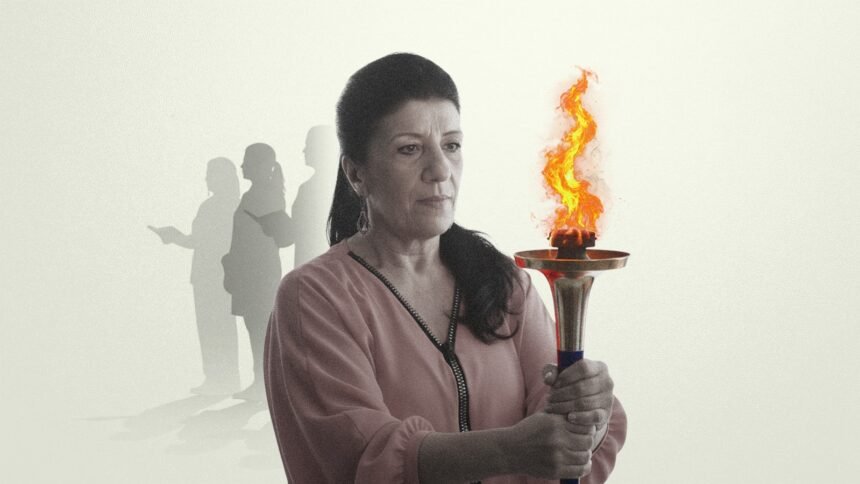
Some are gone: Cheikha Rimitti, raï’s grandmother, who scandalised the pious with lyrics about sex, wine, and poverty; Warda al-Jazairia, whose velvet voice carried the pain of exile; Habiba Msika, the Tunisian-Jewish cabaret star murdered in 1930 for loving too freely. Others still walk among us: Souad Massi, whose guitar weeps for the disappeared; Ghalia Ben Ali, keeper of Tunisia’s malouf tradition; the young Moroccan rapper Khtek, spitting bars against harassment and hypocrisy. Each generation passes the torch through cracked loudspeakers, pirate cassettes, and now viral TikToks — the same message wrapped in new beats: we will not be silenced.
From Belcourt With Fury: The Making of Baya Bouzar
Baya Bouzar — Biyouna — was born on 13 September 1952 in the working-class warren of Belcourt, Algiers, the same streets that once sheltered a young Albert Camus. Her mother sold tickets at a cinema that showed Egyptian musicals; her father worked nights in smoky cabarets. As a child, she sneaked past the usher to watch Umm Kulthum and Farid al-Atrache, then danced in the living room until neighbours banged on the walls. “My grandmother swore I had a genie in my soul,” she laughed decades later.
At fifteen, she was already tambourine in hand with Fadhéla Dziria’s legendary all-female orchestra, singing hawzi and aroubi at weddings where women could finally let their hair down. In 1972, barely twenty, director Mustapha Badie cast her as Fatma in the television epic Al Hariq (The Fire), a socialist-realist retelling of colonial hunger and resistance. Overnight, she became “Fatma of the people” — the loud, rude, unbreakable neighbour every Algerian recognised from their own building. On the single-state channel, she was the only face that looked and sounded exactly like home.
Black Decade, Unbroken Voice
When civil war erupted after the army cancelled the 1991 elections, Algeria became a slaughterhouse. The Armed Islamic Group (GIA) issued death lists that read like a cultural Who’s Who. Singers were shot in their cars, journalists beheaded on camera, and actresses threatened for showing a lock of hair. Most artists fled to France. Biyouna stopped performing between 1994 and 1996. Threatened, she spent two months in Oran with her mother-in-law. “I lasted eight weeks,” she later shrugged. “I prefer the terrorists.”
She went back to Algiers, back to the markets, back to the microphone. Neighbours would see her pushing a shopping bag through streets where patrols feared to walk and beg, “Biyouna, inti machia, walli?” — You’re not leaving, are you? She never did. That choice — to remain when remaining could kill you — made her more than an entertainer. She became a living refusal.
Cinema as Weapon: Moknèche, Meriem, Papicha
Franco-Algerian director Nadir Moknèche understood what she carried. In Le Harem de Mme Osmane (2000), she played Meriem, a landlady who hid runaway wives at the exact moment the civil war began — a role she said only she could play because she had lived every minute of it. In Viva Laldjérie (2004), she was Fifi, the ex-cabaret dancer turned smuggler and avenger, dancing one last time on a rooftop while the city burned below. In Délice Paloma (2007), she ran an underground network of prostitutes and fixers with the weary grin of someone who had seen every hypocrisy twice.
Across the Mediterranean, French audiences discovered her in the television series Aïcha, where her explosive insult — “Pouffiasse! I’m more Algerian than you!” hurled at Isabelle Adjani — became a meme of immigrant pride. The line was improvised, of course. Everything Biyouna did felt improvised, inevitable, true.
Raï, Chaâbi, Hawzi: A Throat Full of Casbah
Her voice was gravel and honey, the sound of Algiers at 3 a.m. — taxi horns, lovers quarrelling under streetlamps, mothers shouting from balconies. She recorded raï standards with Cheikha Rimitti, revived forgotten hawzi pearls, and turned Paris one-woman shows into riotous therapy sessions. Blonde dans la Casbah, her 2001 album, was a love letter to the city that both cradled and tried to choke her. On stage, she insulted presidents, mullahs, and bad lovers with perfect comic timing, then slipped into a melancholy melody that could stop a room cold.
Floods, Breakdowns, Rebirths
Life hit hard. In 2001, catastrophic floods destroyed her Bab el-Oued apartment; tabloids reported a suicide attempt. She brushed it off: “Me and shrinks? If I lie on his couch, he’ll be the one needing therapy.” She rebuilt, remarried (her fourth husband, Mokhtar Bouchaala), kept singing, kept laughing, kept refusing to play the tragic victim.
The Final Curtain, The Endless Echo
On 25 November 2025, lung cancer finally closed the mouth that no regime, no terrorist, no disaster had managed to silence. President Tebboune praised her “sincerity and spontaneity.” Hundreds accompanied her coffin through the same Belcourt streets that formed her. Director Bachir Derraïs spoke for a nation: “You brought joy where joy was forbidden, light where they wanted only darkness.”
To the girls recording protest songs on their phones in Algiers, Casablanca, Tunis, and Tripoli, Biyouna left one instruction, delivered in her unmistakable rasp: “No one shuts my mouth because it’s in my blood. I was born free, and I will die free.”
In the Maghrib, where women have always had to fight twice — once for the nation, once for themselves — Biyouna’s fire still burns. Listen closely on any summer night, and you can hear it in the laughter that refuses to lower its voice, in the tambourine that will not stop, in the Casbah daughter who insists, against every threat ever issued, on dancing in the living room until the walls themselves surrender.