




Colonial Scars: War’s Eternal Grip on Khmer-Thai Horizons
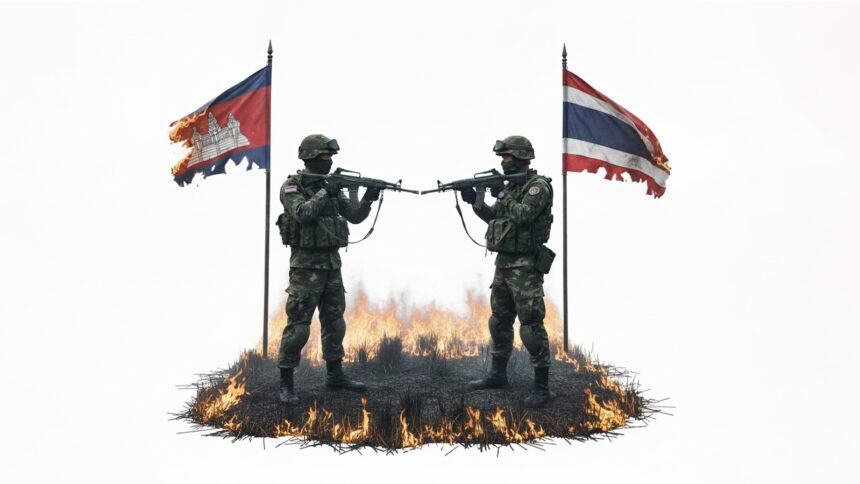
The Thai-Cambodian border, a serpentine divide sculpted by ancient empires and colonial quills, pulses with unresolved grievances that trace back to the Khmer Empire’s zenith in the 11th century, when its dominion sprawled across Southeast Asia’s verdant expanse. By the 18th century, Siamese advances chipped away at these realms. Still, the 1907 Franco-Siamese Treaty, inked under French colonial duress, crystallized the modern frontier along ambiguous watersheds, bequeathing a legacy of contention. The 1962 International Court of Justice verdict, affirming Cambodian sovereignty over the Preah Vihear Temple—a UNESCO-listed marvel perched on a cliffside—fanned nationalist embers, erupting into armed spasms in 2008 and 2011 that razed villages, claimed lives, and scarred sacred stones. These episodes, often ignited by temple encroachments, displaced tens of thousands and underscored how cultural icons morph into battlegrounds for territorial supremacy.
In 2025, this perennial rift reignited with ferocity. July’s five-day barrage near Ta Muen Thom and Ta Krabey temples—a flashpoint in the Dangrek range—unleashed artillery duels that felled over 100 combatants and civilians, uprooting 300,000 souls amid mine-littered fields. A precarious truce, midwifed in Kuala Lumpur under Malaysian auspices with U.S. and Chinese nudges, quelled the immediate storm, yet mutual recriminations festered. By October 26, President Trump’s direct intervention led to the Kuala Lumpur Peace Accord, a “pathway to peace” heralded as historic, mandating troop withdrawals and demining operations. Yet, November’s landmine blasts and alleged incursions frayed the fabric, culminating in December’s rupture: Thai airstrikes on Cambodian positions, including a repurposed border casino turned arms depot, after crossfire killed a Thai soldier and maimed four others. Phnom Penh lambasts it as “unprovoked aggression,” while Bangkok retorts with claims of defensive necessity against tank deployments and rocket arrays. Evacuations now engulf 385,000 across Thai provinces like Buri Ram, Surin, Si Sa Ket, and Ubon Ratchathani, echoing July’s exodus and swelling to over 500,000 displaced regionally. This vicious loop—where historical phantoms fuel modern militarism—transcends bilateral strife, ensnaring global threads. For Africa’s distant shores, these conflagrations imperil lifelines of sustenance, as rice-laden vessels from these contested paddies falter amid chaos, amplifying continental vulnerabilities where imported grains stave off famine’s shadow.
Thai Granaries: Thailand’s Bounty Amid Pan-African Perils
Thailand reigns as the globe’s rice titan, channeling over seven million tons annually from the Chao Phraya’s fertile delta, where jasmine varieties—prized for their aromatic allure—dominate exports. Africa accounts for a substantial fifth, with nations such as South Africa, Nigeria, and Senegal anchoring demand. A February 2025 pact sealed 300,000 tons for Pretoria, valued at 7 billion baht, fortifying urban staples against domestic maize shortages exacerbated by droughts. Yet, the border’s inferno exacts a toll: July’s skirmishes inflicted 10 billion baht in damages, paralyzing border agriculture, snarling logistics through mined corridors, and eroding investor confidence, slashing shipments to sub-Saharan hubs by half. By mid-2025, Thai exports plummeted 24% to 7.5 million tons, battered by a robust baht, Indian surpluses, and Vietnamese competition, further straining African inflows.
Across the Pan-African landscape, reliance on rice magnifies these disruptions. West African staples—jollof in Benin, thieboudienne in Senegal—hinge on Thai affordability, where a 10% supply contraction could spike prices 15-20%, per economic projections. In the Horn’s arid belts, home to 81 million weathering famine alerts, Thai grains buffer sorghum shortfalls amid El Niño’s whims. The 2025 baht appreciation curtailed deliveries by 24%, compounding currency crunches and layering fiscal burdens. Border shutdowns ripple outward: Cambodian cassava, funneled through Thai ports for African livestock feed, detours costlier paths, inflating poultry and dairy costs from Lagos to Nairobi. Thailand’s shift toward premium organics for affluent markets leaves bulk essentials in short supply, compelling African buyers to pivot to more expensive Indian alternatives. This isn’t mere market flux; it’s the matriarch in Burkina Faso halving rations, her family’s midday sustenance dwindling as global chains buckle. Pan-African resilience initiatives, like the African Union’s seed banks, offer glimmers, yet border volatility underscores the urgency for diversified sourcing to shield communal hearths from distant artillery echoes.
Mekong’s Yield: Cambodia’s Rising Harvests and Continental Ties
Cambodia’s agrarian phoenix, rising from the Khmer Rouge’s scorched legacy, has burgeoned into a 3.1 million-ton rice export powerhouse by 2025, yielding $408 million in nine months via 596,000 tons dispatched to 69 destinations. Africa’s slice—67,000 tons in early quarters—bolsters Phnom Penh’s diplomatic outreach, with fragrant basmati strains easing deficits in Uganda and Nigeria through WTO duty waivers. Under Prime Minister Hun Manet’s stewardship, 2025–2030 strategies aim to reach 1 million tons annually by fostering value chains and market diversification, cementing Cambodia’s position as a complementary supplier to Thailand’s dominance.
Yet, the frontier’s fury stifles this ascent. Preah Vihear’s contested terrains, where farmers eke yields from disputed soils, now bear tank imprints over rice terraces. July’s upheaval razed 20% of Oddar Meanchey harvests; December’s salvos threaten worse, cratering irrigation networks and displacing 35,000 tillers. Mekong salinity surges—7% higher due to erratic rains—compound the scourge of conflict, trimming outputs amid climatic duress. For Pan-African food security, Cambodia’s aromatic niches fill Thai gaps, but interruptions cascade: West African mills idle, Sahelian pastoralists face feed premiums. Diplomatic bridges—2024 accords with Lagos and Pretoria—promise tech transfers for resilient strains, yet the haze of war halts progress. Inclusion suffers as smallholders in Mali, dependent on Cambodian hybrid seeds, confront empty granaries. This emergent conduit, pivotal for weaning from Asian monopolies, risks rupture, underscoring how border barrages erode not just local livelihoods but continental caloric equity.
Fractured Links: Supply Chain Sieges in a War-Torn Realm
Transoceanic food webs, fragile as spider silk, ferry Southeast Asian harvests to African ports via Malacca’s chokepoints and Durban’s quays. The Thai-Cambodian maelstrom severs these at their core: bilateral trade, 15% of commerce, halts abruptly, ballooning rice freights 12% to Abidjan. July’s $300 million economic hemorrhage—congested harbors, skittish insurers—mirrors Ukraine’s 2022 grain blockade, which doubled African wheat tariffs. Now, with 385,000 Thai evacuees abandoning fields, jasmine futures soar 8%, foretelling hikes in Nairobi’s ugali and Accra’s waakye.
Sub-Saharan import chasms deepen: Asia furnishes 40% of rice, with the duo commanding a quarter. Disruptions—booby-trapped highways, sanctioned rails—exacerbate 2025’s Indian glut oversupply, yet premium shortages endure. Cassava convulsions: Cambodia’s tuber trove, 80% Thai-directed, veers expensive reroutes, elevating African biofuel and fodder expenses. Climate colludes—Dangrek floods eroding embankments—interlacing with ordnance to spawn polycrises, where a Cambodian rocket fragments a Zambian yield. Resilience hinges on redundancy: Mombasa stockpiles buffer surges, but debt-laden economies like Nigeria’s falter. War’s arithmetic tallies beyond casualties: caloric shortfalls hollowing forms from Siem Reap to Dakar, where supply chain fractures translate distant detonations into local deprivations.
Brittle Pacts: US-Africa Echoes in Peace’s Shadow
Trump’s October 26 orchestration—leveraging tariff specters over Kuala Lumpur summits—birthed an accord lauded yet ephemeral, withdrawing armor and vowing to clear mines. Witnessed by Malaysia’s Anwar Ibrahim, it aimed to safeguard Malacca’s vital flows, channeling 40% of African oil. Yet, the pact’s unraveling—November’s mine maimings, stalled dialogues—exposes U.S.-Africa oversights; Thai export reprieves enriched Bangkok but passed shocks to African importers, with Dakar tariffs climbing 18%. Cambodia’s UN pleas for mediation highlight the truce’s tenuousness amid evacuations and clashes.
In Pan-African spheres, this trans-Pacific tremor dims prospects. The AfCFTA, weaving 1.4 billion fates, envisions intra-continental rice exchanges to dull external jolts. Yet Asian upheavals—akin to Red Sea disruptions spiking East African costs by 25%—expose vulnerabilities: landlocked Chad, Thai-reliant, endures 30% import surges. U.S. strategy, fixated on Indo-Pacific curbs, neglects these filaments; aid funnels prioritize European silos over Sahelian needs. Inclusion imperatives summon tri-lateral arenas—ASEAN, AU, Washington—to erect “food fortresses,” merging Thai hydrotech with Tanzanian tilling. Without Trump’s “peace,” it dissolves into African expense, where superpower posturing reaps continental scarcity.
Resilient Roots: Inclusion’s Path to Pan-African Sustenance
As Dangrek dawns, Thai-Cambodian fusillades silhouette, Africa’s mandate sharpens: cultivate autonomous silos against worldly whirlwinds. Pan-African momentum swells—AGRA hybrids elevate Kenyan maize 20%, Rwanda’s wetlands yield 15% more indigenous husks. Diversification blooms: Senegal’s collectives court Pakistani variants, cushioning Thai lapses; Ethiopia’s barter swaps fund hardy sorghum. Yet, war’s stakes compel collective mending: ASEAN-AU pacts, and transplanting Cambodian canal know-how to the Nile basins, could slash import dependence by 50% by 2030.
Hurdles loom—indebted cultivators, climate’s erratic scourge—but inclusion lights avenues. Malian women’s consortia, fusing Thai pest strategies with fonio cultivation, reclaim nutritional dominion; Ghanaian youth fintechs hedge against Phnom Penh’s perturbations. The horizon? Not inexorable dearth, but robust tapestries: African earths invigorated by Asian wisdom, liberated from frontier caprice. Thai-Cambodian pyres may etch the divide, yet in Africa’s boundless vista, they ignite a crucible for indomitable larders—where peace is forged, not granted, kernel by kernel.