

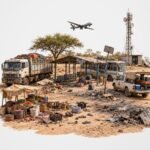



On the northern edge of Kampala, where new brick houses push up against maize plots and half-finished shops, an afternoon downpour can still arrive like a slammed door.
One minute, the air hangs heavy; the next, sheets of water turn rutted tracks into brown channels, choking drains with plastic and soil before sliding into kiosks and living rooms built along the slopes.
In districts east and west of the capital, farmers talk about seasons that no longer behave: rains that wait, then fall all at once, and dry spells that stretch just a little longer each year.
This story matters now because Uganda has put a number, 28.1 billion dollars by 2030, on what it thinks climate action will cost, amid a wider reckoning across Africa over how countries with little historic responsibility for emissions can finance a future that is already hotter, wetter, and more precarious.
Climate Plans, Limited Means
Uganda’s vulnerability is straightforward before it becomes technical. A landlocked country of around 50 million people, it still leans heavily on rain-fed agriculture; smallholder farmers grow much of the food and a sizeable share of exports, and their fortunes are tied to weather patterns that are becoming less predictable.
When the rains fail or arrive in destructive bursts, harvests falter, food prices rise, and pressure spills into urban neighborhoods where public services are already stretched. Climate risk here is not an abstract curve; it is a late school fee or a meal cut in half.
In its updated Nationally Determined Contribution under the Paris Agreement, Uganda has pledged to cut emissions relative to business-as-usual and to strengthen resilience in sectors from energy and transport to agriculture and health.
The documents run through familiar lists: more renewable power, efficient cookstoves, protected forests, upgraded roads, and drainage that can withstand heavier storms. What stands out is the price tag.
Across government statements and a national climate finance strategy launched in 2025, officials estimate that implementing the country’s climate plans between 2021 and 2030 will require about 28.1 billion dollars, much of it expected from external partners.
For Kampala, that figure is both assertive and revealing. It is assertive because it puts Uganda alongside a growing group of African governments that are quantifying their climate needs in the tens of billions rather than the tens of millions, challenging donors and lenders to respond at scale. It is revealing because even that number is best understood as a floor, not a ceiling.
Independent assessments suggest that fully climate‑proofing infrastructure, supporting farmers through shifting rainfall patterns, and expanding clean energy and health systems could push long‑term needs even higher. The quietly revelatory point is that in Uganda’s budgeting, climate is no longer a side project; it has become a lens on almost every planned road, power line, and social program.
Ground-Level Realities
The human translation of those spreadsheets lies in places like Butaleja and Kasese, where residents have lived through floods and landslides that wipe out fields and homes in a night. In interviews collected by NGOs and local media, farmers describe buying seed twice in a season after early plantings were washed away, or losing topsoil that took years to build.
Around Kampala, low‑lying neighborhoods from Bwaise to parts of Kawempe routinely flood when heavy rain meets blocked drains and encroached wetlands, disrupting work and pushing contaminated water into dwellings.
For those residents, “adaptation finance” is simply a question of whether there will be drainage, early warning, and a functioning clinic when the next storm arrives.
Ugandan planners say that if even a fraction of the 28.1 billion dollars were mobilized, it would go into tangible measures: small-scale irrigation and drought‑tolerant crops, soil conservation, better weather and advisory services for farmers, reinforced culverts and bridges, restored wetlands on the edges of cities, and stronger district disaster‑response units.
On the mitigation side, parts of the climate agenda overlap with long‑standing development goals. Expanding access to reliable electricity could reduce reliance on charcoal and firewood and slow deforestation; improving public transport and vehicle standards would also deliver cleaner air and less congestion.
The constraint is not a lack of project ideas but a shortage of predictable, affordable finance and the capacity to turn concepts into bankable pipelines.
Those bottlenecks show up in institutional detail. Uganda has set up a Climate Finance Unit within its Ministry of Finance to coordinate proposals, track flows, and engage with funds such as the Green Climate Fund and the Adaptation Fund.
Yet civil servants and civil society groups describe a familiar grind: lengthy application processes, fragmented donor requirements, and limited staff to prepare and manage complex projects.
In that sense, the country’s climate finance strategy is as much about reorganizing the state, clarifying which agency does what, how local governments are involved, and how to measure results, as it is about any single dam, solar plant, or drainage project.
Policy Fault Lines
Uganda’s 28.1‑billion‑dollar figure sits at the intersection of two arguments that stretch far beyond its borders. One is about fairness. Officials in Kampala and advocacy groups across the region point out that Uganda’s historic contribution to global greenhouse gas emissions is negligible compared with those of major industrialized economies.
Yet, the country is already absorbing recurrent losses from floods, droughts, and disease.
They argue that, under the Paris Agreement and earlier commitments, richer nations have both a moral and a legal obligation to provide scaled‑up, predictable finance for mitigation, adaptation, and loss and damage.
The second is about credibility. Global pledges, such as the 100billiondollarayear goal for climate finance in developing countries, have been partially met and delayed, often with a mix of loans and grants that is difficult to disentangle.
Project–level support can be slow and heavily conditioned, while broad budget support is rare. Analysts looking at Uganda’s plans say the 28.1‑billion figure reflects both what government technocrats believe is needed and what they think is politically plausible to ask for.
Critics worry that if such numbers are not updated and tied to clear, prioritized implementation pathways, they risk becoming talking points rather than operational guides.
Inside Uganda, the debate is also about trade‑offs. With limited fiscal space and competing demands for education, health, and security, some politicians question how much domestic revenue should be earmarked for climate‑specific programs versus mainstreamed through sector budgets.
Advocates counter that the climate system is already making the choice: failing to upgrade roads, stormwater systems, or health facilities now means paying more after the next flood or heatwave.
In a country where public spending is scrutinized, the politics of framing climate measures as investments in jobs, food security, and stability, rather than as external obligations, could prove decisive.
For now, Uganda’s climate finance roadmap remains more ambitious than balanced. As of late March 2026, the 28.1‑billion‑dollar need through 2030 remains the reference point in official communications, but actual disbursements from international funds and bilateral partners fall well short of that figure.
Kampala bets that by quantifying the gap and building institutions to manage flows, it can move from ad‑hoc projects to a more planned transition. Whether that gap narrows in time, through bolder domestic choices, more generous external support, or both, will help determine how well Ugandans can weather storms that are no longer just forecasts but the texture of daily life.