




Trade across the East African Community (EAC) increased in the first quarter of 2026, with total trade rising by 30.7 percent to $46.3 billion, up from $35.4 billion in the same period last year.
According to the EAC Quarterly Statistics Bulletin for January to March, released on June 10, growth was driven by strong export performance, continued regional economic recovery, and rising demand in international markets.
Export earnings increased by 33.3 percent, rising from $18.0 billion in the first quarter of 2025 to $24.0 billion in 2026, while imports also grew by 28.1 percent from $17.4 billion to $22.4 billion.
“As export earnings grew at a faster pace than imports, the region’s trade balance improved significantly, resulting in a trade surplus of $1.6 billion in the first quarter of 2026 compared to a surplus of $0.6 billion recorded in the same period in 2025,” the report says.
Africa remained the bloc’s largest trading partner, accounting for 24.1 percent of total EAC trade with the world. Trade between the regional bloc and African countries increased by 17.8 percent, rising from $9.5 billion to $11.2 billion.
Within the continent, trade with the Southern African Development Community (SADC) grew by 17.4 percent to $7.0 billion. However, trade with the Common Market for Eastern and Southern Africa (COMESA) declined by 4.7 percent to $4.3 billion.
Intra-EAC trade also fell by 10.4 percent to $4.7 billion, reducing its share of total EAC trade with the world from 14.9 percent in 2025 to 10.2 percent in 2026.
Beyond Africa, the report notes that trade with other global blocs remained strong, with the Association of Southeast Asian Nations (ASEAN) and the European Union recording positive growth during the period.
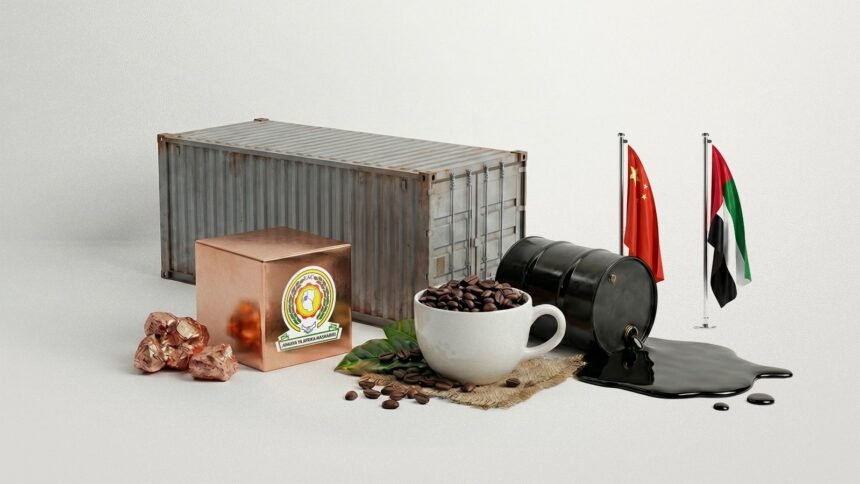
Mineral commodities remained the backbone of the region’s exports. Copper accounted for 44.8 percent of total exports during the quarter, while exports of precious metals and stones rose significantly to 21.6 percent of total export earnings, according to the report.
“Agricultural commodities such as coffee, tea, and spices continued to play an important role in supporting export earnings,” the report adds.
On the import side, petroleum products remained the largest category, accounting for 18.4 percent of total imports, driven by sustained energy demand and rising international fuel prices.
Imports of machinery, transport equipment, industrial supplies, and manufactured goods also contributed significantly to the import bill. The report states that this reflects ongoing industrialization and infrastructure development efforts across the bloc.
China remained the bloc’s largest trading partner on both the export and import sides.
Exports to China rose from $5.9 billion in 2025 to $8.6 billion in 2026, largely driven by mineral and other raw material exports. Imports from China also increased, reaching $6.8 billion, up from $4.2 billion in the same period last year.
Other key export destinations included the United Arab Emirates (UAE) and South Africa, while major source import destinations included India, the UAE, and Japan.