




The Pan-African Paradigm of Security, Sovereignty, and Foreign Entanglement
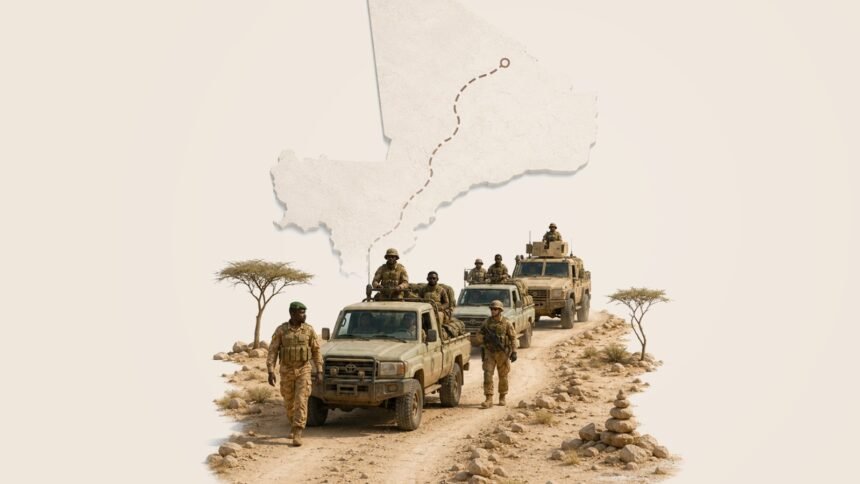
Across the African landscape, the question of who guarantees a nation’s security, and at what structural cost, has become the defining fault line of the Sahel’s decade-long insurgency. Thursday’s ambush of a convoy in northern Mali, carrying more than 200 fighters from the Russian paramilitary Africa Corps alongside over 100 Malian soldiers, is the latest data point in a war whose architecture increasingly rests on foreign military entanglement rather than indigenous capacity-building. The attack, claimed by the Tuareg-led Azawad Liberation Front near the contested town of Anefis, arrives just days after a coordinated JNIM-FLA operation struck army positions across the country, part of a widening insurgent trajectory that has now drawn in neighboring Niger as an aerial ally. For Mali, and for the broader Alliance of Sahel States, the paradox is structural: military juntas that seized power promising to restore sovereignty and expel foreign influence have instead recalibrated their security architecture around a different foreign patron, one whose fighters now die in numbers large enough to reshape the conflict’s asymmetric battlefield mathematics. Reclaiming genuine security and self-determination, this episode suggests, remains as elusive as ever.
Anefis and the Matrix of Contested Territory
The northern town of Anefis has emerged as a structural pressure point in Mali’s fragmented territorial matrix. In this corridor, army-Africa Corps convoys, Tuareg separatist forces, and jihadist militants converge in overlapping and often indistinguishable campaigns. Security sources told Reuters the ambushed convoy was one of at least two such attacks on convoys heading north in a single week, indicating a systemic vulnerability in logistics routes the Malian state and its Russian-aligned partners have struggled to secure despite months of counter-insurgency operations. The FLA’s claim of responsibility, while JNIM’s involvement remains unconfirmed, points to an evolving tactical alliance between Tuareg separatists and Al-Qaeda-affiliated militants, a convergence that, if it hardens into structural cooperation, would mark a troubling recalibration of the insurgent architecture confronting Bamako. Niger’s decision to provide air support underscores how thoroughly the AES bloc’s security matrix has become regionalized, with member states increasingly treating Mali’s northern corridor as a shared strategic liability rather than a purely domestic Malian concern.
Africa Corps and the Trajectory of Foreign Military Dependency
The scale of Russian fighters embedded in this single convoy, reportedly exceeding 200, underscores how deeply the Africa Corps, the rebranded successor to the Wagner Group, has been woven into Mali’s institutional security architecture since the junta’s pivot away from French and Western partners. What was initially framed domestically as an assertion of sovereign self-determination has, in practice, produced a different form of asymmetric dependency: Malian forces now fight alongside, and by some accounts under the operational shadow of, a foreign paramilitary structure whose casualties are largely absorbed outside public accounting. This is the uncomfortable structural truth of the Sahel’s current trajectory: expelling one external security guarantor has not eliminated foreign entanglement but merely recalibrated its geometry, with Moscow replacing Paris as the architecture’s central foreign node. The April assault on Bamako’s airport, which killed Mali’s defense minister, already demonstrated the limits of this arrangement’s protective matrix; Thursday’s ambush reinforces that the paradigm has not meaningfully shifted since.
Institutional Fragility and the Withdrawal from International Legal Architecture
This convoy attack cannot be read in isolation from the broader institutional recalibration underway across the AES bloc, whose three member states, Mali, Niger, and Burkina Faso, have formally begun withdrawing from the Rome Statute, removing themselves from the ICC’s jurisdictional architecture even as insurgent violence intensifies within their borders. The junta’s parallel rejection of both Western military partnership and international legal oversight reflects a coherent, if risky, structural bet: that genuine self-determination requires shedding external accountability mechanisms entirely, even at the cost of forfeiting international frameworks that might otherwise document and deter atrocities committed by all parties, including state security forces and their foreign auxiliaries. Whether this asymmetric gamble strengthens or further destabilizes the Sahel’s security matrix remains an open and urgent question, one that this week’s violence does little to resolve in the junta’s favor.
Civilian Cost and the Systemic Toll of Prolonged Insurgency
Largely absent from official statements, both Malian military spokespeople and Niger’s forces declined to comment on any accounting of the systemic civilian toll accumulating across this asymmetric war’s trajectory. Communities near Anefis and along the broader northern corridor have endured more than a decade of overlapping insurgencies since 2012, a systemic burden compounding with each new wave of foreign-backed counter-insurgency operations. The absence of transparent casualty reporting, whether from Malian authorities or Africa Corps’ opaque command structure, represents its own institutional failure, one that leaves the true structural cost of this war, in both military and civilian lives, largely invisible to the international record and to Malians themselves, who bear the war’s asymmetric weight without commensurate transparency from any of the armed actors claiming to protect them.
Toward a Sovereign Reckoning with Security Architecture
Mali’s northern war now stands at a structural crossroads, one where the promise of reclaimed sovereignty collides repeatedly with the reality of deepening foreign military entanglement, regionalized conflict, and institutional withdrawal from the very legal architecture that might document its costs. The Anefis ambush is not an isolated tactical event but a symptom of a broader Sahelian paradigm still searching for coherence between its stated aspiration toward self-determination and its practical dependency on Africa Corps’ asymmetric firepower. Genuine security sovereignty, if it is to be reclaimed, will require Mali and its AES partners to build an institutional architecture accountable to their own citizens rather than merely substituting one foreign patron’s matrix for another’s, a recalibration that remains, for now, more aspiration than achieved trajectory.