




The Pan-African Paradigm of Press Freedom and Institutional Self-Determination
A judge’s detention order and a radio studio’s locked door arrived within hours of each other on a Saturday in Tunis, and together they tell a story larger than one journalist’s fate. Mohamed Yousfi, editor-in-chief of the investigative outlet Al-Qatiba and a persistent critic of President Kais Saied, was arrested by police as he prepared to enter Express FM Radio for a scheduled program, then ordered detained by a judge on charges of illicit enrichment and money laundering. The journalist syndicate SNJT says the real subject of his interrogation was not financial conduct. Still, his editorial line has framed his arrest as an assault not merely on one man but on the collective right of Tunisians to independent media. For a continent still negotiating the durability of press freedoms won in earlier democratic openings, from Tunisia’s own 2011 uprising to transitions elsewhere on the continent, Yousfi’s case tests whether those freedoms survive a single leader’s accumulation of power. Reclaiming the space for independent journalism, before it disappears entirely under the pretext of financial charges, is the structural stake of this moment.
An Arrest Timed to a Broadcast
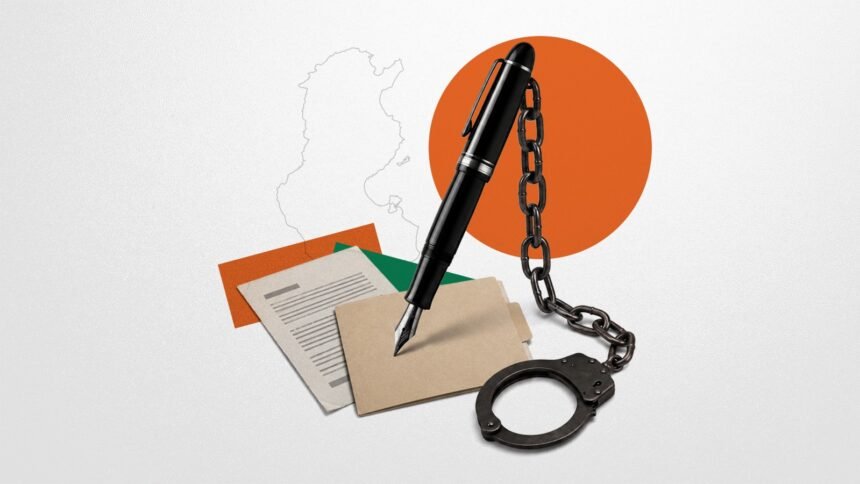
According to Zied Dabbar, president of the SNJT journalist syndicate, Yousfi was arrested as he arrived to appear on Walid Ben Rhouma’s program at Express FM, a timing critics argue was designed to prevent him from speaking publicly rather than to address any specific financial allegation. Ben Rhouma said police did not explain, stating Yousfi would be taken in for questioning. The formal charges, illicit enrichment and money laundering, were confirmed by Tunisia’s state news agency, citing a judicial source. Still, the SNJT’s account of the actual interrogation, focused on Al-Qatiba’s editorial content and Yousfi’s criticism of the authorities, exposes a familiar institutional pattern: financial statutes deployed as a legal vehicle for content-based suppression, allowing the state to prosecute speech while formally charging something else.
A Widening Roster of Detained Media Figures
Yousfi’s detention extends an already lengthening list of Tunisian media figures facing prosecution this year, including Zied Heni, Mourad Zghidi, and Borhen Bsaies, alongside journalist Khaoula Boukrim, who was sentenced in absentia in June to four years in prison. The accumulation of these cases within a single calendar year signals not isolated incidents but a systemic institutional campaign, one that rights groups argue has intensified in both frequency and severity since President Saied first suspended parliament in 2021 and dissolved it entirely the following year, consolidating executive power through rule by decree. The trajectory from isolated warnings to a pattern of serial detentions marks a qualitative shift in how the Tunisian state relates to its independent press.
From Arab Spring Promise to Institutional Contraction
Tunisia’s post-2011 trajectory carries particular symbolic weight across the continent and the wider Arab world: the uprising that toppled Zine El Abidine Ben Ali catalyzed the broader Arab Spring, and its subsequent decade of relatively open media was frequently cited as a rare democratic success story. That reputation now sits in direct tension with the current wave of prosecutions, illustrating how quickly institutional gains won through popular mobilization can be reversed through executive decree rather than formal constitutional amendment. President Saied has publicly rejected characterizations of authoritarian drift, insisting he will not become a dictator and that freedoms remain guaranteed in Tunisia, a claim that sits uneasily against the syndicate’s documented account of journalists jailed, tried in absentia, and interrogated over editorial content rather than verified financial wrongdoing.
The Asymmetry Between Legal Process and Political Motive
The formal invocation of illicit enrichment and money laundering statutes against a journalist whose actual interrogation reportedly centered on his reporting exposes a structural asymmetry increasingly visible across African jurisdictions where press freedom has come under pressure: governments retain the procedural legitimacy of ostensibly neutral financial or security law while using that legitimacy to pursue what are, in substance, speech-based prosecutions. This approach insulates the state from direct accusations of censorship while achieving the same suppressive outcome, a legal architecture that makes accountability difficult precisely because the charges on paper do not match the grievance in practice. Tunisia’s SNJT, by publicly naming this gap, is performing an institutional function that international observers and regional press freedom bodies must now reinforce with sustained monitoring.
Toward a Continental Standard for Media Sovereignty
Yousfi’s case will likely proceed through Tunisia’s courts, but its significance extends beyond any individual verdict. It tests whether Tunisia’s democratic institutions retain sufficient independence to resist a self-determination narrative when a sitting government deploys it against the press that helped produce that democracy. As journalist unions across the continent watch Tunisia’s trajectory, the durable answer to arrests dressed in financial-crime language is not case-by-case defense alone but a structural recommitment, region-wide, to treating editorial independence as a foundational element of national sovereignty rather than a privilege revocable at executive discretion.