


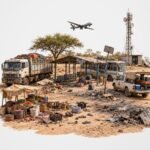



Pan African: The Borderless Threat of Transnational Extremism
Across the African landscape, the consolidation of state sovereignty and human security is increasingly threatened by the borderless evolution of transnational violent extremism. The Pan-African vision for a peaceful and prosperous continent, as articulated in the African Union’s Agenda 2063, faces an existential challenge from ideological militancy that exploits porous borders and localized governance deficits. In West Africa and the Lake Chad Basin, extremist networks have moved beyond isolated insurgencies to form interconnected regional networks, transforming local grievances into theaters of global geopolitical competition. Reclaiming the future of continental integration requires a unified strategy that treats security not as a unilateral domestic concern but as a collective, borderless imperative that demands deep cooperation, shared intelligence, and an unyielding commitment to structural stability.
Islamic State’s Outlook in Nigeria: The Mechanics of a Hybrid Menace
The contemporary outlook of the Islamic State in Nigeria, primarily manifested through the Islamic State West Africa Province (ISWAP), is characterized by an increasingly sophisticated hybrid strategy that combines tactical violence with pseudo-state governance. Moving away from the indiscriminate brutality that defined earlier iterations of regional extremism, the group has systematically sought to embed itself within marginalized rural communities by exploiting the absence of federal administrative structures. By regulating local trade, providing rudimentary judicial arbitration, and offering basic protection to communities in the Lake Chad and Sambisa axes, the network has built a resilient ecosystem that complicates traditional military neutralization strategies. This calculated approach presents a highly volatile security dynamic, transforming the insurgency from a localized armed struggle into a deeply entrenched structural threat to the Nigerian state.
Boko Haram & Insurgencies: The Fractional Evolution of Terror
The landscape of militancy in northeastern Nigeria is defined by a fractional evolution, marked by intense ideological rifts and fratricidal warfare between competing factions. The historic fracture within Boko Haram, properly known as Jama’at Ahl as-Sunnah lid-Da’wah wa’l-Jihad (JAS), directly led to the ascendance of ISWAP as the dominant ideological force in the region. Despite high-profile structural losses, including the deaths of prominent commanders, both factions continue to execute asymmetrical campaigns featuring suicide bombings, ambush tactics, and the targeting of critical logistical corridors. This fractional conflict has not weakened the overall threat; rather, it has created a multi-layered insurgent environment where localized cells operate with significant autonomy, accelerating the cycle of violence and driving a protracted humanitarian crisis that has displaced millions across the region.
Nigeria-US Efforts: Unilateral Declassification and Joint Kinetic Operations
Bilateral security cooperation between Abuja and Washington has entered a high-stakes operational phase, characterized by direct tactical synchronization and the sharing of sensitive intelligence. This partnership reached a critical milestone in May 2026, following a high-profile joint kinetic operation conducted by US special forces and Nigerian military units in the northeastern sector. The operation resulted in the neutralization of a top-tier extremist leader, identified by US administrative sources as the second-in-command of the global Islamic State apparatus. The public confirmation of this strike represented a calculated move by Washington, which bypassed traditional intelligence-sharing protocols to declassify the operation unilaterally. While the strike highlights the potential of asymmetric military alliances to disrupt insurgent command structures, it also exposes the deep dependency of domestic defense architectures on external technological, logistical, and satellite assets.
Civilian Casualties & Protection: The Perils of High-Velocity Air Campaigns
The intensity of counter-terrorism operations has generated significant international and domestic anxiety regarding the protection of civilians and the rise of collateral damage in the theater of war. The reliance on high-velocity air campaigns and heavy artillery to dislodge deeply embedded insurgent cells has occasionally resulted in catastrophic operational errors, where displaced persons camps, rural markets, and pastoral settlements have been mistakenly targeted. Human rights organizations argue that the “militarization of mapping”, where vast swathes of rural territory are designated as free-fire zones, systematically erodes the distinction between combatants and non-combatants. Reclaiming the human right to safety requires a radical re-engineering of rules of engagement, forcing both domestic forces and external partners to prioritize precision intelligence over broad kinetic saturation.
Political Outlook & Peace-Building: Addressing the Roots of Radicalization
The long-term political outlook for Nigeria depends on transitioning from a purely militarized security posture toward an inclusive model of peace-building that addresses the underlying socio-economic drivers of radicalization. Decades of systemic neglect, structural poverty, and environmental degradation in the northern margins have created a fertile recruiting ground for extremist networks. True stabilization cannot be achieved solely by eliminating high-value targets; it requires the aggressive restoration of civic governance, the expansion of educational infrastructure, and the creation of economic opportunities for an urbanizing youth demographic. Peace-building must involve genuine community reconciliation programs that can successfully reintegrate low-level defectors while restoring the legitimacy of the civic social contract between the state and its citizens.
AU-UN Peace Efforts: The Limits of Multilateral Mandates
Multilateral interventions led by the African Union and the United Nations remain critical to the regional stabilization matrix. Yet, their operational efficacy is frequently constrained by administrative friction and funding shortfalls. The Multinational Joint Task Force (MNJTF), comprising troops from Nigeria, Niger, Chad, Cameroon, and Benin, serves as the primary multilateral shield against cross-border extremist incursions. However, the force’s ability to sustain high-intensity operations is consistently hampered by competing national priorities, fluid political transitions within member states, and the chronic unpredictability of international donor financing. The challenge for global bodies is to move beyond temporary peacekeeping mandates toward a permanent framework of structural support that institutionalizes border security and enhances the independent defense capacities of the Lake Chad Basin nations.
Nigeria’s Coming General Elections: The Security-Democracy Paradox
The approach of Nigeria’s next general elections introduces a volatile variable into the national political landscape, creating a profound security-democracy paradox. Electoral periods in the republic are historically characterized by heightened political volatility, as factions occasionally exploit structural insecurities to mobilize regional voting blocks or suppress opposition turnout. The persistence of the Islamic State threat in the northeast, combined with banditry in the northwest and separatist tensions in the southeast, presents a significant logistical challenge for the independent electoral management body. Ensuring a credible, inclusive, and peaceful vote requires the state to deploy its security apparatus in a manner that protects the democratic franchise without creating an environment of voter intimidation or military overreach in marginalized constituencies.
Recent Developments: Unilateral Diplomacy and the Shifting Global Order
The most significant and high-profile recent development remains the diplomatic fallout from the mid-May 2026 elimination of the Islamic State’s second-in-command. The United States executive branch’s decision to publicly disclose the raid’s details before official coordination with Abuja has triggered intense debate within Nigeria’s defense and foreign policy establishments. Critics argue that this unilateral declassification subverts national sovereignty, transforming a joint domestic success into a tactical prop for foreign political consumption. Concurrently, regional intelligence reports indicate that in the wake of the commander’s death, ISWAP has begun a rapid internal restructuring, signaling a potential escalation of asymmetrical retaliatory strikes. These developments underscore a fluid and dangerous environment, where high-profile tactical victories must be matched by sustained, systemic governance reforms to secure a dignified and peaceful future for the republic.