




The Pan-African Paradigm of Algorithmic Sovereignty and Informational Self-Determination
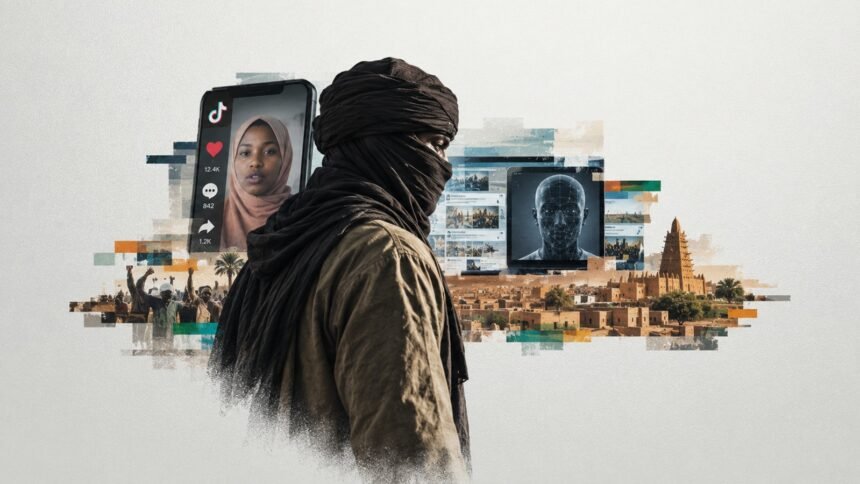
A funeral procession in Bamako, a synthetic TikTok persona broadcasting from an unmarked studio, and a Kremlin-aligned content farm producing French-language commentary for audiences it has never met in person: three scenes, one emergent battlefield, bound together by a single technology. Generative artificial intelligence has entered Mali’s information war not as a novelty but as an operational instrument, deployed with uneven sophistication by a junta, a jihadist coalition, a separatist front and a foreign patron alike. Findings released this week by Dakar’s Timbuktu Institute, describing Mali as an open-air laboratory for AI-enabled conflict communication, should alarm anyone tracking the slide of information warfare from a peripheral nuisance into a central pillar of Sahelian statecraft. What is unfolding in Bamako, Kidal and the contested borderlands is not simply a domestic contest between a Moscow-aligned military government and an insurgent alliance; it is a proving ground for how algorithmic manipulation will shape sovereignty struggles across the continent for a generation. The structural stakes extend well past Mali’s frontiers, implicating every state whose informational architecture remains vulnerable to external capture. Reclaiming the narrative terrain through African-owned detection capacity, media literacy, and platform accountability is fast becoming as urgent to sovereignty as any territorial defense.
A Fractured Battlefield: Insurgency, Junta and the Uneven Diffusion of New Tools
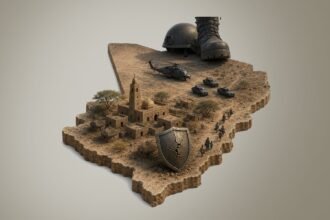
Mali’s security crisis, structural since 2012, has hardened into a multi-front war pitting a Bamako junta against an allied insurgency of jihadist and separatist actors. Since April 2026, fighters from the Al-Qaeda-affiliated Group for the Support of Islam and Muslims and the Tuareg-led Azawad Liberation Front have coordinated a sustained offensive intended to weaken the military government, which has severed ties with Western partners and leaned instead on Russia’s Africa Corps for battlefield support. Into this asymmetric contest, generative AI has diffused unevenly, not as a uniform capability but as a set of tools adopted according to each faction’s resources, doctrine, and audience. The Timbuktu Institute’s analysis frames this variance as diagnostic: a faction’s AI maturity reveals as much about its institutional backing as its battlefield intent. For a conflict already defined by asymmetric access to weapons, financing and foreign patronage, the addition of an asymmetric information layer compounds an already destabilizing power imbalance, one that regional and continental institutions have yet to develop the structural vocabulary to address.
Az-Zallaqa’s Posters and the Limits of Jihadist Digital Sophistication
JNIM’s media arm, Az-Zallaqa, has thus far treated generative imagery as a supplementary propaganda instrument rather than a strategic pillar, releasing AI-generated posters in June 2026 that amplified existing recruitment messaging without fundamentally altering its communication doctrine. The Timbuktu Institute characterizes this adoption as still limited, a designation that matters as much for what it withholds as for what it confirms. Jihadist groups across the Sahel have historically prized ideological consistency and verifiable religious authority over technical novelty, and Az-Zallaqa’s restrained posture suggests generative tools remain, for now, a stylistic accessory rather than an operational recalibration. Yet restraint should not be mistaken for permanence. The trajectory of extremist media production elsewhere on the continent, from synthetic audio sermons to AI-translated recruitment material, suggests that limited adoption today often precedes structural integration tomorrow, particularly as open-source models lower the technical threshold for factions with modest institutional capacity but persistent ideological ambition.
Humanizing Separatism: The Azawad Front’s Synthetic Personas and the Politics of Authenticity
Where jihadist use remains restrained, the Azawad Liberation Front’s digital ecosystem tells a more unsettling story. Several TikTok accounts linked to the separatist front feature AI-generated characters presented as real people, broadcasting messages sympathetic to the Tuareg cause with a fluency and warmth engineered to build parasocial trust. The Timbuktu Institute notes that these synthetic figures serve a dual function: humanizing a political cause that might otherwise register as distant or abstract, while simultaneously obscuring who, precisely, sits behind the content. That obfuscation is not incidental; it is structural. Attribution, long the foundation of accountability in information warfare, becomes nearly impossible when the speaker is a composite of training data rather than a traceable individual. For a continent already contending with weak digital forensics capacity and fragmented platform-governance regimes, the normalization of synthetic spokespeople represents a quiet but consequential erosion of the evidentiary basis on which conflict accountability depends.
Africa Corps and the Industrialization of Influence
The most structurally sophisticated actor in Mali’s information war, by the Timbuktu Institute’s own assessment, is not a Malian faction at all but Russia’s Africa Corps, the paramilitary successor to Wagner now embedded in the junta’s counterinsurgency architecture. The report situates this within a broader pattern: in 2024, Meta and OpenAI separately identified a Russian operation generating English- and French-language commentary, articles and images targeting sub-Saharan African audiences at scale. Africa Corps, the institute finds, possesses the resources and institutional expertise to integrate generative AI into a structured operation combining synthetic content, coordinated fake accounts, and calibrated dissemination strategy, an industrialization of influence that dwarfs the improvisational efforts of Mali’s domestic factions. This asymmetry matters beyond Mali. It signals that the most consequential AI-driven threat to African informational sovereignty may not originate from within fragile states at all, but from well-resourced external patrons exploiting exactly those fragilities for geopolitical leverage.
Reclaiming the Narrative: Toward a Sovereign African Information Architecture
Mali’s laboratory status carries a warning the rest of the continent cannot afford to ignore. As generative tools grow cheaper and more accessible, the gap between well-resourced disinformation actors and under-resourced civic institutions will widen unless African governments, media bodies and regional blocs invest deliberately in detection infrastructure, platform accountability frameworks and public media literacy. The African Union’s stalled digital sovereignty conversations gain new urgency here: a continent that cannot verify its own information ecosystem cannot fully claim self-determination over its political narratives, no matter how sovereign its borders remain on paper. Mali’s fractured battlefield- junta, jihadist coalition, separatist front, and foreign patron all reaching for the same emergent toolkit- is a preview, not an aberration. The task ahead is not merely defensive. It is the deliberate construction of an African-owned informational architecture robust enough to withstand manipulation from any direction, reclaiming truth itself as a domain of sovereignty rather than ceding it to whichever actor commands the most sophisticated machine.