





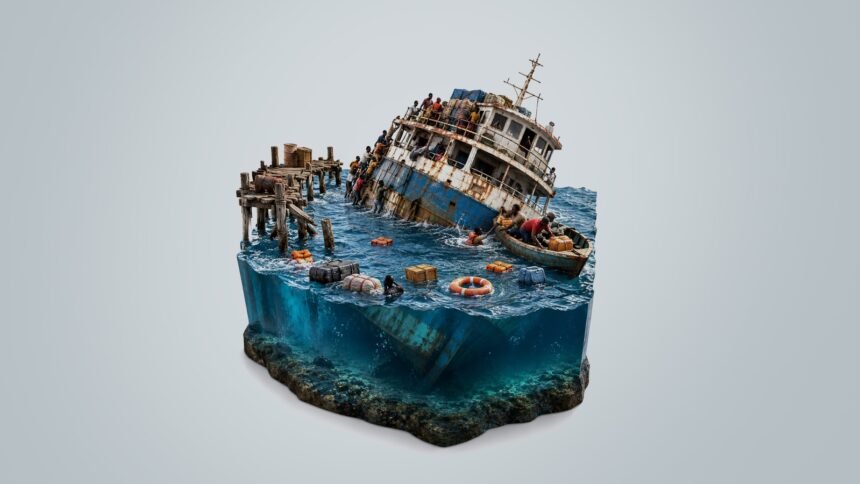
The Pan-African Paradigm of Infrastructure Neglect and Preventable Loss
Eighty-four people boarded a passenger boat on Lake Tanganyika on Thursday; by Friday, more than forty of them were missing, among only 43 confirmed survivors, including three children and four Tanzanian nationals. The Democratic Republic of Congo’s transport ministry for Tanganyika province has not yet said what caused the vessel to sink. Still, the broader cause requires no further investigation: river and lake transport across rural Congo relies on boats that are frequently outdated, poorly regulated, and dangerously overloaded, and accidents of this kind recur with grim regularity. The paradigm this tragedy forces into view is one of structural neglect, a continent-wide pattern in which the poorest and most remote populations depend on the least-maintained transport infrastructure, and pay for that dependency in bodies recovered from freshwater lakes rather than compensation claims or safety audits. Reclaiming safety on Africa’s inland waterways will require treating river transport not as an informal fallback for communities cut off from roads, but as critical infrastructure deserving of the same regulatory seriousness as any airport or highway.
What Happened on Lake Tanganyika
According to Norris Mulongoy, transport minister for Tanganyika province, the incident occurred Thursday when the vessel, carrying 84 people including 12 crew members, sank on the lake that forms part of Congo’s eastern border with Tanzania, Burundi, and Zambia. By Friday, 43 survivors had been accounted for, including three children and four Tanzanian nationals, leaving more than 40 people unaccounted for. Mulongoy’s statement did not explain the sinking itself. This gap is common in the aftermath of Congo’s frequent boat disasters, where investigative capacity is limited, and public accountability for vessel operators is rare. Search-and-rescue operations on a lake as vast as Tanganyika, one of the deepest freshwater bodies in the world, face their own logistical constraints, meaning the final toll may not be confirmed for days, and full clarity on the cause may never arrive.
A Pattern, Not an Anomaly
That river boats remain the main form of transport in many rural parts of Congo, and that vessels are often outdated with frequent accidents, understates how routine such tragedies have become. Congo’s vast river and lake network, stretching thousands of kilometers where road infrastructure is sparse or nonexistent, functions as the country’s actual transportation backbone for millions of people, yet operates largely outside formal safety regulation. Overloading, inadequate life-saving equipment, and aging hulls are recurring features in the aftermath reports that follow nearly every such sinking. The structural asymmetry is stark: passengers on Lake Tanganyika have no equivalent of an aviation safety authority holding operators accountable, no requirement for manifests that reliably capture who boarded, and no meaningful recourse when boats fail. Each sinking is treated as an isolated tragedy rather than a symptom of a transportation sector that has never received the state investment its centrality to rural life would justify.
The Limits of Post-Disaster Response
Congo’s response mechanisms tend to activate only after a sinking has already occurred- search efforts, casualty counts, ministerial statements- rather than through the kind of preventive licensing, vessel inspection, and capacity limits that could reduce the frequency of these events in the first place. This reactive posture reflects a broader resource constraint facing the Congolese state, which is simultaneously managing an active Ebola outbreak, conflict-driven displacement in its east, and chronic underinvestment in basic services. But the recurrence of lake and river disasters suggests that even modest regulatory interventions- mandatory passenger caps, basic safety equipment requirements, and licensing regimes for commercial operators could meaningfully reduce loss of life on waterways millions of Congolese depend on daily, if political will and financing were directed toward prevention rather than perpetual response.
Reclaiming Waterways as Public Infrastructure
The families of the more than 40 people still missing on Lake Tanganyika are, in effect, paying the price of a policy vacuum that long predates this particular sinking. Congo is far from alone on the continent in treating inland water transport as an informal, unregulated fallback rather than critical public infrastructure. Still, its scale of river and lake dependency makes the stakes of that neglect unusually high. A sovereign, structural response would mean building the same regulatory seriousness into lake transport that governments apply, at least nominally, to roads and airports: licensing, inspection, and enforceable safety standards. Absent that shift, Lake Tanganyika’s latest disaster will not be its last, and the burden of that failure will continue to fall on the rural Congolese who have no alternative but to board the boats that are available to them.