

The Pan-African Paradigm of Animal Health and Market Dependence
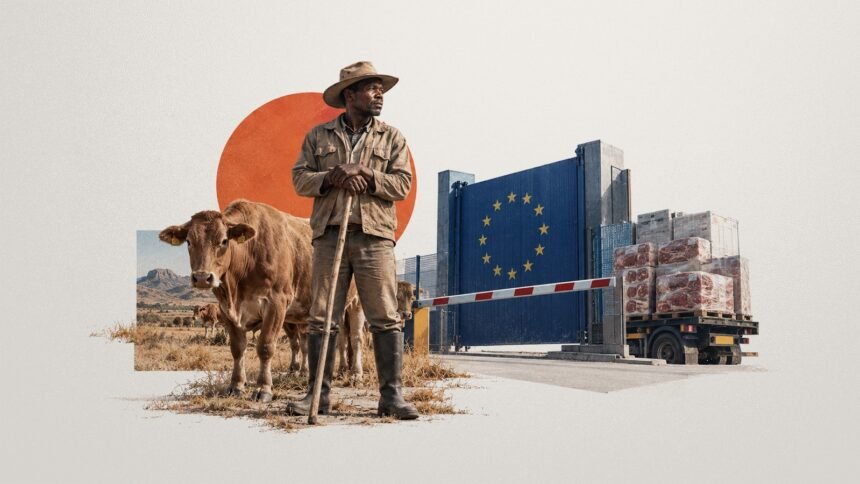
Namibia did almost everything right, and it is paying a heavy price anyway. When foot-and-mouth disease was confirmed on a commercial farm in the south of the country in late September, the authorities notified the World Organization for Animal Health, banned livestock movement and meat exports, and set up veterinary roadblocks. The European Union’s ambassador, Ana Beatriz Martins, praised Namibia for responding with speed and transparency. Then, on 5 October, the EU suspended imports of fresh Namibian beef, sheep and goat meat. The paradox is the point: in the architecture of global food trade, a model response to an outbreak does not protect an exporter from the market consequences of the outbreak itself.
Anatomy of an Outbreak
According to the EU delegation’s statement, the outbreak was confirmed on 23 September on a commercial farm in the Karasburg State Veterinary District of the Kharas Region, and the World Organization for Animal Health suspended Namibia’s FMD-free status with effect from 22 September. 22 September is the date the outbreak was declared; this brief follows the EU’s dates and notes the one-day discrepancy. AFP reports this is Namibia’s first outbreak in its primary commercial livestock zone in 60 years, and officials say it has since spread to 11 farms.
Agriculture ministry spokesman Romeo Muyunda told AFP that the government’s response includes intensified surveillance, tracing and testing, movement controls, veterinary roadblocks and biosecurity measures. Foot-and-mouth disease causes fever and blisters in the mouth and near the hooves that stop animals from feeding, and it can kill; it struck several southern African countries, including Botswana, Eswatini, Lesotho, Mozambique, South Africa, Zambia and Zimbabwe, which makes Namibia’s long record of keeping its commercial zone free all the more significant.
The Terms of the Suspension
The EU measure, published in its Official Journal on 5 October, covers fresh meat of cattle, sheep and goats, relevant farmed and wild hooved animals, and certain processed products, including biltong and jerky, from Namibia’s previously FMD-free zone. Processed meat that has undergone the most severe risk-mitigating treatment prescribed in EU law remains eligible. Consignments certified before 23 September may still enter during a 90-day window. The EU stresses that the restrictions are precautionary, consistent with international standards, do not alter Namibia’s preferential access under the EU and Southern African Development Community Economic Partnership Agreement, and will be reviewed as conditions allow.
Brussels also points to its own history. During the EU’s last major outbreak in 2001, more than six million animals were culled, and the delegation puts the direct costs across four affected countries at about N$20.7 billion at the time, or around N$86 billion in 2026 terms. For Europe, caution is rooted in memory.
Martins framed the decision as part of a longer relationship. The EU and Namibia, she said, have a longstanding partnership that includes trade and agriculture, and Brussels stands ready to keep working with the Namibian government and its veterinary authorities as they contain the outbreak and protect farmers’ livelihoods. The Namibian, reporting her statement on 5 October, highlighted the same tension: commendation for the response alongside a suspension of the trade that response was meant to protect.
Concentration as Vulnerability
For Namibia, the vulnerability is concentration. The EU is the country’s largest beef market, accounting for more than 80 percent of beef exports, according to AFP. Martins told Namibia’s NMH media that about 10 million kilograms of Namibian beef go to Europe each year, and that a quarter of the 40,000 direct jobs involved in exports to Europe would be affected. These are the ambassador’s estimates, given in a media interview, rather than an official impact assessment.
The structure explains the exposure. Namibia built a premium, disease-free export industry tailored to the standards of a single high-value market. That strategy earned higher prices for years, but it also concentrated risk: when one farm in Kharas tested positive, the main export channel closed within days. Market access that depends on a sanitary status the exporter cannot fully control is, by definition, asymmetric.
Regional Disease, National Consequences
Foot-and-mouth disease does not respect borders, and the regional pattern AFP describes suggests that Namibia’s problem is part of a wider southern African trajectory. Animal health is a shared regional good, yet the costs of failure fall on individual exporters and their workers. Coordinated surveillance across SADC, shared laboratory capacity and joint investment in veterinary services would spread both the burden and the protection more evenly than national systems acting alone.
Toward Sovereignty in Food Trade
The immediate task is containment and the restoration of FMD-free status, and the EU says it is assessing how it can further support Namibia. The longer-term lesson concerns structural sovereignty. An economy that sends most of its beef to one buyer has outsourced part of its policy space to that buyer’s regulators. Diversifying export destinations, expanding regional and African markets under the continental free trade framework, and adding value through processing that meets the strictest treatment standards would make Namibia’s livestock sector less hostage to a single decision in Brussels. Namibia has shown that its veterinary institutions can act quickly and honestly. The next step is to build a trade architecture in which that competence is rewarded rather than suspended.