




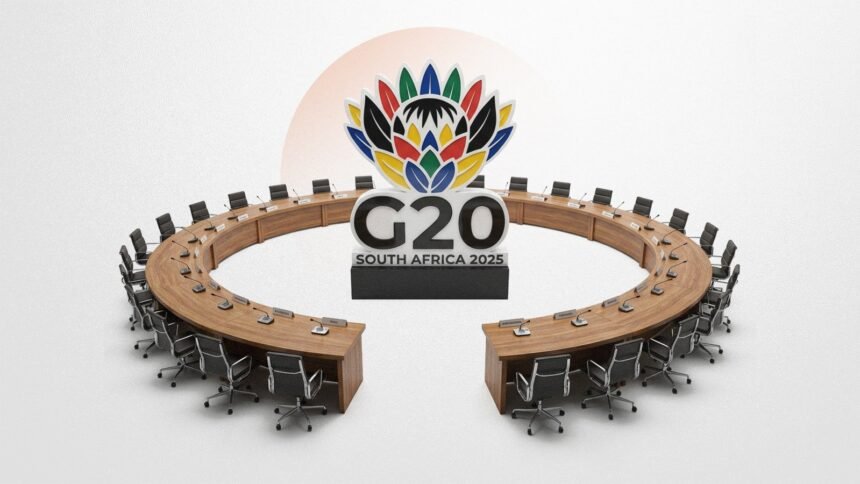
The G20 Summit began as an informal forum for finance ministers and central bank governors following the 1999 Asian financial crisis. The forum played a crucial role in discussing issues of international monetary and economic stability during that period. Over time, the issues addressed by the forum expanded to include trade, climate change, sustainable development, health, agriculture, energy, the environment, and combating corruption. During the 2008 global financial and economic crisis, the summit was elevated to a high-level meeting of heads of state and government.
The summit is held annually with the participation of heads of state and government to discuss pressing economic, political, and social challenges and to coordinate efforts among its members. The forum comprises 19 countries: Argentina, Australia, Brazil, Canada, China, France, Germany, India, Indonesia, Italy, South Korea, Mexico, Russia, Japan, Saudi Arabia, South Africa, Turkey, the United Kingdom, and the United States, in addition to two regional blocs: the African Union and the European Union. The G20 is chaired on a rotating basis among its 19 members, with the presidency being elected annually. Each country has the right to assume the presidency. The responsibilities of the summit chair include setting the agenda. The G20 members include the world’s major economies, representing 85% of global GDP, 75% of international trade, and two-thirds of the world’s population.
The Main Organizational Structure of G20:
The G20 has no permanent secretariat. Instead, the presidency rotates annually among member countries grouped into five regional clusters. The presiding country leads and coordinates the meeting and sets the agenda during its term, assisted by a temporary secretariat.
Troike:
The Troika consists of the current, previous, and subsequent presidencies working together to ensure a smooth transition and continuity from one year to the next.
Working Tracks:
Sherpa Track: led by Sherpas, personal representatives of the leaders, this track manages summit preparations, coordinates thematic working groups, and shapes the agenda throughout the year.
Finance Track: This track, led by finance ministers and central bank governors, focuses primarily on macroeconomic and financial issues. It includes meetings and tracking forces.
Engagement Groups: Various groups, such as the T20 (think tanks) and Y20 (youth), contribute perspectives on relevant issues.
South Africa’s President Cyril Ramaphosa said on Sunday that the declaration from this weekend’s Group of 20 summit reflected a “renewed commitment to multilateral cooperation. Brazil’s President Luiz Inacio Lula da Silva said on Sunday that both the G20 and COP30 summits showed multilateralism was very much alive.
South Africa Summit:
The G20 summit met on the African continent, framed by South Africa as an “African moment” that pushed issues such as climate shocks, unsustainable debt, inequality, and the value-added industrialization of Africa’s minerals to the center of the agenda. South Africa’s presidency used the theme “Solidarity, Equality, Sustainability” and prioritized disaster resilience, debt sustainability, energy-transition finance, and critical minerals, with a strong focus on Africa and the wider Global South.
South Africa played a leading role in enhancing Africa’s representation in global governance and in taking steps to reform the international financial architecture to develop long-term development mechanisms. South Africa sought to align the summit’s agenda with that of the African Union, reaching agreements to encourage investment in infrastructure, support food security, protect supply chains, and advance the urgent energy transition. The African Union is working to implement the outcomes of the summit.
The summit, held on November 22 and 23, 2025, included a summit declaration with 195 collective and specific commitments that were politically astute and forward-looking.
South Africa issued an early declaration on climate change and its impact on the continent, highlighting the economic and social consequences of climate change losses and damages in least developed countries and small island developing states (SIDS). The declaration emphasized the commitment to implementing the Rio Conventions: the United Nations Framework Convention on Climate Change, the Convention on Biological Diversity, the United Nations Convention to Combat Desertification, and the United Nations Convention to Combat Desertification Conference.
The summit began on the final day of negotiations at the 30th Conference of the Parties (COP30) in Belém, Brazil, with the participation of Brazilian President Lula da Silva. The conference outcomes were recognized. COP30 included support for just energy transitions and the need to realize the vital ecosystems provided by forests.
Final Statement of the G20 Summit 2025:
The statement emphasized the need to address climate change by fully and effectively implementing the Paris Agreement and its goals to limit global warming and support efforts to achieve net-zero emissions by mid-century.
The statement acknowledged that disaster risks are escalating due to insufficient action by the G20. It urged parties to pay particular attention to those affected in least developed countries and small island developing states. The G20 encouraged donors and international institutions to invest in disaster risk reduction.
The statement noted that high debt levels constrain the ability of low- and middle-income countries to invest in development priorities, including infrastructure and disaster resilience.
A tangible outcome was Italian Prime Minister Meloni’s announcement of a debt-for-development swap plan to halve the debt of low- and middle-income countries over the next decade. Efforts to transform the energy sector faced difficulty reaching an agreement, with the statement committing to a voluntary ministerial-level investment plan for clean cooking infrastructure. The Africa agenda was highlighted through efforts to strengthen the G20 Compact with Africa and the G20 Initiative to Support Industrialization in Africa and Least Developed Countries.
The Africa Committee presented a report highlighting the links between growth, development, and debt. The Committee discussed the impact of unsustainable sovereign debt on development in Africa and the resilience of African countries to climate change. It proposed increased debt transparency and improved methodologies for credit rating agencies. The Expert Group seeks to support G20 engagement by developing mechanisms related to the financial aspects of the group’s engagement with the continent.


