




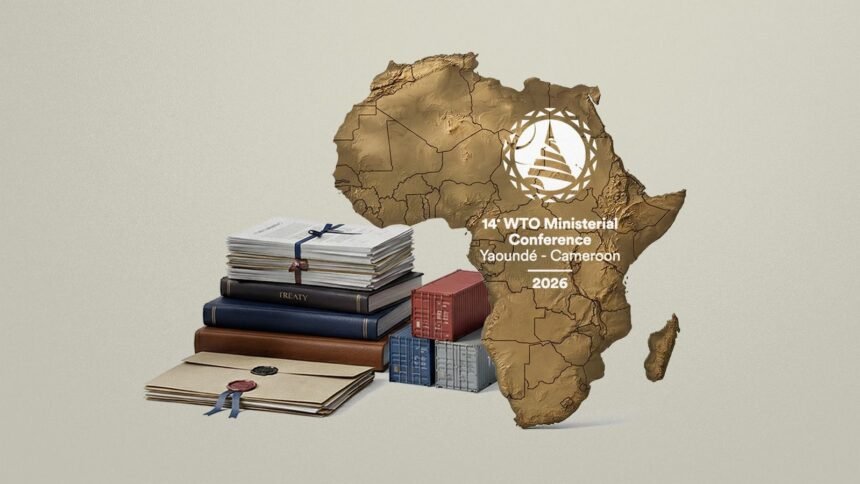
Delegates filed past security cordons and television cameras into a conference center draped with the World Trade Organization logo in Yaoundé. Inside, translators adjusted their headsets, and ministers shuffled through thick briefing folders, ready for another round of speeches on global trade rules.
Just a few blocks away, in a smaller room with weaker air‑conditioning and no live TV feed, a different kind of conversation was underway. Around a U‑shaped table, African trade officials, economists, and civil society representatives were debating a blunt question printed on the program:
“MC14: What’s in it for Africa?” The session was one of several Africa‑focused side events held on the margins of the WTO’s 14th Ministerial Conference (MC14), which runs from March 26 to 29 in Cameroon’s capital.
At stake is more than the wording of communiqués. MC14 has drawn ministers and thousands of delegates from the WTO’s 166 members to discuss issues ranging from agriculture and subsidies to digital trade and dispute settlement.
For African countries, the gathering is both a test of whether the multilateral system can still deliver for poorer economies and a rare chance to shape rules on everything from fisheries to the future of the clean‑energy transition.
This story is about those quieter rooms in Yaoundé, how African negotiators and experts are trying to make a sprawling trade summit deliver concrete gains on development, critical minerals, and sustainable trade, and why the outcome will reverberate far beyond the conference center.
The Road to MC14
The WTO’s ministerial conferences, which usually take place every few years, are the organization’s top decision‑making body. The Yaoundé meeting comes at a time of rising trade tensions, with disputes over industrial subsidies, digital trade, and climate‑related border measures straining relations between major powers.
Many developing countries, including in Africa, complain that promises made in earlier “development” negotiations have not been fully honored and that some new rules risk entrenching existing inequalities.
African governments arrive with specific concerns. Several are still grappling with slow growth and debt burdens aggravated by the pandemic and recent food and fuel price shocks. At the same time, they face pressure to add value to raw commodities, integrate regional markets, and align with climate goals.
Trade policy runs through all of those challenges: it shapes which exports are competitive, what kinds of investment arrive, and how new green standards affect market access.
The official MC14 agenda includes negotiations on issues such as agriculture and public stockholding for food security, reform of the WTO’s dispute settlement system, and new disciplines on harmful fisheries subsidies.
A 2022 agreement reached at the previous ministerial conference set initial rules to curb subsidies that contribute to illegal, unreported, and unregulated fishing; members in Yaoundé are working to expand those commitments to cover a broader range of support that fuels overfishing, including on the high seas.
For coastal African states, whose artisanal fishers complain of dwindling stocks and competition from industrial fleets, the outcome could affect both livelihoods and marine ecosystems.
Alongside these formal negotiations, the Yaoundé conference is increasingly framed by debates over “green” trade: how climate‑related policies, from carbon border charges to support for clean‑energy industries, will interact with development needs.
African leaders and experts have warned that poorly designed measures could become a new form of protectionism, even as they seek more investment for renewable energy and low‑carbon industries.
Human Stories and Real-World Examples
The side event titled “MC14: What’s in it for Africa? What next for secure development outcomes and fast integration imperatives?” organized by the U.N. Economic Commission for Africa, tries to translate those broad concerns into concrete questions.
Around the table, officials compare notes on how multilateral trade rules affect their efforts to implement the African Continental Free Trade Area, a flagship agreement aimed at creating a single African market of 1.4 billion people.
One trade negotiator from West Africa describes the dilemma: her country wants to preserve space for infant industries and regional value chains but also needs predictable access to global markets and clear rules for investors. In sessions like this, officials discuss whether proposed MC14 outcomes on subsidies, services, and digital trade would reinforce or undermine their industrial strategies.
A second side event, “Trade Cooperation on Africa’s Critical Minerals: Pathways for Equitable Clean Energy Transitions and Sustainable Development,” draws a different crowd: mining officials, climate policymakers, and trade lawyers.
Many African countries host large reserves of cobalt, lithium, manganese, and other minerals essential to batteries, solar panels, and wind turbines. Historically, those resources have been exported mainly as raw ore, with limited domestic processing.
Now, as demand for critical minerals surges, governments are asking whether trade and investment rules can help them capture more value and avoid repeating a pattern of extraction without broad‑based development.
At the Yaoundé event, speakers from regional bodies and research institutes discuss ideas such as cooperation on pricing, environmental and labor standards in mining, and strategies to attract battery and component manufacturing rather than just mines.
For communities in mineral‑rich regions, the stakes are double‑edged. New investment could bring jobs and infrastructure, but also environmental damage and social disruption if not managed carefully. African civil society groups at MC14 argue that any trade‑facilitating measures must be tied to strong safeguards and transparency in the sector.
Policy, Debate, and What’s Next
Across the formal plenaries and side events, several tensions run through the Yaoundé discussions. One concerns the balance between flexibility for developing countries and the desire for common, enforceable rules.
African delegations often argue for “policy space” to use tariffs, subsidies, or local‑content requirements to pursue industrialization and regional integration. Some wealthier members worry that too much flexibility could undermine the predictability that businesses rely on.
A second fault line is visible in debates over climate and trade. The European Union’s carbon border adjustment mechanism, which will eventually impose charges on certain carbon‑intensive imports, looms large in African discussions even if it is not formally on the MC14 agenda.
European officials describe it as a climate measure designed to prevent “carbon leakage.” African exporters and analysts fear it may act as a new barrier to entry, especially for countries with limited capacity to measure and reduce their emissions.
Experts from think tanks and international organizations at the Trade and Sustainability Hub, a parallel forum organized by the International Institute for Sustainable Development in Yaoundé, argue that MC14 is an opportunity to align trade rules more clearly with sustainability goals.
Sessions there examine how stronger disciplines on fisheries subsidies can protect marine ecosystems, how environmental standards might support rather than hinder market access for developing‑country producers, and how to ensure that green‑industrial policies in rich countries do not crowd out opportunities elsewhere.
On critical minerals, views diverge over how far trade cooperation should go. Some African officials and analysts argue for forms of coordination that would echo past efforts by commodity‑producing countries to improve their bargaining power. O
thers caution that attempts at collective action could be difficult to sustain, given differing national interests and the risk of backlash from major importing economies.
What is clear is that Africa’s representation at MC14 is more organized and vocal than in earlier eras of trade talks. Regional institutions like the Economic Commission for Africa and the African Union’s trade bodies have invested in technical work and policy notes ahead of Yaoundé, seeking to arm ministers with concrete proposals rather than general appeals.
When the gavel finally falls to close MC14, headlines are likely to focus on whether ministers clinched a package of agreements on fisheries, agriculture, or dispute settlement, or whether key files were pushed to the next meeting.
For African countries, the verdict will depend less on the press releases and more on whether the outcomes open space for what participants in those side rooms say they want: trade rules that help them industrialize, manage their resources for a low‑carbon future, and protect vulnerable communities from the costs of transition.
The scenes in Yaoundé’s smaller conference halls, a negotiator underlining a draft paragraph on development, a mining official asking how to avoid exporting jobs along with ore, a coastal representative tracking every word on fisheries, may not feature in the official photo albums. Yet for many on the continent, the answers worked out there will matter as much as anything said under the bright lights of the main ministerial stage.