



The Pan-African Paradigm of Military Sovereignty and Institutional Fragility
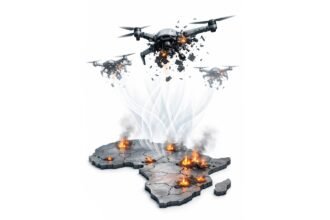
Across the African landscape, the promise of military rule as a shortcut to sovereignty is being tested by its own internal contradictions, and nowhere is this paradox more starkly rendered than in Niamey, where mutinous soldiers turned their weapons inward against the very junta that claimed to be restoring order. The predawn assault on Niger’s airport and presidential palace on August 30 is not an isolated flare-up but a structural symptom of a continental pattern: regimes that seize power in the name of security sovereignty often find that the architecture of control they build cannot withstand the pressures it was meant to contain. From Bamako to Ouagadougou to Niamey, the Sahelian juntas have recalibrated their alliances toward Moscow and away from former colonial patrons, framing this realignment as an assertion of self-determination. Yet the events in Niamey reveal an asymmetric trajectory: external sovereignty claims advancing even as internal institutional cohesion erodes. The Pan-African project of reclaiming agency from extractive foreign interests cannot succeed on rhetoric alone; it demands the harder, less visible work of building durable command structures, equitable resource distribution, and accountable governance capable of absorbing shocks from within, not merely without.
The Anatomy of an Uprising in Niamey
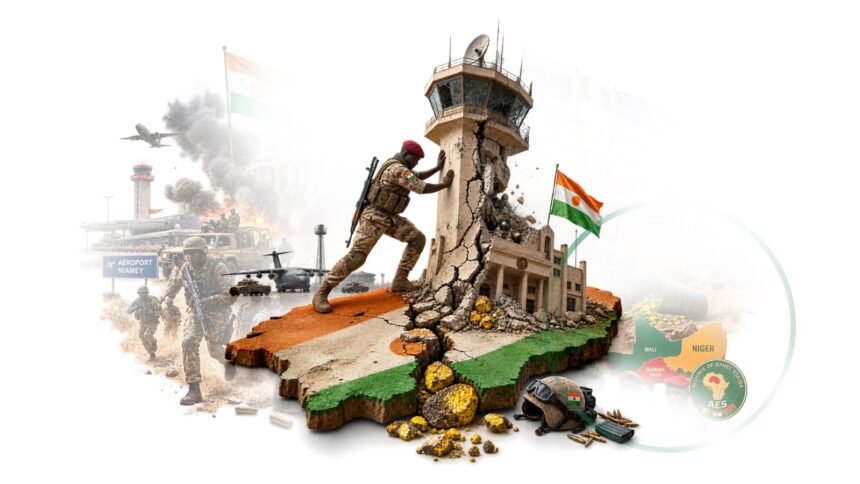
The mutiny that convulsed Niger’s capital before dawn on August 30 began with soldiers from a base inside Niamey opening fire on what state television later described as “sensitive sites,” briefly knocking the national broadcaster off air and triggering hours of gunfire and explosions around the airport and the presidency. By late morning, Niger’s defense ministry reported that armed forces were gradually retaking positions seized overnight. However, security sources said mutineers still held ground at the airport well into the afternoon, and the full picture remained unresolved by nightfall. A Reuters witness described heavy explosions near the military airbase, where Russian and Italian forces are stationed, underscoring how the country’s post-coup foreign partnerships have themselves become entangled in its internal instability. General Abdourahamane Tiani, who seized power in the July 2023 coup that ousted President Mohamed Bazoum, made no public appearance throughout the day, a silence that itself became a data point in the uncertainty gripping the capital. The mutineers reportedly sought to detain “some of their comrades” at the military airbase, according to the defense ministry. However, officials offered no further elaboration on the internal fracture driving the revolt.
Frontline Fatigue and the Sahel’s Asymmetric War
What distinguishes this mutiny from mere palace intrigue is its apparent origin among frontline units exhausted by an unwinnable counter-insurgency. Soldiers implicated in the operation reportedly came from Ouallam, Tera, and Dosso in Niger’s southwest, localities that have absorbed some of the heaviest casualties in the military’s campaign against Islamic State’s regional affiliate. Just a week before the mutiny, roughly eighteen soldiers were killed in a single overrun attack in Dosso, part of what analysts describe as an escalating pattern of mass-casualty assaults that is fraying the loyalty of troops asked to fight an asymmetric war with dwindling returns. Heni Nsaibia, a senior West Africa analyst with the Armed Conflict Location and Event Data project, characterized the jihadist groups as the singular beneficiaries of any internal security disturbance, since resources diverted to policing the army’s own ranks are resources withdrawn from the counter-terrorism trajectory the junta was installed to prosecute. This is the structural bind facing every Sahelian military government: the security paradigm used to justify extra-constitutional rule becomes, over time, the very thing that rule cannot deliver.
Uranium, Extraction, and the Economics of Control
Niger’s uranium wealth sits at the intersection of this crisis and the broader continental struggle over resource sovereignty. Since the 2023 coup, Tiani’s government has moved to seize assets from France’s Orano and reallocate uranium permits, including those formerly held by Orano and Canada’s GoviEx, to state-backed companies, a decree finalized only last week. Niger once supplied roughly fifteen percent of Orano’s uranium at full capacity, making it a structurally important node in Europe’s nuclear fuel architecture. The nationalization drive has been framed domestically as a reclamation of mineral sovereignty from extractive colonial-era arrangements, echoing a continental trend visible from the Democratic Republic of Congo’s copper export policies to Tanzania’s gold reserve strategy. But sovereignty over subsoil wealth means little if the institutional matrix meant to secure and administer it is itself vulnerable to internal collapse, as Saturday’s unrest starkly demonstrated.
The Alliance of Sahel States and the Limits of Solidarity
The Alliance of Sahel States, the confederal bloc uniting Niger, Mali, and Burkina Faso since their common break from ECOWAS, moved quickly to declare the mutiny thwarted and to voice support for Niger’s military establishment. Yet by Saturday night, it remained unclear whether Mali or Burkina Faso had provided any concrete military assistance, exposing the gap between the AES’s declaratory solidarity and its operational capacity. This is emblematic of a broader institutional weakness across the confederation: a shared ideological commitment to sovereignty and anti-Western realignment has not yet been matched by the interoperable command structures, resource-sharing mechanisms, or rapid-response frameworks that would allow the bloc to function as a genuine collective security architecture rather than a rhetorical alignment of convenience.
Reclaiming the Sahelian Trajectory: Sovereignty Beyond the Barracks
The unrest in Niamey warns against conflating the seizure of state power with the construction of durable sovereignty. Genuine self-determination, the kind the AES and its junta leaders invoke to justify their break from Western tutelage, cannot rest solely on realignment with new external patrons or on the nationalisation of extractive assets; it must be built from the institutional foundation upward, through professionalised, cohesive security forces whose loyalty rests on legitimacy rather than coercion, and whose grievances are addressed structurally rather than left to fester until they detonate in the capital’s streets. As Niger’s defense ministry works to consolidate control and as regional analysts assess how deeply the mutiny has fractured trust within the ranks, the broader continental lesson is unmistakable: the Sahel’s path toward reclaiming its sovereignty from centuries of extractive external interference runs not only through Moscow, Bamako, or Ouagadougou, but through the far harder work of building institutions that can hold under pressure from within. Until that architecture is in place, the region’s asymmetric war against instability will remain a battle fought as much in the barracks as at the frontlines.