



Nigeria’s counter-terrorism efforts face a stark escalation with Islamic State West Africa Province (ISWAP) deploying armed drones in attacks on military bases in Borno State, as seen in the January 29, 2026, raid on Sabon Gari that killed several troops and marked the group’s second assault that week. This tactical shift, using commercial drones rigged with grenades, signals a new phase in the 17-year insurgency, blending jihadist ideology with technological adaptation amid ongoing hybrid threats. As the military repels incursions and recovers arms, the focus shifts to bolstering defenses against this aerial menace, underscoring the need for integrated strategies to restore civil order.
Pan African Skies: Drone Threats in Regional Turmoil
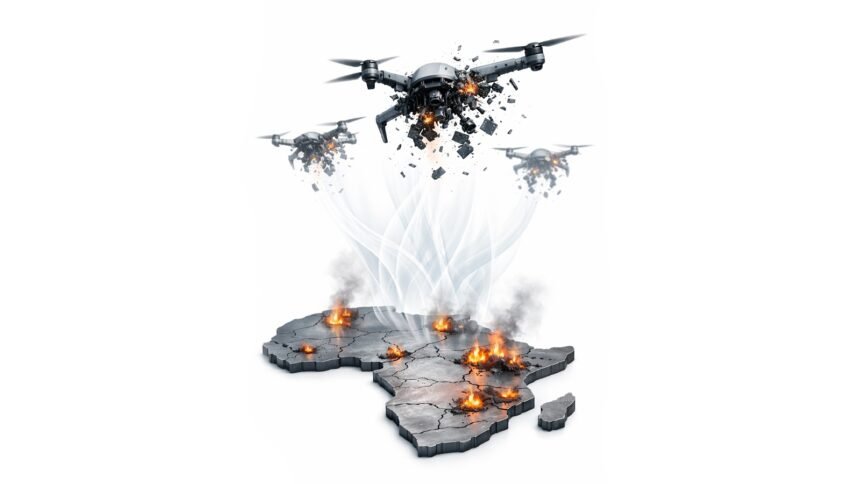
The advent of drone-backed militant attacks in Nigeria casts ominous shadows over Pan-African skies, where jihadist innovations threaten to redefine continental security dynamics. ISWAP’s January 29 assault on Sabon Gari base, deploying four armed drones alongside ground forces, resulted in heavy troop losses and a brief perimeter breach before air support repelled the invaders. This follows a similar raid earlier in the week, highlighting ISWAP’s growing operational sophistication in Borno, a hotspot where Lake Chad’s desiccation fuels herder-jihadist alliances.
Regional turmoil amplifies this: Sahel’s JNIM sieges displace millions in Mali, Mozambique’s ISIS raids uproot 300,000 since July, and Central African voids enable hybrid violence. Pan-African responses strain under ECOWAS fractures and AU funding gaps, yet Nigeria’s experience demands shared vigilance: intelligence fusion to track drone supply chains from Libyan markets, lest aerial threats cascade southward, disrupting trade arteries such as the Ivory Coast’s cocoa exports and undermining collective stability.
Nigerian Horizons: Escalating Drone Assaults on Bases
Nigerian horizons darken with escalating drone assaults on military bases, where ISWAP’s tactical evolution challenges entrenched counter-terror frameworks. The Sabon Gari raid, militants storming before dawn with drone-dropped grenades, killed at least nine soldiers and wounded 16, per security sources, marking a dangerous uptick in Borno’s violence. This builds on December 2024’s Wajiroko attack, where four grenade-laden drones injured five troops, and similar strikes in Damaturu and Abadam, signaling ISWAP’s shift from surveillance to offensive aerial capabilities.
Horizons reveal vulnerabilities: northwest Lakurawa hybrids tax communities amid herder-farmer clashes that kill thousands annually, while northeast ISWAP taxes Lake Chad for millions, funding technological upgrades. Military repels yield recoveries, AK-47s, RPGs, but overstretch persists: 40,000 troops juggle fronts, with corruption diverting funds. Escalations demand horizon expansion: enhanced surveillance and anti-drone tech to counter this aerial pivot, restoring operational dominance in jihad’s heartlands.
Counter-Terror Calculus: Responding to Aerial Jihad
Counter-terror calculus in Nigeria recalibrates amid aerial jihad, where ISWAP’s drone deployments force strategic adaptations beyond traditional ground ops. Sabon Gari’s breach, repelled by air support after initial losses, exemplifies this: militants’ coordinated drone-ground assault overwhelmed perimeters, yet rapid reinforcement neutralized the threat. This echoes December’s Wajiroko repulse, where troops downed drones and recovered munitions, killing assailants in follow-up pursuits.
Calculus integrates technology: Super Tucano jets deliver precision strikes, while U.S. hardware bolsters intelligence amid December’s Sokoto strikes. Yet jihad’s aerial edge, commercial models rigged for grenades, exploits gaps in drone defenses, with 2025 attacks surging 50 percent. Responding requires multifaceted approaches: AI surveillance and tracking of supply chains, community scouts for early warnings, and deradicalization pods rehabilitating thousands, balancing kinetics with prevention to outmaneuver this elevated threat.
AUV Wars: Nigeria’s Skirmishes with Drone Militancy
AUV wars unfold in Nigeria’s skirmishes with drone militancy, where ISWAP’s adoption of unmanned aerial vehicles transforms asymmetric conflicts into high-tech battles. Sabon Gari’s raid, drones scouting before ground incursions, breached defenses briefly, killing troops in a pattern seen in Wajiroko’s grenade drops, injuring five. These skirmishes mark ISWAP’s 2024-2025 pivot: from propaganda tools to offensive assets, with at least six confirmed drone attacks in Borno and Yobe.
War dynamics exploit terrain: Lake Chad’s islands shield bases, while the northwest forests harbor hybrids such as Lakurawa. Military counters, downing drones, and recovering payloads yield tactical wins, yet strategic strains emerge: overstretch diverts from banditry and separatists. Skirmishes demand AUV countermeasures: jammer technology disrupting signals, radar nets over bases, and Pan-African pacts sharing drone intelligence, turning aerial advantages against militants.
Protection Pathways: Shielding Civilians from Drone Perils
Protection pathways in Nigeria veer toward shielding civilians from drone perils, where ISWAP’s aerial assaults endanger communities beyond military targets. Sabon Gari’s raid spilled chaos into nearby villages, with unexploded grenades threatening farmers, echoing Wajiroko’s injuries to troops but risking broader harm. Perils amplify in Borno’s IDP camps, 2 million displaced, where drones scout for raids, blending with bandit abductions like Papiri’s 315 pupils.
Pathways fortify: community rangers patrol perimeters, while the Centre’s 2025-2030 plan devolves security with ethnic quotas. Shielding extends: agro-reserves ease herder conflicts, fueling recruitment, and scholarships reclaim 18.5 million out-of-school youth. Protection requires holistic approaches: interfaith accords, healing divides, Pan-African aid, bolstering trauma pods, and transforming perils into resilient pathways for communal safety.
Civil Order Constructs: Rebuilding Amid Drone Disruptions
Civil order constructs falter amid drone disruptions, where ISWAP’s attacks erode governance in Borno, displacing thousands and shuttering schools. Sabon Gari’s breach disrupted supply lines, while Wajiroko’s assault halted patrols, thereby amplifying bandit ransoms, which netted billions. Disruptions intersect hybrids: northwest Lakurawa tax flows fund arms, spilling from Sahel incursions.
Constructs rebuild: military recoveries, AK-47s, RPGs, bolster ops, while Tinubu’s reforms allocate trillions for security tech. Rebuilding demands inclusive edifices: devolved policing empowering local communities, economic networks lifting 53 percent of people out of poverty. Amid disruptions, constructs fortify civil fabrics: AU-backed dialogues mediating ethnic rifts, transforming chaos into ordered resilience against drone-borne threats.