




East African leaders are exploring plans to establish a shared oil refinery as part of efforts to reduce the region’s heavy reliance on imported fuel and unlock more value from locally produced crude.
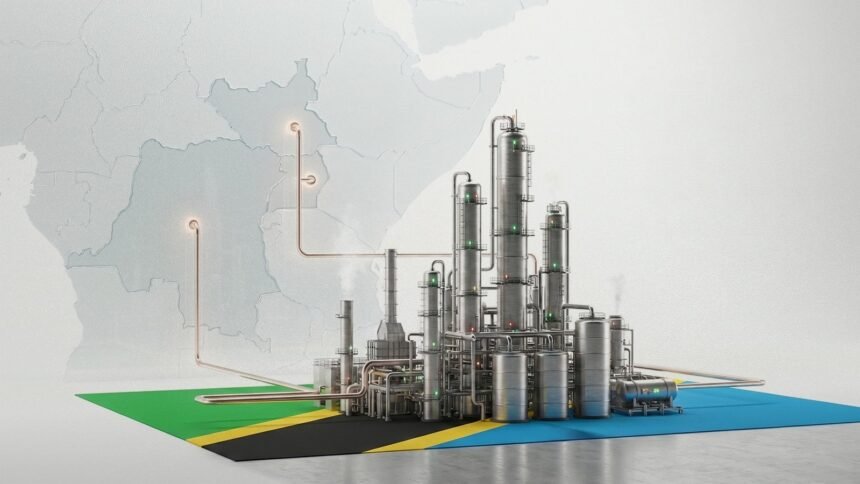
Speaking at The Africa We Want Summit in Nairobi, Kenya’s President, William Ruto, said the proposed refinery would be set up at Tanga Port in northeastern Tanzania and serve multiple countries across the region.
“We are going to develop a joint oil refinery in Tanga to benefit all of us,” Ruto said, noting that the facility would process crude oil from countries such as the Democratic Republic of the Congo and South Sudan.
The proposal has already attracted interest from major investors, including Nigerian industrialist Aliko Dangote, who expressed readiness to back the project. Dangote said that if regional governments provide the necessary support, a refinery similar to the one he operates in Nigeria could be built within four to five years.
“I can give commitment to the two presidents that are here, if they will support the refinery, we will build an identical one to what we have in Nigeria,” he said.
Dangote’s refinery, which began production in 2024, is currently the largest in Africa, with a capacity of 650,000 barrels per day following a $20 billion investment.
Despite producing around 10 million barrels of oil daily, about 10 per cent of global output, Africa continues to import a significant share of its refined petroleum products. The continent’s annual fuel import bill exceeds $90 billion, highlighting a major gap in domestic refining capacity.
At current market rates, Africa’s crude oil production is valued at roughly $270 billion each year. However, leaders argue that refining the oil locally could more than double its value. According to Ruto, exporting refined products instead of crude could generate over $500 billion annually.
“This represents a forgone income of about $230 billion, which is nearly 7.5 per cent of our GDP from just one resource,” he noted.
Data from the Africa Finance Corporation shows that the continent imports more than 70 per cent of its refined fuel and faces a broader import bill estimated at $230 billion annually, covering essential goods such as fuel, food, fertilizer, plastics, and steel.
Uganda’s President, Yoweri Kaguta Museveni, also backed the idea of a regional refinery, arguing that such projects are both viable and profitable.
“When we discovered oil in Uganda, the major oil companies kept telling us refineries do not make money. But when I checked, a refinery in Uganda is actually very profitable,” he said.
Uganda is preparing to begin commercial oil production and has already signed an agreement with UAE-based Alpha MBM Investments to develop a refinery with a capacity of 60,000 barrels per day.
Museveni further pointed out that the region has untapped financial resources that could support such large-scale infrastructure projects, including funds held in pension schemes.
Beyond oil, East Africa is also rich in renewable energy resources and critical minerals needed for the global energy transition, including copper, cobalt, lithium, and rare earth elements. The Democratic Republic of Congo, for instance, remains the world’s leading producer of cobalt, accounting for more than 70 per cent of global supply.
Leaders say harnessing these resources through local processing and value addition will be key to strengthening regional economies and reducing dependence on imports.