





Pan-African Mineral Renaissance: From Raw Export to Continental Mastery
For decades, Africa has exported the future in its rawest form: cobalt from Katanga, tantalum from Rwanda, lithium from Zimbabwe, and, quietly beneath the radar, some of the planet’s richest rare-earth endowments. The continent hosts an estimated 18–22 % of the world’s identified rare-earth resources (far higher if underexplored carbonatites and ionic-clay systems are fully mapped). Yet it refines less than 1% of the global supply. The African Union’s Mining Vision of 2009 and its 2025 African Green Minerals Strategy have now converged into a single, unambiguous objective: to capture the downstream value chain, keep refining and magnet-making on the continent, and use the proceeds to industrialise. The 17 elements that power everything from F-35 jets to offshore wind turbines are no longer just geological accidents; they are the leverage with which Africa intends to renegotiate its place in the world economy.
The New Scramble: Why Rare Earths Suddenly Matter More Than Gold
Rare-earth elements are not particularly rare in crustal abundance, but they are challenging and expensive to separate into usable oxides. Until the 1980s, the United States led the world from its Mountain Pass mine in California. By the early 2000s, China had captured 97% of refined output through a combination of low costs, lax environmental oversight, and strategic state support. Today, a single Chinese province (Jiangxi) processes more rare earths than the rest of the planet combined. The shock of 2010–2011, when Beijing slashed export quotas and prices spiked tenfold overnight, exposed the fragility of Western supply chains. The green and digital transitions have since multiplied demand: a single 3 MW wind turbine requires roughly 600 kg of neodymium-praseodymium (NdPr) magnet material; an electric vehicle needs 1–2 kg; a Tomahawk missile uses several kilograms of samarium-cobalt. With global demand forecast to triple by 2040, the West has no realistic path to net-zero or defence modernisation without African deposits.
Beneath the Equator: Africa’s Extraordinary Rare-Earth Geology
Africa’s rare-earth geology is uniquely favourable. South Africa’s Steenkampskraal remains the highest-grade undeveloped REE deposit on Earth (14.4% TREO in surface material). The Zandkopsdrift carbonatite in the Northern Cape, Phalaborwa’s re-treatment of historic phosphate tailings, and the emerging Wigu Hill project in Tanzania all grade above 3–6 %, dwarfing typical Chinese ion-adsorption clays at 0.05–0.2 %. Further north, the Lofdal dysprosium-terbium project in Namibia is one of only two significant heavy rare-earth projects outside China moving toward production. Madagascar’s Tantalus and Ampasindava ionic-clay discoveries mirror southern China’s easily leachable deposits. At the same time, Angola’s Longonjo and the DRC’s vast but chaotic Gakara and Lueshe carbonatites hint at trillion-dollar in-situ values. Taken together, credible industry estimates now place Africa’s realistic production potential at 12–15 % of global supply by 2035, provided capital, technology, and political will converge.
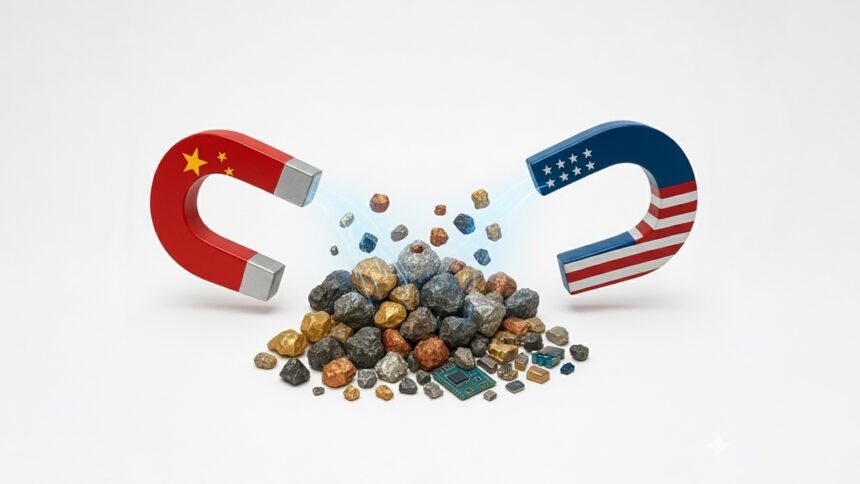
Dragon and Eagle: The Intensifying Sino-American Duel in African Soil
China arrived first and dug deepest. From 2005 to 2020, Beijing secured more than forty mining and exploration agreements across the continent, often bundled with roads, railways, and power stations. By 2024, Chinese entities controlled or held significant stakes in Burundi’s Gakara, Namibia’s Lofdal (before its recent re-negotiation), Zimbabwe’s multiple ionic-clay prospects, and large swathes of the DRC’s mineral belt. The model is familiar: infrastructure loans swapped for long-term off-take, refining done in Ganzhou or Baotou, value accruing far from African soil.
Washington’s counter-strategy crystallised only after 2021. The Biden administration’s Minerals Security Partnership, the re-capitalised U.S. International Development Finance Corporation (DFC), and the G7’s Partnership for Global Infrastructure and Investment (PGII) now target the same terrain. Landmark moves include:
- The $3.8 billion Lobito Corridor railway linking Angola’s coast to the Copper-Cobalt heartland of Zambia and the DRC is explicitly designed to offer an Atlantic alternative to Chinese-controlled routes.
- DFC financing for the re-opening of Steenkampskraal and the development of Mkango’s Songwe Hill in Malawi.
- A trilateral US–DRC–Zambia memorandum on electric-vehicle battery value chains that implicitly includes rare earths.
- Direct equity investments by U.S. funds in Namibia’s Lofdal 2B-4 project after a Chinese partner was bought out in 2023.
The competition is no longer abstract. In Burundi, a U.S.-backed consortium lost the Musongati nickel-rare-earth project to a Chinese bidder in 2022 despite offering better environmental terms. In Madagascar, Chinese firms dominate the northern ionic-clay belt while American juniors scramble for scraps further south. The stakes are measured in decades of supply security.
Economic Sovereignty: Beyond Dig-and-Ship
Every African leader now repeats the exact phrase: “We will not be the hewers of ore and drawers of water for the 21st century.” US investment, unlike much Chinese capital, is increasingly conditioned on local processing. The DFC’s standard loan covenants require at least first-stage separation (crude concentrate to high-purity oxide) to occur in-country. South Africa’s planned Rare Earth Refinery in the Waterberg, partly funded by U.S. pension funds, aims to produce 4,000 tonnes of separated oxides annually by 2029. Malawi’s Kayelekera will host a separation plant attached to its uranium-rare-earth operation. These facilities, modest by Chinese standards, would still represent the first meaningful non-Chinese refining capacity built in twenty-five years.
The multiplier effects are considerable. Each direct mining job creates 6–9 downstream positions; separation plants are skill-intensive; magnet and component factories even more so. A single NdPr oxide plant employing 400 people can generate $1–2 billion in export revenue at current prices. Tax revenues, royalty structures tied to processed value, and mandatory free-carry state equity (10–20 % in most new codes) give governments real fiscal leverage for the first time since the commodity supercycle collapsed in 2014.
Green Paradox: Fuelling the Energy Transition While Guarding the Continent’s Lungs
Rare earths are indispensable to decarbonisation, yet their extraction can be environmentally brutal. Traditional processing uses thousands of tonnes of ammonium sulphate and oxalic acid, leaving radioactive thorium tailings and acidified watersheds. Africa has a chance to leapfrog this legacy. American and European investors, constrained by their own ESG mandates, are piloting:
- Dry-stack tailings and zero-discharge circuits at Steenkampskraal.
- Bioleaching and resin-in-pulp technologies that slash chemical use by 70–90 %.
- Solar-powered mine sites in Namibia and Madagascar that eliminate diesel.
The continent’s rainforests and water tables cannot absorb another generation of Chinese-style open-loop processing. The African Union’s Green Minerals Strategy now demands complete cradle-to-grave environmental management plans before licences are granted. The US, for all its strategic urgency, has little choice but to comply if it wants access.
Dignity in the Depths: Labour, Communities, and the Artisanal Shadow
Rare-earth deposits often overlap with artisanal mining zones. In Burundi and the eastern DRC, hand-dug pits for coltan and gold already yield incidental rare-earth concentrates sold into opaque Chinese networks. Child labour, tunnel collapses, and mercury contamination are routine. Any serious Western investor must confront this reality head-on. New projects increasingly incorporate:
- Formalisation programs that transition artisanal miners into mechanised cooperatives with equity stakes.
- Community development agreements that allocate 3–5 % of gross revenue to health, education, and water infrastructure.
- Blockchain-traced supply chains that allow premium pricing for verified ethical material.
The U.S. State Department’s Artisanal Mining and Property Rights project in the DRC now explicitly folds rare-earth zones into its remit. Without these measures, no Western rare-earth mine will survive NGO scrutiny or local resistance.
The Next Decade: Scenarios for an African Rare-Earth Order
Three broad futures are plausible by 2035:
- Chinese Dominance Entrenched Beijing finances the majority of new capacity, builds refineries in special economic zones, and locks Africa into another generation of raw or semi-processed exports. Western efforts remain fragmented and underfunded.
- Bipolar Standoff: The US and allies secure 25–30% of African output and a similar share of new refining capacity, but at a premium. Prices stay high, innovation is duplicated, and African governments play the two blocs against each other with mixed success.
- Pan-African Breakthrough (the stated goal of Agenda 2063). Coordinated AU policy forces all investors—Chinese, American, European, Emirati—to build separation and at least a precursor manufacturing base on the continent. A pan-African Rare Earth Exchange sets benchmark prices. Revenue funds the African Development Bank’s industrialisation window. Supply chains diversify, monopolies erode, and the continent finally captures the value that has eluded it since the colonial era.
The United States now has both the motive and the means to tilt the outcome toward the third scenario. Whether it possesses the patience, the humility, and the long-term capital commitments required remains the open question of the decade. What is no longer in doubt is that the crimson earth beneath Africa’s feet will help decide who powers the century ahead.


