



The Pan-African Paradigm of Insecurity and Displacement
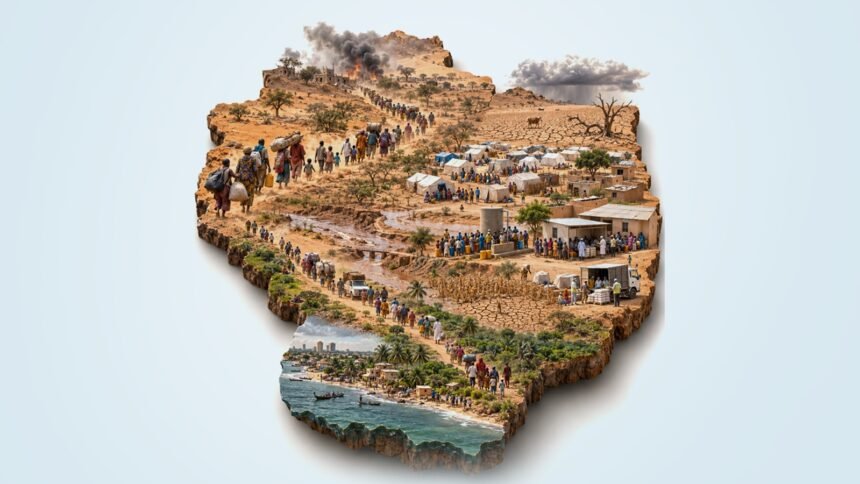
In 2020, before the wave of coups that reshaped the region, the central Sahel counted more than 1.7 million internally displaced people and 365,000 refugees. Six years later, the UN refugee agency (UNHCR) says nearly four million people have been forced from their homes in Burkina Faso, Mali and Niger, more than double the earlier total. Among them are 818,000 refugees and asylum seekers. The agency raised the alarm in Geneva on Friday, warning that the crisis is deepening just as the world looks away.
Three Pressures, One Outcome
UNHCR’s diagnosis is blunt. “The crisis is being compounded by continued attacks affecting civilians, climate-related shocks and severe humanitarian funding shortfalls,” it said in a statement. Each of these pressures on its own would strain any state. Together, they create a trajectory in which displacement becomes self-reinforcing: violence empties villages, drought and erratic rains erode what livelihoods remain, and a lack of funding means the displaced cannot rebuild, so they move again.
Abdouraouf Gnon-Konde, UNHCR’s regional director for West and Central Africa, said these pressures are “forcing more families to flee, eroding livelihoods and limiting opportunities for displaced people to rebuild their lives,” contributing to further movement within and beyond the region. Speaking after a visit to the Sahel, he added: “Unfortunately, the international attention is receding.”
Koro: When Refugees Equal the Host Population
The numbers become concrete in places like Koro, in Mali’s central Bandiagara region near the border with Burkina Faso. In July, the town hosted some 86,000 Burkinabe refugees, including more than 14,000 children, after several recent influxes. According to UNHCR, the refugee population there is now nearly equal to the local host community. That pressure falls on land and water that were already limited and on health services that are now overwhelmed.
Koro illustrates a dimension of the crisis that rarely draws attention: the cost borne by host communities that are themselves poor and insecure. Most refugees in Mali come from neighboring Burkina Faso. The Sahel’s displaced are not, for the most part, traveling to wealthy countries. They are moving into communities facing many of the same threats they fled. Gnon-Konde noted that instability is increasing pressure on asylum systems in countries already struggling with weak public services.
The Southward Spillover
The crisis is no longer contained within the central Sahel. UNHCR warned that hundreds of thousands of people have been displaced towards coastal West Africa, into Benin, Côte d’Ivoire, Ghana and Togo. That southward movement carries the Sahel’s insecurity into states that have so far been more stable, and it tests whether their institutions, from border administration to local health systems, can absorb new arrivals without sharpening local tensions.
This spillover is the strategic heart of the story. The coastal states have a direct interest in what happens in Burkina Faso, Mali and Niger, yet they cannot resolve a crisis whose drivers lie beyond their borders. The doubling of displacement since 2020 has coincided with a period of coups and political upheaval in the central Sahel, and the consequences now travel south regardless of how governments realign. Displacement does not respect diplomatic boundaries.
A Funding Gap That Becomes a Policy Choice
In September, UNHCR estimated that it had received only 27 percent of the funding it needs for its work in the Sahel. A shortfall of that scale is not a technical problem. It determines whether displaced families receive shelter, whether children go to school and whether host towns like Koro can keep clinics open. When international attention recedes, as Gnon-Konde warned, the people with the fewest options pay first.
There is an asymmetry here worth naming. Donor attention follows headlines, and the Sahel competes with wars that receive far more coverage. Yet the scale of displacement, nearly four million people, rivals crises that command global summits. The decline in funding is a choice, even when it is made passively through neglect.
The funding gap also undermines the logic of prevention. Support that allows displaced families to farm, trade and send children to school near where they have settled reduces the pressure for onward movement towards the coast and beyond. Withdrawing that support does not make the crisis cheaper; it relocates the cost to host communities, to coastal states and, eventually, to the displaced themselves, who are forced to move again with even fewer resources than before.
Closing: Structural Sovereignty and the Right to Stay
The central Sahel’s governments have framed their recent course as a reclaiming of sovereignty. That claim will be measured by whether citizens can remain safely in their homes. Structural sovereignty means the capacity to protect civilians from attack, to build resilience against climate shocks and to support the communities that host the displaced, using national resources and regional cooperation rather than depending on dwindling outside aid. Until that architecture is in place, the region’s most visible export will continue to be its own people, moving from one fragile place to another in search of a safety that keeps receding.