






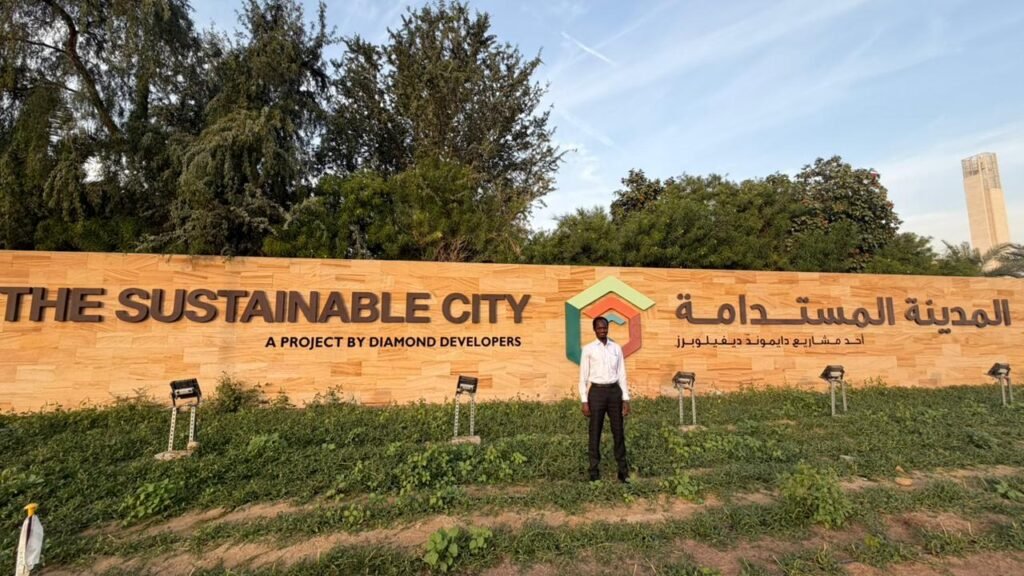
At a net-zero campus on the edge of Dubai’s desert, a quiet revolution in career thinking is underway. At SEE Institute’s “SEE Futures: Purpose to Profession, Careers & Leadership in Sustainability” event, sustainability was not presented as a niche, feel‑good field, but as one of the most demanding and deeply human career paths of our time.
For students, young professionals, and seasoned leaders gathered in The Sustainable City, the message was unmistakable: this work is not about glossy ESG reports or green branding. It is about culture, behaviour, power, and the uncomfortable emotional work of changing how organisations and societies operate.

From slogan to system: what a sustainability career really entails
Hosted at SEE Institute’s pioneering net‑zero building, the event set out to explore a deceptively simple question: what does it mean to turn personal purpose into a profession in sustainability?
The answer that emerged over the course of the day was layered and, at times, sobering.
Speakers described sustainability roles spanning strategy, policy, innovation, and community engagement. Today’s practitioners are expected to understand climate risk and circularity, speak the language of finance and regulation, and communicate clearly to employees, communities, and sceptical executives.
The pressures are both structural and personal. Many organisations are trapped between the urgency of climate targets and the inertia of business‑as‑usual. That tension can slow progress or push companies towards superficial fixes – the greenwashing that fills websites while leaving core models untouched. For those building careers in this space, frustration is not a side effect; it is part of the job description.

From compliance to culture: humanizing sustainability at work
Few captured this tension more sharply than Dr. Hanane Benkhallouk, founder and Executive Director of Sustain Leadership, whose work focuses on human‑centred leadership and systems transformation. She began by dismantling a phrase that has long governed corporate life: “It’s business, it’s not personal.” In sustainability, she argued, that line simply no longer holds. Much of this work is intensely personal – for employees whose identities are bound up with their work, for communities living with climate impacts, and for leaders who must decide what kind of legacy they will leave.
The core thesis is that reports and compliance do not change behaviour; people and culture do. Organisations that treat sustainability as a reporting exercise will struggle to move beyond rhetoric. Those that create psychological safety – where people can question, experiment, and fail without fear, are the ones capable of genuine transition. That shift, in her words, is a move “from C to C”: from compliance to culture.
She pointed to the Susceptivity and SEE Institute as the proof of concept. Their framework begins deliberately with the “S” in ESG – social – because the social fabric has shaped how the city has functioned for more than a decade. The community design is human‑centred, built around residents’ needs and values. Over time, that design has allowed sustainable behaviours to emerge organically: neighbours nudging one another, social norms forming without heavy‑handed enforcement.
Dr Benkhallouk also challenged a persistent misconception: that “human‑centric” automatically means humanitarian or charitable. In reality, she noted, market‑leading products and services increasingly rely on human‑centric design because customers can no longer be reduced to demographic clichés. Even within a single household, streaming platforms reveal multiple distinct profiles and tastes; sustainability strategies that ignore this complexity will fail both commercially and ethically.
Expertise is not enough: the execution gap.
If Dr Benkhallouk’s intervention centred on culture, Hakeem Haidar’s session drilled into capability – and the uncomfortable truth that knowledge alone does not move the needle. A Chartered Manager (CMgr MCMI) and MENA Engagement Manager at the Chartered Management Institute (CMI), Haidar has spent years working with universities, employers, and training providers to raise management and leadership standards across the region. Drawing on that experience, his warning to the room was blunt: becoming a sustainability expert is not sufficient if you neglect your own broader professional development.
He noted that when most people hear “sustainability,” they think of environmental skills: carbon accounting, biodiversity, renewable energy, and climate science. These are essential foundations, he acknowledged, but they cover only part of the terrain. The critical – and often missing- piece is execution: project management, stakeholder influence, organisational politics, and the practical ability to turn frameworks, strategies, and degrees into outcomes that actually change how an organisation operates.
To students and early‑career professionals, Haidar offered a concrete prescription: build and maintain a living log of continuous professional development. That record, he suggested, should not only list new technical courses, but also leadership programmes, communication and presentation training, mentoring relationships, and real experiences of cross‑functional collaboration. It is dangerously easy, he argued, to become absorbed in assignments or day‑to‑day operational tasks and lose sight of what will be required to operate at the management or leadership level. A sustainability degree may open the door; execution skills determine what you can do once inside.
For senior leaders in the room, his message was equally clear. Hiring sustainability officers or creating ESG titles will not deliver transformation on their own. If organisations genuinely want change, they must invest in these professionals’ development, give them access to decision‑making forums, and create space for them to lead initiatives rather than advise from the margins. In Haidar’s framing, the future of sustainability as a career depends as much on management quality and leadership pipelines as it does on climate expertise.
Connect, protect, reflect: an accessible model for impact.
If some of the conversations felt heavy, Sulaiman Alaleeli brought welcome lightness without diluting the message. A chemical engineer by training, he has built a career across sustainability, clean energy, green hydrogen, and decarbonisation, and framed his own path as proof that there is no single, linear route into this field. Promising to explain “how to be more successful,” he boiled his advice down to three verbs: connect, protect, reflect.
Connect, he argued, because sustainability is a systems problem and no single department, discipline, or job title can solve it alone. Professionals must build genuine relationships across silos, sectors, and even ideologies if they hope to move entrenched systems. Protect, not just in the environmental sense, but in the human one: safeguarding trust, well-being, and dignity is central to any credible sustainability agenda. Reflect, because without regular, honest reflection, sustainability slips into branding, and language drifts away from lived reality. In his own words elsewhere, “sustainability careers don’t follow one path,” and that diversity of journeys only becomes an asset when people are willing to pause, learn, and recalibrate.
He also named a stubborn perception problem: for many people, “doing sustainability” still sounds like a matter of updating website content or tweaking communications. Part of the task for sustainability professionals, he suggested, is to reframe the conversation so that leaders understand it as a core strategic function that shapes every aspect of how a company operates – from investment decisions and product design to how people are hired, managed, and rewarded.
Soul, Purpose, Profession: Sheikh Abdulaziz’s 4Ps of Sustainability
Sheikh Dr. Abdulaziz bin Ali bin Rashid Al Nuaimi, widely known as “The Green Sheikh”, set the tone in his keynote by framing sustainability as a journey of the soul as much as a professional path. A member of the Ajman ruling family and Environmental Advisor to the Government of Ajman, he has spent decades advocating for sustainable lifestyles, environmental protection, and youth empowerment through his roles, initiatives, and the Green Sheikh Academy.
Drawing on his 4Ps framework, Passion, Purpose, Practice, and Profession, he urged the audience to see sustainability not as an external agenda imposed by policies or trends, but as a way of life that begins with inner conviction and daily practice before it translates into career choices and public leadership. His stories and reflections grounded the day’s discussions in values and responsibility: the idea that the most resilient sustainability careers are built where inner purpose, spiritual integrity, and professional ambition meet.

An African lens: when policy creates careers
The questions raised in Dubai echo far beyond the Gulf. Across Africa, where climate vulnerability is acute and youth unemployment is high, governments and partners are experimenting with ways to turn sustainability from an abstract global agenda into concrete careers. One telling example is Rwanda.
Through its Green Growth and Climate Resilience Strategy and aligned programmes, Rwanda has sought to connect climate action with youth employment, particularly by supporting environment‑related businesses. Initiatives backed by UNDP and others help young entrepreneurs build ventures in sustainable agriculture, waste management, eco‑tourism, and other green sectors – treating sustainability not just as a policy commitment but as a job creation engine.
The logic parallels SEE Institute’s message: purpose becomes a profession when an ecosystem enables it. That ecosystem includes coherent policy, access to skills and training, supportive regulation, and communities that recognise the value of this work. For African countries, the Rwanda example suggests a path forward: embed sustainability into education and vocational systems, design labour policies that recognise green jobs, and empower young professionals to advocate for climate action from within local government, business, and civil society.
A new kind of professional
Taken together, the voices at SEE Futures and the realities unfolding from Dubai to Kigali sketch the outline of a new professional archetype. This is someone who is technically literate in climate and ESG, as well as emotionally intelligent, ethically grounded, and relentlessly committed to learning.
A career in sustainability is not the soft option it is sometimes imagined to be. It means working with incomplete information, slow timelines, and frequent resistance. It means insisting that “business” and “personal” can no longer be kept apart when the stakes are planetary and generational. Yet precisely because it is difficult, it offers a rare kind of meaning.
In moving from compliance to culture, from knowledge to execution, and from individual ambition to shared responsibility, sustainability professionals are helping to redefine what success looks like in business and public life. For those willing to embrace its demands, sustainability is not just a sector. It is a demanding, deeply human way of shaping the future.