



Pan-African Prism: Continental Debt Dialogues in Dispute
Africa’s debt dialogues refract through a pan-African prism of contested reforms and creditor concessions, where Ghana’s protracted IMF negotiations mirror broader frictions amid a $90 billion repayment wall in 2026. Sub-Saharan liabilities, surging to $707 billion, siphon 15% of revenues into servicing debt, eclipsing social investments in 38 nations and fueling disputes over austerity versus growth. This prism illuminates West Africa’s squeeze: Ghana’s $45 billion stock, post-2023 default, echoes Senegal’s “fundamental differences” with the IMF on pessimistic projections, rejecting restructurings that imperil sovereignty. Continental currents clash: IMF’s global parity demands haircuts and fiscal tightening, while AU-led initiatives, like Lomé’s conclave, advocate hybrid relief, unlocking $150 billion in swaps. Ghana’s rift, delays in creditor pacts, and disputes over exchange frameworks resonate with Ethiopia’s bondholder lawsuits and Zambia’s 1,138-day odyssey. Yet, the prism gleams with BRICS ballast: Afreximbank’s $750 million settlement in December 2025 counters isolation, AfCFTA’s $650 billion uplift by 2043 diversifies, refracting disputes from deadlock to developmental dawn across Africa’s fiscal spectrum.
Gold Coast Guard: Ghana’s Sovereign Stance Amid IMF Pressures
Ghana’s sovereign stance guards its Gold Coast legacy against IMF pressures, where disputes over fiscal assumptions and creditor treatments underscore a guard against external overreach. Historically, post-2016 commodity crashes have bred vulnerabilities, culminating in 2023’s default on $45 billion in debt, 60% of GDP, amid cedi slumps and 25% inflation. Guard’s contours: IMF’s 36-month $3 billion ECF, approved May 2023, mandated reforms, revenue mobilization, expenditure curbs, yet the fifth review in December 2025 highlighted frictions: an agreement in principle with Afreximbank resolved the $750 million standoff, but ongoing engagements with remaining commercial creditors delay full relief. Ghana’s stance rejects the IMF’s “pessimistic” outlooks, insisting on sustainable paths sans haircuts that jeopardize relations. Central to guard: disputes over exchange rate frameworks, where the IMF queries the balance between stability and competitiveness, amid yuan swaps saving $215 million annually. In this guard, Ghana’s 4.4% 2026 growth, led by gold’s 148 tonnes, non-oil exports, and defense of autonomy, transforms IMF pressures into pragmatic pacts.
Global Guardian Clash: IMF vs. Ghana Central Bank’s Policy Tug
The IMF and Ghana’s Central Bank’s policy tug-of-war embodies a global guardian clash, where directives for stringent reforms pull against Accra’s calibrated autonomy in the monetary and fiscal spheres. IMF’s tug: ECF reviews demand primary surpluses (1.5% of GDP by 2025 end), revenue hikes, SOE oversight, and fifth review-approved disbursements, praising 2026 budget’s alignment yet flagging downside risks from global fragmentation. Vs. BoG’s stance: exchange management balances price stability (inflation at the 15% midpoint) with competitiveness, rejecting IMF critiques of FX interventions as overly rigid. Clash intensifies in creditor talks: IMF insists on comparability, haircuts, maturity extensions, while BoG guards against restructurings that spike yields (9.8%), preferring bilateral accords like Afreximbank’s December 2025 settlement. Policy tug’s tensions: IMF’s pessimistic assumptions clash with Ghana’s optimistic indicators, long-term sustainability sans defaults. In this guardian fray, clash catalyzes compromise: BoG’s reforms deepen, IMF’s flexibility fosters, tugging toward balanced fiscal fortitude.
Fiscal Faultlines: Debt Crisis & Economic Relief’s Uneasy Equilibrium
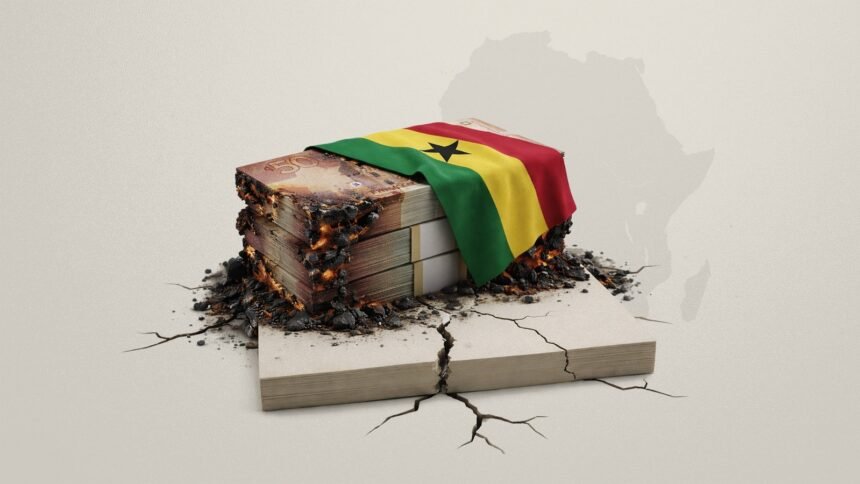
Ghana’s debt crisis carves fiscal faultlines, where IMF relief’s equilibrium teeters uneasily between austerity’s edge and economic revival’s ridge. Crisis’s contours: $45 billion in stock post-2023 default devours 40% of revenues, diverting from the SDGs amid food insecurity for millions. Faultlines fracture: creditor opacity, 43% private, prolongs pacts, with IMF’s ECF unlocking $3 billion yet conditioning on restructurings that halve ratios, freeing $5 billion for health. Relief’s uneasy arc: bilateral deals with the Official Creditor Committee, commercial engagements yield agreements in principle, yet disputes over the “pessimistic” IMF outlook reject haircuts, insisting on sustainable trajectories. Equilibrium shifts: yuan swaps, Afreximbank settlements counter U.S. tariffs’ 0.8% GDP dent, while 2026 budget’s fiscal discipline, deficit curbs, align with relief. Yet, faultlines persist: social unrest from 2024 protests hampers implementation, and poverty at 24% demands safeguards. In this equilibrium, crisis and relief forge uneasy paths, mending faultlines toward resilient ridges.
Prosperity Pillars: Economic Development & Poverty’s Intertwined Paths
Ghana’s prosperity pillars interweave economic development with persistent paths of poverty, where IMF disputes highlight tensions between growth imperatives and equitable uplift. Development’s pillars: 4.4% 2026 ascent, gold’s 148 tonnes, non-oil exports $11.6 billion, harnesses reforms for manufacturing surges, yet poverty’s 24% grip (2025) diverts gains, with 6 million in extreme deprivation. Intertwined arcs: IMF’s ECF demands revenue mobilization and SOE efficiency to free $5 billion for health and education, countering the crisis’s diversion. Yet, disputes over pessimistic projections risk austerity that exacerbates inequality, with a Gini coefficient of 0.43, amid youth exclusion. Prosperity’s paths: AfCFTA integrations lift intra-trade, BRICS pacts diversify from commodity traps. Poverty’s pall: food insecurity, climate shocks demand IMF-flexible safeguards, social grants, vocational boosts. In these pillars, development and poverty entwine: IMF-guided growth, if sovereign-aligned, erects equitable edifices, illuminating paths from intertwined trials to prosperous peaks.
Autonomous Arcs: Sovereignty in IMF’s Shadowed Sphere
Ghana’s sovereignty arcs through the IMF’s shadowed sphere, where disputes defend autonomous arcs against the global guardian’s gaze, balancing external aid with internal agency. Sovereignty’s silhouette: post-default autonomy rejects IMF-pushed restructurings, insisting on “sustainable debt” sans creditor jeopardy, echoing Senegal’s “fundamental differences.” Arcs arch: BoG’s exchange framework guards competitiveness, yuan swaps affirm multipolarity amid U.S.-China war tariffs. Shadowed tensions: IMF’s conditions, haircuts, fiscal rules, risk-eroding agency, yet ECF’s $3 billion unlocks relief without full concessions. Sphere’s shifts: Afreximbank settlements, AU forums amplify voice in $90 billion wall. Sovereignty strengthens: 2026 budget’s discipline, revenue hikes preserve policy space, countering shadow’s overreach. In autonomous arcs, Ghana’s stance illuminates the sphere: sovereignty not subdued but shadowed, arcing toward self-determined fiscal freedom.