




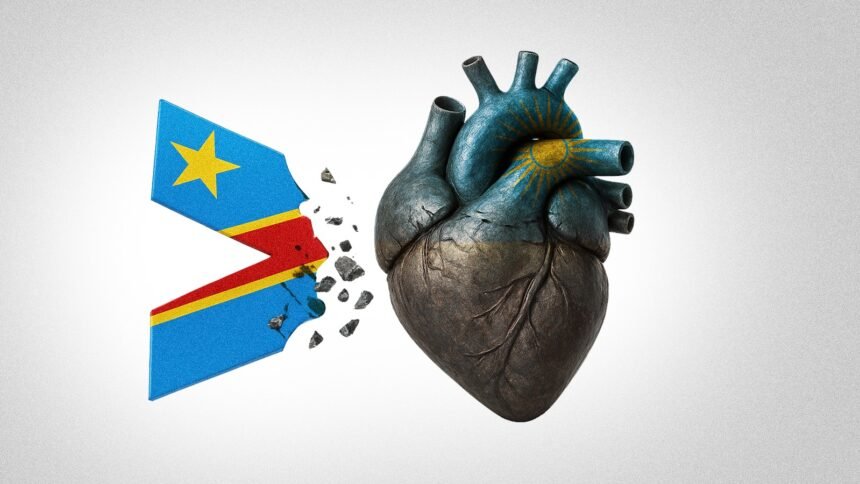
President Paul Kagame has pushed back against long-running allegations that Rwanda’s mineral exports originate from the Democratic Republic of the Congo (DRC), insisting that the country possesses its own verified, high-quality deposits.
Speaking in an interview with Al Jazeera released on December 7, shortly after Rwanda and DR Congo signed the Washington Accords, Kagame said the narrative portraying Rwanda as a transit hub for Congolese minerals overlooks decades of scientific studies and independent geological assessments.
Kagame criticised the assumption that mineral deposits commonly associated with the DR Congo exist exclusively in that country.
“People have wrongly believed that everything DR Congo is known to have is only in DR Congo and nowhere else,” he said.
He noted that Rwanda hosts established deposits of tungsten, tin, and tantalum, minerals essential to global electronics and industrial supply chains.
According to Kagame, these minerals are not only present in Rwanda but boast “super quality,” strengthened over the years by long-term investment and geological research conducted by international firms such as Trinity Metals.
Those findings, he argued, underscore that Rwanda’s mineral output “has nothing to do with DR Congo,” countering accusations that have persisted in advocacy circles and political commentary around the conflict in eastern DR Congo.
Kagame also highlighted other strategic minerals found in Rwanda, including beryllium, lithium, and gold. While acknowledging that DR Congo may hold larger gold reserves, he dismissed the notion that Rwanda’s gold exports are automatically linked to smuggling.
“We cannot assume that every gold we export comes from DR Congo,” he said, adding that far greater volumes of Congolese minerals exit the region through other neighbouring countries, yet Rwanda is frequently singled out.
He linked this treatment to what he described as a broader tendency to deflect responsibility for instability in eastern DR Congo and to minimise the role of the FDLR, a militia composed mainly of remnants of the perpetrators of the 1994 Genocide against the Tutsi.
“The way some international actors try to cover up for the FDLR and shift responsibility elsewhere is staggering,” he said, referencing the role of certain Western governments in amplifying misleading narratives.
Data from the Rwanda Mining Board indicate that the country hosts numerous documented mineral occurrences and active mining sites. Key commodities include cassiterite, wolframite, columbite-tantalite, native gold, and a range of pegmatite-related rare minerals, including rare-earth elements, beryl, and lithium-bearing minerals. Rwanda also produces industrial minerals, including granite, quartzite, volcanic rocks, clay, sand, and gravel, as well as peat used for energy production.
Mining in Rwanda dates back to the 1930s and has grown into one of the country’s strongest export sectors. By 2024, mineral exports generated $1.75 billion, up from $373.4 million in 2017. The country produces between 8,000 and 9,000 tonnes of 3T minerals annually, with revenues fluctuating according to global prices.
Rwanda is also ranked among the world’s leading tantalum producers, accounting for more than 22% of global supply used in electronics manufacturing as of 2024.
Sector reforms have focused on strengthening mineral traceability and expanding local processing. Government figures indicate that processed mineral exports now exceed raw mineral exports as Rwanda seeks to enhance value addition and compliance with international due diligence standards.


