




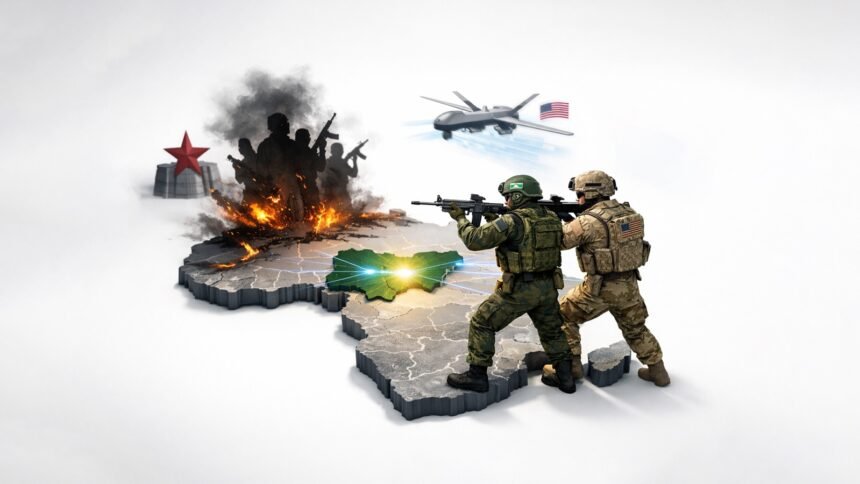
The deepening Nigeria-US counter-terror collaboration, marked by the February 3, 2026, dispatch of a small US military team to Nigeria for intelligence support and enabling strikes, signals a pivotal escalation in joint efforts against Islamic State militants. Following December 25, 2025, airstrikes in Sokoto State, this deployment focused on unique capabilities to aid Nigerian forces, aiming to curb threats from groups like ISWAP amid accusations of Christian persecution. This security analysis examines the alliance’s dynamics within the Sahel’s terror landscape, highlighting opportunities and risks for regional stability.
Pan African Predicaments: Jihad’s Continental Creep
Jihad’s continental creep poses profound Pan-African predicaments, where Nigeria’s northwest becomes a frontline in the Sahel’s expanding terror web, displacing millions and straining alliances. The US team’s arrival, coordinated with Abuja to gather intelligence and facilitate strikes, targets ISWAP and Lakurawa hybrids taxing communities amid herder migrations and poverty rates exceeding 50 percent. This mirrors Mozambique’s ISIS raids uprooting 300,000 since July 2025 and the Central African voids enabling massacres.
Predicaments amplify with Sahel spillovers: Mali’s JNIM blockades starve Bamako, Burkina’s sieges claim thousands, while Niger’s Niamey airport assault on January 29 damages aircraft via drone-backed militants. Pan-African responses falter amid ECOWAS fractures and AU funding gaps. Yet, Nigeria-US efforts offer a model: shared intel hubs could bridge divides, addressing roots like ethnic marginalization to curb jihad’s creep and foster collective resilience.
Terror in the Sahel: Militant Mayhem’s Regional Reach
Terror in the Sahel manifests as militant mayhem’s regional reach, where ISWAP’s drone assaults on Borno bases in January 2026 kill troops, echoing JNIM’s Niamey incursions, damaging Ivorian and Togolese planes. In Nigeria, Lakurawa’s northwest camps, hit in December 2025 by US strikes, hybridize herder vendettas with jihad, launching raids amid Gaza outrage, radicalizing youth.
Mayhem’s reach extends: Burkina’s Djibo massacres, Mali’s Moura atrocities, Niger’s Tillabéri killings highlight transnational threats taxing gold for millions to fund escalations. Sahel’s terror demands dissecting: alliances between ISSP and JNIM blur lines, exploiting junta voids post-2023 coups. Countering requires regional recalibration: enhanced border patrols and community sentinels to disrupt the momentum of mayhem.
Nigeria-US Counter-Terror Efforts: Collaborative Campaigns
Nigeria-US counter-terror efforts coalesce in collaborative campaigns, with the February 2026 US team deployment enhancing intelligence and strike capabilities against ISWAP following December 2025 airstrikes killing militants in Sokoto. The small team, bringing unique tools from AFRICOM, builds on surveillance flights from Ghana, enabling Nigerian ops like January 19 Borno airstrikes, decimating 40 militants.
Campaigns evolve: US hardware bolsters Super Tucanos reclaiming 70 percent of the territory since 2015, while joint working groups align on threats like Lakurawa’s border taxes. Efforts address accusations of Christian targeting, yet emphasize ecumenical violence, 80 percent Muslim victims. Collaborative success hinges on synergy: Nigeria’s ground intelligence fused with US technology, transforming campaigns into sustained pressure against jihadist hybrids.
Boko Haram vs. JNIM: Rival Radical Realms
Boko Haram’s ISWAP splinter versus JNIM delineates rival radical realms in the Sahel, where Nigeria’s northeast battles intersect Sahelian incursions. ISWAP’s 3,000 fighters tax Lake Chad for $100 million, launching drone raids like January 2026’s Borno base assaults killing troops, while JNIM’s 6,000 coordinate blockades and airport strikes like Niamey’s January 29 damage to aircraft.
Rivalries fuel competition: ISWAP’s ISIS allegiance clashes with JNIM’s al-Qaeda loyalty, yet tactical osmosis, shared drone tech from Libyan markets, hybrids threats in Niger’s Tillabéri. Realms exploit voids: Boko Haram’s 2009 roots evolve into urban incursions, mirroring JNIM’s Fulani recruitment amid herder wars. Countering demands, dissecting rivalries: targeted ops disrupting alliances, while addressing poverty to erode radical appeals.
Niger-Russia vs. Nigeria-US Efforts: Proxy Power Plays
Niger-Russia versus Nigeria-US efforts embody proxy power plays in the Sahel, where Niamey’s January 29 airport assault highlights Russian-backed junta vulnerabilities post-2023 coup. Wagner’s Africa Corps guards uranium but commits excesses, enabling ISSP’s drone strikes, while Nigeria-US campaigns, December 2025 airstrikes, and February 2026 team, target ISWAP with precision tech.
Power plays contrast: Russia’s resource-focused ops in Niger alienate populations, fueling jihad, versus Nigeria-US intel-sharing reclaiming Borno enclaves. Plays complicate alliances: the AES confederation’s defiance isolates the junta, while U.S. sanctions strain Niger’s economy. Sahel’s stability requires balancing proxies: Pan-African arbitration regulating foreign influences, leveraging U.S. technology with Russian arms under local command.
Geopolitical Tensions: Sahel’s Divided Domains
Geopolitical tensions divide Sahel’s domains, where Niger’s Niamey assault amid France-Russia shifts exacerbates fractures post-Barkhane’s 2022 exit. Juntas expel UN MINUSMA, embracing Wagner for arms, yet 2025 violence surges 50 percent, with atrocities like Mali’s Moura alienating Fulani.
Tensions comparative: France’s legacy failures pave Russian inroads, while US-Nigeria efforts face backlash from “genocide” rhetoric, risking radicalization. Domains’ divides: ECOWAS sanctions backfire, fueling AES isolation. Resolving tensions requires geopolitical bridges: AU-mediated pacts that foster equitable partnerships and mitigate divided domains for unified security.
Human Rights Horizons: Balancing Sahel’s Security Scales
Human Rights horizons in the Sahel balance precarious security scales, where Niger’s post-assault cordons restore calm but echo junta repressions detaining opposition. 2025’s 7,800 civilian deaths, many from Wagner excesses in Mali, highlight abuses fueling jihad recruitment.
Horizons comparative: Burkina’s VDP recruits commit reprisals, while Nigeria-US operations risk collateral damage from airstrikes, such as Sokoto’s off-target missiles. Balancing requires oversight: AU protocols mandating rights training for forces and integrating community monitors to safeguard dignity amid counterterrorism operations.
Protection Paradigms: Sahel’s Safeguard Strategies
Protection paradigms in the Sahel evolve safeguard strategies, where Niger’s Niamey defenses, which repelled militants without casualties, highlight urban vulnerabilities amid refugee influxes and strategic strain: Burkina’s militarization and Mali’s neglect of the peripheries, fueling JNIM’s advances.
Paradigms in comparative perspective: Nigeria-US intelligence shields the northeast, yet northwest hybrids persist. Safeguarding demands holistic approaches: inter-ethnic accords to ease herder conflicts, AU financing for resilient infrastructure, and transforming paradigms into inclusive bulwarks against jihad’s encroachments.


